
Source: http://z.about.com/d/politicalhumor/1/0/p/p/1/relevant_elephant.jpg
“Father, forgive me,” says the man in the confessional, “I have sinned.” We are not looking for the quick way ahead, but seeking redemption, a way of reconciling who we have been, who we are, and who we can be. When you deny who you have been, you set aside some of the core of creativity that you can draw upon.
As I embrace the Read/Write Web as a way to track and amplify my voice as a learner, I know I have made and will make mistakes. It would be hypocritical for a teacher to chide his/her students, a break with the ideals of lifelong learning–that naturally INVOLVE making mistakes–to say, “Delete your Facebook accounts before going to get that job,” as some suggest.
Instead, a leader who is integrated says, “If you put yourself out there, if you show who you really are, then make sure that you put yourself ALL out there. Don’t just show yourself exhibiting actions that could be critiqued by an employer, show those actions which will redeem you as a human being and potential employee and lifelong learner. And, if they’re not interested, then they’re not the best employer for you…pursue passion-based learning and see where it takes you.”
Is this too…pie in the sky? Too idealistic? If so, let’s remember this particular part of The ClueTrain Manifesto, shown to be so prophetic:
Who gives us permission to explore our world? The question implies that the world in fact belongs to someone else. Who gives us permission to communicate what we’ve experienced, what we believe, what we’ve discovered of that world for ourselves? The question betokens a history of voice suppressed, of whole cultures that have come to believe only power is sanctioned to speak. Because the ability to speak does involve power. It entails ownership and the control conferred by ownership.
Source: Internet Apocalypso, The Clue Train Manifesto
Creativity experts are challenging us to not restrict children…in their inane questions, in their passionate pursuit of their interests rather than just what we limit them to thinking about, they have the potential to better our world. Some people, though, haven’t gotten the message yet.
The world may belong to our employers, but our experience of that world belongs to each of us and our employers are poverty-stricken when they diminish our experiences as shared online in blogs, image sharing, facebook/myspace to protect a status quo that is past. If we consider that poverty is defined as the threshold below which families or individuals are considered to be lacking the resources to meet the basic needs for healthy living; having insufficient income to provide the food, shelter and clothing needed to preserve health, being poverty-stricken as an organization might be interpreted as lacking the human capital to preserve the health of the organization.
Simply, my focus as an employer has to be on hiring people who are NOT afraid of learning, communicating and collaborating at a distance in virtual environments. If I cling to past concepts of what is acceptable, I cut starve the organization of the creativity inherent in people who are risk-takers.
Justin (The EdJurist) shares that he’s not into technology for technology’s sake. No, of course not. I’m not either. I’m for embracing the power of new communication technologies that enable me to have conversations with people I’ve never met (and, perhaps claim their words are hypocritical (sigh, sorry about the harshness of that Justin)) about our shared learning journey.
This isn’t about technology, it’s about how one person empowers learning for all through a living network of people. It’s time to reconsider our whole approach to law and the Internet, and education. Simply, force of habit is insufficient to our work. This is why this is so fundamentally powerful…precedent is no longer relevant, and negatively assessing a potential hire by the mistakes that signal their willingness to be risk-takers and virtual learners .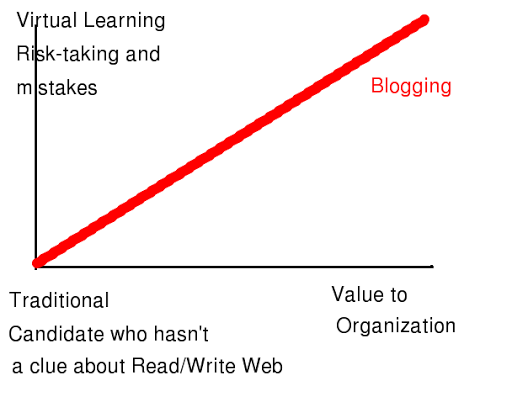
Made with Tuxpaint and shared under CC-SA-NC-Attrib ;->
Note to Readers: This chart isn’t backed up by research AT ALL…but should it be?
 Subscribe to Around the Corner-MGuhlin.net
Discover more from Another Think Coming
Subscribe to get the latest posts sent to your email.
 Another Think Coming
Interesting comments, Miguel. One of the things that everyone who ventures into this realm should do is carve out and feed their own identity. That does deal with the serious side of things and it honours the fact that leaders have a proven track record and are worthy of employment.As you note, it does need to go deeper. If a leader doesn’t experiment and try to push the technology or the message or the technique, then they end up playing safe. Does “safe” allow us to discover new things or exploit what we currently have?I think that we need to develop a tolerance for the ongoing sandbox. I would think that a leader who plays in the sandbox and fails or plays and succeeds exhibits much of the traits that we want in a potential employee or a lifelong learner. Thanks for sharing your thoughts; I think that they are spot on.
Interesting comments, Miguel. One of the things that everyone who ventures into this realm should do is carve out and feed their own identity. That does deal with the serious side of things and it honours the fact that leaders have a proven track record and are worthy of employment.As you note, it does need to go deeper. If a leader doesn’t experiment and try to push the technology or the message or the technique, then they end up playing safe. Does “safe” allow us to discover new things or exploit what we currently have?I think that we need to develop a tolerance for the ongoing sandbox. I would think that a leader who plays in the sandbox and fails or plays and succeeds exhibits much of the traits that we want in a potential employee or a lifelong learner. Thanks for sharing your thoughts; I think that they are spot on.
I agree, Miguel. I celebrate mistakes. I avoid the quest for polish, and yet I have high standards and like things I work on or create to be perfect. The way I handle the tension is to work toward perfection and the standard, but publish my products/communications/thinking to the world when time dictates, knowing that everything is continually in process.The alternative is that someone is paralyzed by fear of twittering, blogging, presenting, podcasting; you name it. Learning is the real victim in that scenario. We democratize creativity/ communications/ thinking when we accept mistakes. Social groups have done this for centuries; the difference now is that line between the private and public face of our web 2.0 social groups is blurred by definition and design!Regards,Dennis Richards
I agree, Miguel. I celebrate mistakes. I avoid the quest for polish, and yet I have high standards and like things I work on or create to be perfect. The way I handle the tension is to work toward perfection and the standard, but publish my products/communications/thinking to the world when time dictates, knowing that everything is continually in process.The alternative is that someone is paralyzed by fear of twittering, blogging, presenting, podcasting; you name it. Learning is the real victim in that scenario. We democratize creativity/ communications/ thinking when we accept mistakes. Social groups have done this for centuries; the difference now is that line between the private and public face of our web 2.0 social groups is blurred by definition and design!Regards,Dennis Richards
Miguel, I saw the name of this blog in your tweet and asked a friend “Hm. . no longer relevant–what’s that about? her immediate response–“THREE QUARTERS of what we still do in school!”Interesting blog–thanks for getting me thinking on this topic!Paula
Miguel, I saw the name of this blog in your tweet and asked a friend “Hm. . no longer relevant–what’s that about? her immediate response–“THREE QUARTERS of what we still do in school!”Interesting blog–thanks for getting me thinking on this topic!Paula
DougPete, thanks for introducing the concept of a Web 2.0 sandbox, a way of exploring how communication and learning can happen in collaboration with others online.miguel
DougPete, thanks for introducing the concept of a Web 2.0 sandbox, a way of exploring how communication and learning can happen in collaboration with others online.miguel
Dennis, thanks for sharing. “We democratize creativity/ communications/ thinking when we accept mistakes.” Since we’ve spent so much time demonizing mistakes, it’s hard to step back and appreciate what a mistake signals–a willingness to take a risk for oneself and the organization. Now, unless the individual risks, the organization loses.Miguel
Dennis, thanks for sharing. “We democratize creativity/ communications/ thinking when we accept mistakes.” Since we’ve spent so much time demonizing mistakes, it’s hard to step back and appreciate what a mistake signals–a willingness to take a risk for oneself and the organization. Now, unless the individual risks, the organization loses.Miguel
Quote: “It’s time to reconsider our whole approach to law and the Internet, and education. Simply, force of habit is insufficient to our work. This is why this is so fundamentally powerful…precedent is no longer relevant, and negatively assessing a potential hire by the mistakes that signal their willingness to be risk-takers and virtual learners.”Now you have something we can agree on. We DO need to reconsider law and education in light of the Internet. And, actually, I spend a lot of my time working on just that. But, as wrong as the law is on some issues these days, it is no less relevant and I try as best I can to keep schools on the right side of the law while still fostering new conversations in new ways. That’s why we need good people pushing the envelope (and making mistakes) so that the law will eventually follow along. Thanks for having the courage to push the envelope, Miguel.
Quote: “It’s time to reconsider our whole approach to law and the Internet, and education. Simply, force of habit is insufficient to our work. This is why this is so fundamentally powerful…precedent is no longer relevant, and negatively assessing a potential hire by the mistakes that signal their willingness to be risk-takers and virtual learners.”Now you have something we can agree on. We DO need to reconsider law and education in light of the Internet. And, actually, I spend a lot of my time working on just that. But, as wrong as the law is on some issues these days, it is no less relevant and I try as best I can to keep schools on the right side of the law while still fostering new conversations in new ways. That’s why we need good people pushing the envelope (and making mistakes) so that the law will eventually follow along. Thanks for having the courage to push the envelope, Miguel.