
Source: Dubai Dynasty, http://pictures.smashits.com/dubai-dynasty.html
Do we want to keep pumping money that should be going to our students to business companies who have slick sales people that buy free lunches for district administrators to get in the door?
We need to start with a clean slate in regards to open source adoption in schools. We need to win the Florida Lottery when it comes to open source adoption in schools. We could but we don’t.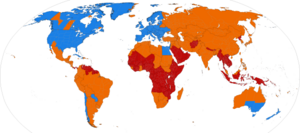
Source: Wikipedia
Daylight saving time (check out this web exhibit…nifty!) is controversial but so is adoption of free open source software. With daylight savings time, some businesses benefit while others suffer. Increasingly, it seems like daylight savings time is just a bother. Who wants more daylight in their day? Wouldn’t it be better to slow down when night falls? I’ve always been a bit hazy on when it starts and ends, but apparently, this Sunday is the day Daylight Savings Time ends until it starts again next March. In 2008, Daylight Saving Time begins on March 9 and ends on Nov.2. (Source).
But the controversy remains.

I can easily see a connection between the controversies of daylight savings time–that benefits businesses–and free open source software adoption. However, in many countries, open source software is being adopted. Consider the adoption of OpenOffice and GNU/Linux:
“The Foreign Ministry [Germany] is migrating all of its 11,000 desktops to GNU/Linux and other open source applications. According to Schuster, this has drastically reduced maintenance costs in comparison with other ministries. “The Foreign Ministry is running desktops in many far away and some very difficult locations. Yet we spend only one thousand euros per desktop per year. That is far lower than other ministries, that on average spend more than 3,000 euros per desktop per year.
“The ministry has so far migrated almost four thousand of its desktops to GNU/Linux and expects to complete the move by the summer of 2009, Schuster said. About half of all the 230 embassies and consulates have now been switched over. “It is not without problems. It took a while to find a developer in Japan to help us with some font issues we had in OpenOffice.”
Source: Benjamin Horst via SolidOffice
Although I use GNU/Linux every day, as well as OpenOffice (in fact, on every computer I use, whether it’s Mac, Windows or GNU/Linux without much problem), a recent study (also via SolidOffice) highlights the problems with open source adoption:
- Conversion and compatibility-Tests showed that opening Microsoft Office documents in OpenOffice.org sometimes resulted in errors in both layout and content when handling complex documents. Data conversion appears to be a much more complex issue in a data–intensive environment …than in organizations in which macros are seldom used.
- Tools and integration- Software vendors are inclined to develop tools or other software products that are interoperable with the Microsoft Office suite because of its large market share.
- Costs- Some factors obscured the actual level of these potential cost savings. First, some of the licenses for Microsoft Office had already been purchased…Second, our informants indicated that the TCO of OpenOffice.org could not be estimated precisely, due to the uncertainty regarding the cost of the conversion of applications and macros. Hence, during the project, no detailed TCO analysis was made. This is consistent with the results of previous studies that showed that organizations found it difficult to assess the TCO of OpenOffice.org, even after having performed the migration.
- End user acceptance- Regular users were found to be rather indifferent with respect to which particular office suite was to be adopted. The concern of deskilling, in which employees are afraid to loose their experience with Microsoft Office (Fitzgerald and Kenny, 2003), did not appear to be present either.
- Network effects – management did not see any drivers in the immediate business environment of the FPS Economy to migrate.
Some interesting conclusions could be drawn from this (feel free to chime in if you think I’m off) for school purposes:
- In education, probably 99% of users–even secretaries high in the organization–do not use macros in MS Office. As such, conversion and compatibility should become less of an issue based on macros and other high end customization of Word documents. Simply, OpenOffice 3 is that good (hey, I use it every day with work documents just to see and seldom have issues).
- On the tools and integration with other vendors, sheesh, we really need to get out of this locked box we’re in that satisfies the financial needs of vendors. How much money is flowing into education then going right back out again to software vendors? Let’s keep that money internally and spend it to improve our education programs rather than throwing it away on externally delivered software.
- Total cost of ownership can be tough to calculate but if you aren’t investing money into OpenOffice at purchase–except for training and support–it seems the more saturated an environment becomes with OpenOffice, the easier it will be for end users to get accustomed to it. And anyways, better to spend time worrying about how to INCREASE the amount of hardware in schools so that access is ubiquitous.
- David Thornburg shared at a NECC 2008 presentation that kids essentially didn’t care/know what Office suite or computer they were working on; “2/3rds of kids didn’t know they were using Linux at school .” Why don’t we emulate the kids’ on this rather than continue to cling to old security blankets of use and familiarity?
Daylight savings time and open source…both controversial. The adoption of daylight savings time shows our bias for supporting business, while our choice to not embrace free software like OpenOffice our unwillingness to spend money on our children in lieu of business. Is that the right choice?
 Subscribe to Around the Corner-MGuhlin.net
Discover more from Another Think Coming
Subscribe to get the latest posts sent to your email.
 Another Think Coming