
Source: http://www.britannica.com/blogs/wp-content/uploads/2007/07/image4.jpg
In a recent article, it is asked, Should textbooks or technology be Texas’ spending priority?
Although online curriculum is commonplace, access to needed technology hardware has been a limiting factor for schools to use that resource, said Anita Givens , acting associate commissioner for standards and programs at the Texas Education Agency.
Fewer than 7 percent of school campuses statewide have reached the target of providing a computer for every student and having all classrooms fully equipped and wired for the Internet, according to a state survey published this fall. On about 57 percent of the campuses, there are four students per computer, and three-quarters of the classrooms and library have Internet connectivity.
Read More
What do I think? Glad you asked! I honestly don’t think Texas is ready. That’s based on my observation of what prejudices or biases my fellow Texans continue to hold regarding technology.
Here goes my short list of the biases Texans still hold in regards to K-12 technology use…what do you think?
- Technology is not integral to core content instruction. That is, technology is irrelevant to the daily work of teaching and learning in K-12 schools.
- Technology maintenance–at least 20-30% of the district’s total budget, not just the state technology allotment plus whatever a district gets from NCLB Title 2, Part D–funding is non-existent or gone. This is money that needs to be budgeted for a regular hardware replacement cycle.
- Online professional learning opportunities are not available in great quantity or quality, nor are they required in lieu of face to face workshops. Consider how much money is spent on gifted and talented, as well as bilingual/ESL, HR compliance training, but none of this is online.
- There is little leadership at the State level (e.g. TEA, TCEA, COSN Texas CTO) to involve stakeholders to develop online professional learning for Texas teachers that meets NACOL, and ISTE NETS-T standards.
- The focus on “technology” is on buying pre-packed, big ticket and vendor products. The goal is to use drill-n-practice, tutorial software to rapidly boost student achievement scores. In this environment, computer labs are used for drill-n-kill, rather than engaging learners with authentic learning opportunities, fostering higher-order thinking, and achieving great teaching and learning environments with technologies. How much money has YOUR district spent on, let’s see what the latest list has to say, Plato, Compass Learning, Renzulli Learning, Successmaker, Waterford Learning, Read180, FastForWord, and many others. For a write-up on Integrated Learning Systems, read what NCREL has to say.
- Superintendents just don’t how technology will help them achieve AYP and keep their district’s scores up there. If technology doesn’t raise scores by 10 points, then why bother with it? Better to pour that funding into quality teachers, infrastructure (e.g. buildings, classrooms, electrical) than technology that no one knows how to use.
- School districts continue to embrace the cadillac model of technology that diverts precious funding to expensive software vendors (e.g. MS Windows/Mac, MS Office, Adobe, Inspiration) instead of seizing free, open source software for str
 ategic placement in schools. Technology departments continue to embrace proprietary software and server solutions in the face of tough economic lessons, choosing to NOT build up their human capital.
 - School districts and state agencies continue to invest in closed technologies that do not provide for open access or open content. A great example of this would be to provide every student with a Kindle, to ensure that textbooks can’t be remixed by students, or adapted for learning purposes.
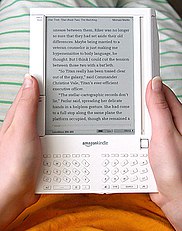
So, no, I don’t agree that Texas is ready for digital textbooks…but I do agree that we need to “move people’s cheese” and the way to do that is to dump textbooks and purchase less expensive technologies that allow for openness and embody the principles of free software.
Consider this chart from /rc/etc:
| Amazon Kindle | OLPC | |
| Reads Books | Books bought from Amazon |
Books from Project Gutenberg |
| Web Access | Kindle Store, paid subscriptions. Black and White | Full web access (in color) |
| Newspapers | Upon Subscription | Websites, some free, some upon online newspaper subscription |
| Blogs | Select blogs (about four) upon paid subscription (no /rc/etc blog!) | All blogs |
| Reading Offline | All content on device (Unknown hard disk size, though) | Saved HTML files, page left open |
| Wireless | EVDO, avg. 4.5 mbps | 802.11b/g/s |
| Documents | Send PDF, DOC, JPG, PNG to kindle for $0.10 each | Free, in a multitude of ways |
| Operating System | Unknown | Linux |
| Document Editing | None | Full |
| Compatibility* | Windows | Every OS |
| Applications | Amazon Provided, mostly fee-based | Open Source, expandable |
| Screen | 4-level gray, no backlight. 600×800 non-rotatable | 1200×900 in color, 2400×1800 grayscale. Rotatable, backlit if needed. |
| Input | Tiny nonstandard QWERTY keyboard with irregular buttons | Small QWERTY keyboard (designed for children) |
Would this still hold true for other netbooks, like the Asus Eee, HP Mini, Acer Aspire One? Would any of these work as open content alternatives to Kindle and the locked down technologies that school districts network “georges” prefer?
 Subscribe to Around the Corner-MGuhlin.net
Discover more from Another Think Coming
Subscribe to get the latest posts sent to your email.
 Another Think Coming