
Ask me any day of the week what my best work experience has been, and I default to a golden age when I worked on a team that allowed me to be very creative in the situation I found myself. The context or culture of the organization did not limit the creativity, but rather, served as raw materials for that creativity…such experiences, I’ve found, are rare. They endure for a short time and then slip away…changes in leadership, staffing, the magic only lasts a short time.
Although I could work alone–and often did, since that’s part of the education approach I grew up with in schools and became comfortable in–I found incidents of collaborative creativity to emerge over time as interests converged between my teammates and I. Today, few would argue that increasing collaboration within teams and team-to-team across the digital crescent is critical.
Yet, what tools do you use to facilitate that collaboration? Early last year, I introduced GoogleDocs to my team and we started working with that to solve problems. I found GoogleDocs to be great to throw stuff out there and work our way through various issues that arose. When I had to shut down GoogleDocs–it wasn’t in line with the philosophy of our parent organization–for use in my team, it forced some reflection about what tools we could use in lieu of GoogleDocs…in the end, we found little that would equal what we had had.
When you’ve been working in the cloud, how do you “shrink yourself back down” to the ground, trying to fit into the old limits? Let me tell you, it’s difficult.
Attending the Virtual School Symposium in Austin, I found the decision to use technologies like Skype and GoogleDocs–which are sometimes blocked or unauthorized in public school districts–to be increasing in popularity among education professionals who are not limited by their culture’s philosophy. This was driven home by one presentation slide–all about webinar creation–such as the one shown (entitled Team Project Management Tools). I have to compliment these folks for the effort and detail they put into creating webinars. In fact, they inspired me to want to do more of this.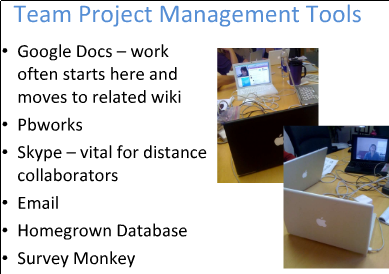
One of the tools RETA:NMSU embraced was Adobe Acrobat Connect Pro…check out Jonathan Finklestein Learning Times (they mentioned it). Some of the benefits this group shared in their presentation:
- Multiple presentation file types,
- audio, video, recording and archive, chat, application sharing, white board, polling, notes
So, instead of Skype, we’ll be using Adobe Connect…but how to replace GoogleDocs? More importantly, how can we model technologies that are collaborative AFTER they are banned? How does lack of access to collaborative tools limit what we can accomplish in schools?
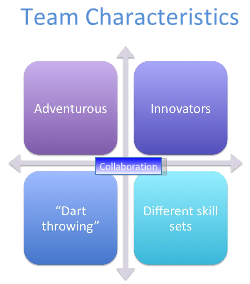
Will the that even make a difference at all in public schools today caught up in top-down, assessment-focused activities? Or could it mean the difference between success and failure for America vs the world?
Does it even matter? Maybe everyone is getting too excited. This afternoon, a man sat next to me with a pad of paper, futilely taking notes just as I managed to type a few words. His only audience was himself, while my audience was everyone who reads my tweets and access my notes for the event.
In the end, the difference meant nothing to him, but everything to me. . .was the difference significant? How does YOUR team collaborate, and what have you been able to accomplish that you wouldn’t have been able to before through the use of tech tools?
 Subscribe to Around the Corner-MGuhlin.org
Everything posted on Miguel Guhlin’s blogs/wikis are his personal opinion and do not necessarily represent the views of his employer(s) or its clients. Read Full Disclosure
Discover more from Another Think Coming
Subscribe to get the latest posts sent to your email.
 Another Think Coming
I love this post. How do we put people back in a box once they've seen what working in the "cloud" i like? What does that do to our new teachers or innovative leaders?It seems that districts would want to support their innovators who help them "grow" the district vision and gain a reputation for the district in the public education forum as well.I don't know that they see it as strategic as well as the networking advantages.It is the same difficulty our students have when having to "tone down" when they enter the buildings.It is so true that collaborations that work well are a rare treasure, and once you've had them, it is hard to do without.
I love this post. How do we put people back in a box once they've seen what working in the “cloud” i like? What does that do to our new teachers or innovative leaders?It seems that districts would want to support their innovators who help them “grow” the district vision and gain a reputation for the district in the public education forum as well.I don't know that they see it as strategic as well as the networking advantages.It is the same difficulty our students have when having to “tone down” when they enter the buildings.It is so true that collaborations that work well are a rare treasure, and once you've had them, it is hard to do without.
Adobe Buzz=Google Docs
Adobe Buzz=Google Docs