About the Image Above: A new organization is forming to potentially represent Museum and Education Associations in the San Antonio area…it’s great to be in on observing the “ground floor” creation of such an organization, the brainchild of Molly Valdez and Carey Eagan, two veteran educators. The org’s banner image is displayed above and the organization web site (nothing there yet) is online at http://www.aamaea.org
On Wednesday, December 2, I had the opportunity to deliver the keynote address–Reaching 21st Century Learners–at the first meeting of Alamo Area Museum and Education organizations. I’m very grateful to Lupita Barrera (Director at the ITC) and Carey Eagan (Facilitator) for having me over to present!
The “Let’s Get Connected” Luncheon included a diverse assembly in San Antonio, Texas such as the Institute of Texan Cultures (ITC), San Antonio Museum of Art, San Antonio Botanical Garden, Texas Transportation Museum, and several others. It was fun to point out that these sites are not RSS subscribable, so I’m hoping they’ll all be revamping their web sites.
Here’s the welcome message from Carey Eagan:
Welcome to the first San Antonio Museum Professional’s Let’s Get Connected Luncheon. I am very excited to have everyone here today. The idea for the luncheon came about during the ITC Education and Interpretation goal setting meetings. As you all may know ITC is undergoing great changes, and many of us here are new to the field, the museum and the city. We felt it would be beneficial to come together with our local colleagues and share ideas. We hope that this will become a regular event.
The focus of my presentation was on enhancing communication and collaboration so as to better meet the needs of 21st Century learners. I can honestly say I was humbled to be speaking to this group.
Listen to Podcast – Not Yet Available
Juxtaposing the past with a present that is racing forward was a delight and offers these folks a great opportunity for growth. Social media tools like Twitter, Facebook, MySpace are only some of the tools available to these organizations…but how to use them to engage 21st Century Learners is another issue altogether.
My presentation had 3 points: 1) Local and low tech is insufficient way of reaching 21st Century learners; 2) It’s important we learn to act on our imagination rather than stick with traditional approaches we are more comfortable with; and 3) It’s critical that we make our work irrelevant without technology.
One of my favorite quotes from the presentation is from Guy Clawson, who points out that “We need to know what to do when we don’t know what to do.” For me, this highlights the need we have to involve information problem-solving strategies. Another key point is how we can bring our passion for the work we do–such as the Park Ranger in the audience who spoke eloquently about protecting the Earth and how podcasts have played a key part in that–and share it in ways that are engaging to 21st Century learners.
These passions for history and change over time MUST be shared…but the primary ways of sharing them are no longer doing the job. For example, schools are increasingly marginalized as parents realize their children can access resources online. How can museums reach their “niche learners” and audience using social media tools?
The concept of acting on the imagination is also incredible.

I made a minor adjustment to the quote from Thomas Friedman above…if our museums can’t empower, nurture and enable imagination among students and citizens, then they will fade away into boring digital archives that are clickable but fail to engage.
Finally, it was so thrilling to listen to the audience after the presentation and get their feedback. It’s always fun to see a group realize that the answers to the questions they have are IN the group’s members.
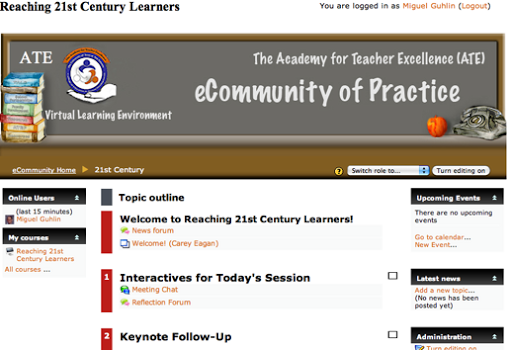
Next steps? This group needs to build a virtual presence, something that Lucretia Fraga from the UTSA Academy for Teacher Excellence (ATE) was able to do! Lucretia set up a Moodle course for participants at the “Let’s Get Connected” event organized by the ITC to connect virtually:
While I recorded my presentation as a podcast, it isn’t available just yet. However, this draft press release was shared from ITC…
INSTITUTE OF TEXAN CULTURES WELCOMES LOCAL MUSEUM PROFESSINALS,
BEGINS BUILDING MUSEUM ALLIANCE
Representatives from missions, museums attend
SAN ANTONIO – The Institute of Texan Cultures recently took another step in strengthening its relationships with local museums and educators. New personnel and leadership in the Education and Interpretation department welcomed 30 guests from local museums for a Dec. 2 luncheon, with plans to collaborate further in the coming year.
Lupita Barrera, the institute’s director of education and interpretation, and Carey Eagan, an educational specialist, both new employees, continue to search for ways to connect the institute with major stakeholders – educators and peers at other museums. The luncheon conceived by Barrera and Eagan, gathered representatives from the National Parks Service, the Witte Museum, the San Antonio Museum of Art, Mc Nay Art Museum, Museo Alameda, The Botanical Gardens, The Spanish Governors’ Palace, Texas Transportation Museum, Ft. Sam Houston Museum, and The U.S. Army Medical Department Museum.
At the institute’s Connally Conference Room, tables were arranged by role, with education specialists, curators and librarians grouped together, creating opportunities to discuss current events at their institutions, best practices in their fields and opportunities to share resources.
The keynote speaker for the afternoon was Miguel Guhlin, San Antonio Independent School District’s Director of Instructional Technology and Learning Services, who discussed the evolution of technology in the classroom and how students are getting more information through the use of technology.
The gathered company of educators agreed to form a new alliance of San Antonio area museums and schools, Alamo Area Museum and Education Association or AAMAEA. Agreeing to meet next quarter, the association is considering options for continuing education and training to maintain best practices in museum and education fields and better serving students and the public by effectively delivering information and fitting museum content into classroom curriculums.
For more information on AAMAEA visit www.aamaea.org or contact Carey Eagan from the Institute of Texan Cultures Department of Education and Interpretation at (210) 458-2351.
The Institute of Texan Cultures is located on the UTSA HemisFair Park Campus, 801 E. Durango Blvd., a short distance from the Alamo and the River Walk. Regular hours are 10 a.m. – 5 p.m., Monday through Saturday; noon to 5 p.m. Sunday. Admission is $8 for adults (12-64); $7 for seniors (65+); $6 for children (3-11); free with membership, UTSA or Alamo Colleges identification. For additional information, call (210) 458-2300 or visit TexanCultures.com.
-30-
The Institute of Texan Cultures is an agency of the Vice President for Community Services at The University of Texas at San Antonio (UTSA). The mission of the institute is to engage lifelong learners in the understanding and celebration of Texas cultural heritage. Located on the UTSA HemisFair Park Campus in downtown San Antonio, the 182,000-square-foot complex features 65,000 square feet of interactive exhibits and displays that tell the stories of Texans. The institute develops quality, accessible resources for educators and lifelong learners on topics of cultural heritage and strives to develop a rich and vibrant culture in the arts and humanities that will expand the community’s awareness and appreciation of Texas through an engaging series of exhibits, programs, and special events. Resources for multiple audiences are available at the institute’s Web site, TexanCultures.com.
Finally, be sure to check out the ITC’s TUSKS event:

 Subscribe to Around the Corner-MGuhlin.org
Everything posted on Miguel Guhlin’s blogs/wikis are his personal opinion and do not necessarily represent the views of his employer(s) or its clients. Read Full Disclosure
Discover more from Another Think Coming
Subscribe to get the latest posts sent to your email.
 Another Think Coming