A colleague recently shared with me the following:
These are the web sites we will need to access during the training session this week.
www.polleverywhere.com
www.wordpress.com
www.google.com
Twitter.com is blocked in my colleague’s district. If blocked, does that mean that the presenter coming in WILL NOT be able to do the session? What will be the discussion around this blockage? “Oh, you’re not alone…a lot of districts block Twitter because they want to protect children from inappropriate chats with adult strangers. You’ve seen that Twitter-spam that just pops up on your screen“
Or, perhaps, will the conversation be negative, such as, “What’s wrong with YOUR district? How come it’s not allowing it’s staff and students to publish at will and share what they really think–and THINK is the key word–with a global audience? Who do they think they are fooling when they say, ‘We’re protecting you!’ when we really know they’re protecting themselves from liability.” What do you think?
Does it mean that my colleague’s district has somehow banned professional learning the way it is expressed, practiced in the 21st Century?
Twitter is being espoused as a tool that can be helpful in the classroom. However, many districts have taken a different course to ban it. Should we take such a ban as a way of “silencing the people?” Twitter enables instant communications among large groups of people…with Twitter, any one person can decide choose to share what they are learning, what they agree or disagree with and the world will know about it. Why aren’t schools–and organizations–up to the challenge?
Think about it. If the work we are doing is so sacrosanct, why can’t Twitter use be allowed in school by learning professionals that are trusted to do the right thing? If Twitter is so dangerous for children to have access to, why do we allow parents who don’t have a clue about raising them the right to do so, let them sleep in Children’s Shelters, stress them out over high-stakes tests…maybe, Twitter is dangerous because it would allow, not adults inappropriate access to children, but rather, children to say to adults what they really think of the precious work we are (or aren’t) doing in schools. What would happen if students were allowed to gather and discuss and be influenced by American democratic ideals, then apply those filters to how they learn in school? What would be their reaction?
Might that reaction be similar to what is discussed in “What Do You Mean I can’t Twitter?“
Would you go to a conference or a presentation the banned Twittering or Social Media during talks or discussions? I don’t think that causing a disruption or disturbance is warranted in any case. However, if you can’t stand the heat….The Twitter stream and backchannel provide a place for the audience to comment, in real-time on what is being discussed.
As a conference participant and presenter I have to ask some questions. As an audience member, why should I not be able to question and comment on what is being presented? Should I just sit and accept, without question, what is being said? As a presenter, do I not want people to discuss my work and ask questions, and yes, even criticize?
When did Twittering become an “unalienable right?” You know what I mean, right?
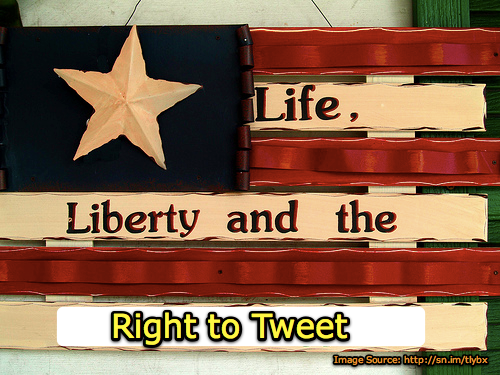
We hold these Truths to be self-evident, that all Men are created equal, that they are endowed by their Creator with certain unalienable Rights, that among these are Life, Liberty and the pursuit of Happiness. (Source)
Yes, fellow Americans, one of those that Thomas Jefferson meant to refer to but was downplayed because of lack of universal technology access was the right to tweet. Why should any organization delivering professional learning in the 21st Century or anyone attending a conference be granted access to social media tools to share with others? Is the right to Twitter synonymous with a 21st Century version of freedom of assembly?
Freedom of assembly, sometimes used interchangeably with the freedom of association, is the individual right to come together and collectively express, promote, pursue and defend common interests.[1] The right to freedom of association is recognized as a human right, a political freedom and a civil liberty. (Source)
Let he who can tweet, do so. If you can’t afford a smartphone (e..g iPhone/Blackberry) that can send out tweets and enable you to be a part of the conversation that can happen IN SPITE OF the regulations in schools and association meetings, well then, perhaps the Government should put to good use the funding banks have “paid back” and put them into equipping every American with the tools they need to achieve their unalienable right of Tweeting rather than spending it on job creation…although I suspect that if they were to invest in equipping every person with a mobile phone, that might create a lot of jobs SOMEWHERE.
In short, though, if you have the ability to tweet–using your mobile phone–and you are at a public event, then do so. If, as a member of the Press, I were to attend one of these events, I would make pains to be accurate and report on what was going on. I don’t see that as any different that what Twitterers are doing when they are microblogging a conference presentation.
As another commenter points out, don’t present at a conference what you’d rather keep secret.
 Subscribe to Around the Corner-MGuhlin.org
Everything posted on Miguel Guhlin’s blogs/wikis are his personal opinion and do not necessarily represent the views of his employer(s) or its clients. Read Full Disclosure
Discover more from Another Think Coming
Subscribe to get the latest posts sent to your email.
 Another Think Coming