Since launching in 2009, the Texas Virtual School Network has provided first-time high school course credit, credit recovery and dual-credit opportunities in a variety of subjects for students across the state, said Kate Loughrey, the Texas Education Agency‘s director of distance learning. About $20.3 million for the program was obliterated in the Texas House and Senate base budget proposals. But a number of legislators, including Sen. Florence Shapiro, R-Plano and the Senate Education Committee‘s chairwoman, have filed legislation that assumes the network’s continued existence and, in some cases, recommends the creation of diploma-granting virtual high schools. Rep. Jerry Madden, R-Richardson, a network supporter, said he is working to restore funding, and the Senate Finance Committee last week approved a recommendation to allot $9 million to fund virtual learning.
Read More at MySanAntonio.com
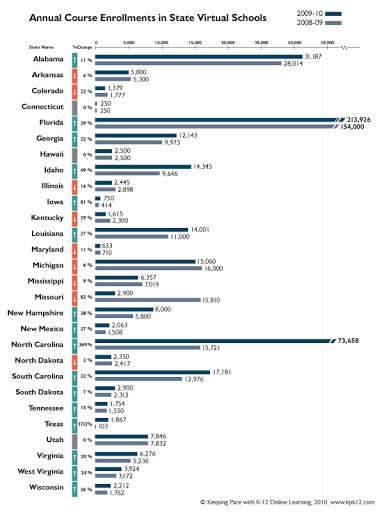
Over the last year, I’ve seen examples of school districts with great implementations of the Texas Virtual School Network. The challenging aspect of TxVSN.org is that school districts need to build the infrastructure NOW (actually, over the last 2 years) so that students will be able to take advantage of the online courses available.
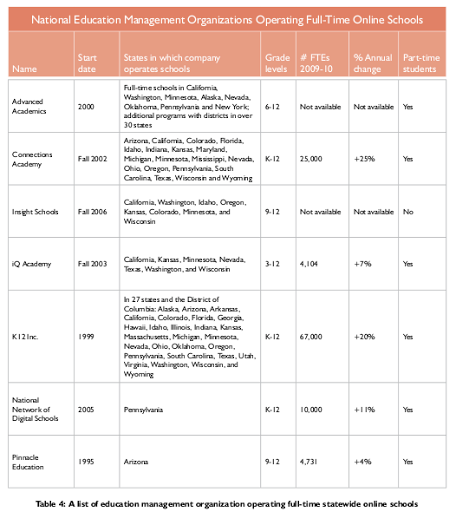 |
| Page 31 of the 2010 Keeping the Pace with K-12 Online Learning with more reports here |
Once you are teaching online, it doesn’t matter where the person on the other end is from. The computer will (soon) provide realtime translation. At that point, the entire world is a potential provider of learning…Budget problems will drive schools to outsource larger and larger chunks of education to much cheaper (because non union) overseas teachers.If you are in the information business, you better be prepared to offer something that can’t be outsourced. (Read the complete blog entry)
More people will create their personal learning networks, while snake oil salesmen will attempt to put this in an attractive box and sell it to unsuspecting organizations.”
Source: Harold Jarche as cited here.
- Large multi-national company pays a few million dollars to public school district to win its favor. We’ll help establish a “local” presence, kick in the cost of a computer lab or two ($50K or less per lab), and pay the stipend of an online learning paraeducator ($30K) to provide on-site assistance for two years.
- Let us use your school district name and we’ll make all this available to you at no additional charge.
- We’ll offer courses as if they were from your district but have actually been developed by our carefully selected, outsourced workers in India. They can craft a course a lot more cheaply than you trying to use local talent and a Moodle.
- Don’t worry, if we facilitate online courses, your student information will remain confidential.
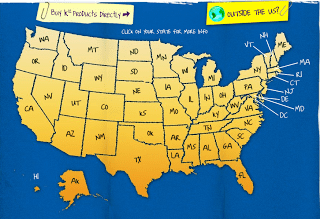 |
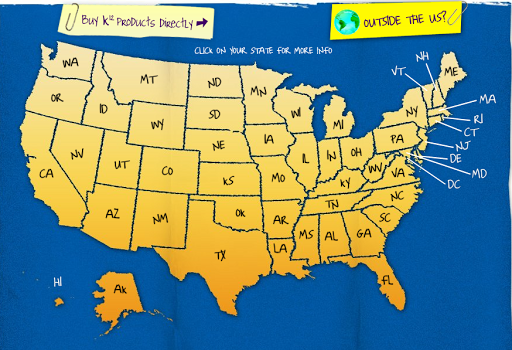
| a map of K12, Inc. services |
India-based workers who scored and commented on student papers from Arizona Virtual Academy (AZVA) had access to the names and other specific information about the students whose papers they were grading. I was told by Mary Gifford, the western regional Vice President for student services with K12 Inc., AZVA’s parent corporation, that papers were “scrubbed” of personal information before they went to India. Since then, I have learned that the process of transmitting papers and information to and from India included the names of students on their papers as well as Grade Tracking Sheets with class lists containing the names and school IDs of the students.
Student information didn’t slip through due to someone’s carelessness. The names were part of the communication process between AZVA and India. Nine other schools run by K12 Inc. in states across the country also sent student papers to India and used the same basic system of identification.
In addition, four schools run by K12 Inc. used tutoring services based in India where the students and the tutors wrote comments back and forth in real time. The tutors, who knew the names of the students they were working with, used common American names during the tutoring sessions instead of using their real names. So far as I know, AZVA did not use the tutoring service.
In 2005, a single company (K12, Inc)…reported having sold curriculum and distance-learning products to school districts, charter schools, and home-schoolers in 13 states serving 50,000 students, up from 12,000 students in 11 states in 2004. Source: Gene Glass, The Realities of K-12 Virtual Education
- Three out of every four public K-12 school districts were offering online or “hybrid” (part online, part face-to-face) courses.
- Seventy percent of the districts had one or more students enrolled in a course that was completely online.
- More than 1 million K-12 students in the U.S. were engaged in some form of virtual schooling…this represents 2% of the elementary and secondary students in the US.
State of Fear is a 2004 techno-thriller novel by Michael Crichton concerning eco-terrorists who attempt mass murder to support their views. The novel had an initial print run of 1.5 million copies and reached the #1 bestseller position at Amazon.com and #2 on the New York Times Best Seller list for one week in January 2005. (Source: Wikipedia)


Enter your email address:
Delivered by FeedBurner

 pingthis();

Discover more from Another Think Coming
Subscribe to get the latest posts sent to your email.
 Another Think Coming
Hey there, I've been working on a research project project regarding K12, Inc and their virtual schools. I was hoping to speak to the author of this article, but cannot find any contact info. Would the author mind contacting me at aaron@falconreserach.net? Thank you.
Hey there, I've been working on a research project project regarding K12, Inc and their virtual schools. I was hoping to speak to the author of this article, but cannot find any contact info. Would the author mind contacting me at aaron@falconreserach.net? Thank you.