 |
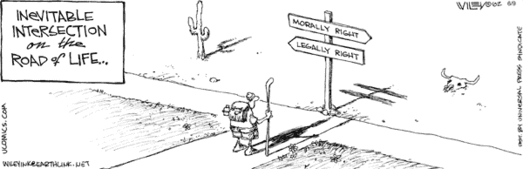
| Source: http://www83.homepage.villanova.edu/richard.jacobs/ MPA%208300/theories/legal-ethical.gif |
“More challenging is making the change on the iPad in a way that a savvy user cannot change,” Mayorga said. “That is still an unresolved issue. To this point, the Apple devices do not play nice in corporate networks where security restrictions need to be enforced.”

- Can this consumer device be made to be effective in schools? A tough question because you have to consider the rich variety of cultural approaches schools take to technology. In some places, technology must support the status quo, while in others, it supports a culture of change. Bringing in a device and hoping it will change the culture is foolhardy.
- Can teachers make effective use of this device to achieve instructional objectives? As nice as the iPad is–and there’s plenty of evidence that the iPad CAN be used to support instructional objectives, if not the ones schools or state departments believe teachers should be indoctrinating–we have to ask what is the purpose or plan developed ahead of purchase and deployment. Looking at a blog entry of a few districts are doing and saying, Yes, this is what we want to do, too fails to take into account the complex differences in stakeholder roles, motivations, culture. If it’s about making change, the process isn’t a mystery as the tale shows, right?
- Can the District’s Technology Department adequately support a technology that makes it touching each device one by one? The back-end question here is, what happens when this technology takes off and every staff member and student wants one? If you have 8000 staff members, each using the iPad in a different way, how do you handle the various uses and implementations? For example, the maintenance, transportation departments may have different ways of using the iPad than the Special Education folks who require special software such as Proloquo2go that has a hefty price tag (no, it’s not your $1.99 app…more like $190). And, of course, as great as it is to have 10 great digital storytelling apps, is that the ONLY thing students and teachers need to be doing?
Yesterday, Doug Johnson (Blue Skunk Blog) responded to my blog post about cozying up to school owned iPad–Manifesting Our Fears in iPad Use–with the following comment:
I am not convinced that personal use of school owned equipment is ethical – by teachers, tech directors or superintendents – unless there is some benefit to students because of it.
You cannot get the most out of an iPad without letting the student own it, and harness their personal accounts, tastes and media for some creative learning. Putting it in a lab…takes away from the iPad’s principle boon: it helps us move further away from the office metaphor of learning and into new, personalised, anytime anywhere learning metaphors.
If you’re letting a student “own it,” then certainly, the same goes for a classroom teacher, no?Source: Ewan Mcintosh via GeekDad
Is personal use of school-owned mobile devices (ipads, netbooks) ethical? (e.g. running netflix on a school-owned iPad after hours)
- I don’t. I’m to paranoid that they’ll dig into it…like they can with email.
- Our policy does not allow it. Further, our policy requires using only your district email acct. to be registered with Apple to use on device…In our district, a person cannot authorize a mobile device with an account created by an external email address- thus, a paper trail.
- our district does not allow personal use for the school owned devices. You cannot download anything without preapproval.
- I don’t believe it is ethical. It is provided for district use not personal use.
- I not only don’t have a problem with it, I encourage our teachers to do it – provided I haven’t locked it down for security reasons. Why? Because the more of that person’s time they spend using that device, the better they get with it & can do great things with it in the clssrm…Moreover tech has a “life” of 3-5y whether its used or not. WHY not fully utilize a device in that time frame, rather than recycle hardly…used machines that cost a lot, but never produced much.
- I agree with this.. if I want to be totally useful to my students, I also need to be aware of what works well with the device
- use it fully so you learn what can be done and how to
- Amen!! When we stop making people paranoid, they’ll be able to relax and actually *learn* how to use the technology!
- You know the saying, “Emotionally locked; learning is blocked.” Goes for adults, too. We, in education, continue to hold ourselves back.
- Kevin H said it best, “Innovation in education dies from domestic abuse.” That MUST change.
- this is just fine. A teacher needs to treat it as their “own” to see what it can do.
- I don’t have a personal problem with it, but it’d probably be best to have a policy that stated whether or not it was allowable.
- I get caught up with the same situation as I am using school iPad but want to purchase some apps.
Yes and No…yes if apropriate content…no if not. (Lacey Gosch via Facebook)
Is the non-use of school-owned technology ethical? Is the spending of school money for impractical technology ethical?
Ethical decisions are often trade-offs between: 1) Utility – the value delivered to the stakeholders in your organization; 2) Rights – entitlement to something; and 3) Justice – equitable sharing of pain and pleasure
If you use your work Blackberry or work laptop for all your personal email and phone calls and so forth, your employer can search through your messages, cancel your service, intercept email coming to your email address, and more. That may not matter to you much today but what about if you leave your job, get stuck with a crazy boss or even see your employer go out of business? How are you even backing up personal stuff like digital photos you might be keeping on a work laptop? You could lose access to much of your entire digital history. It’s not a good way to live. (Read More and Playboy on iPad)
Ethical leaders, then, are those women and men who possess an abiding interest in forging a shared purpose and set of values among contending factions of followers in practice episodes, not making them subservient and acquiescent functionaries…When an organizational leader’s decision causes harm—and it is quite likely that any decision made in an ethical dilemma will cause some degree of harm—it is entirely natural that the leader will wonder if one is at fault, even if to outsiders it is patently obvious that the organizational leader bears no ethical responsibility for that harm. (Read source)

Enter your email address:
Delivered by FeedBurner

 pingthis();

Discover more from Another Think Coming
Subscribe to get the latest posts sent to your email.
 Another Think Coming