“Technology provides access to more learning resources than are available in classrooms, and connections to a wider set of ‘educators’ including teachers, parents, experts, and mentors outside the classroom. On-demand learning is now within reach, supporting learning that is life-long and life-wide.”
“Outside school, students are free to pursue their passions in their own way and at their own pace. The opportunities are limitless, borderless, and instantaneous. The challenge for our education system is to leverage the learning sciences and modern technology to create engaging, relevant, and personalized learning experiences for all learners that mirror students’ daily lives and the reality of their futures.”
Source: National Education Technology Plan as cited in District Administration
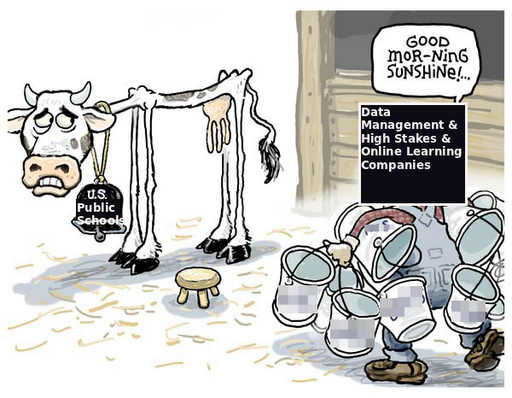
In the summer of 2010, Lu Young, the superintendent of schools in Jessamine County, a Lexington, Ky., suburb, took a trip to Australia paid for by the Pearson Foundation, a nonprofit arm of Pearson, the nation’s largest educational publisher. Ten school superintendents went on the trip, which cost Pearson $60,000. While the foundation described the visit as a way “to exchange ideas on creating schools for the 21st century,” there was ample time for play. . .In April, Kentucky’s Education Department approved a $57 million contract with Pearson. And then, over the next six months, the commissioner who oversees that department, Terry Holliday, traveled to both China and Brazil on trips underwritten by — that’s right — the Pearson Foundation.
(Source: New York Times)
There’s nothing wrong with wanting to be economically secure. But thinking that we are going to somehow find the “best” teachers and make them rich is to set teachers off on a chase for something that makes the kids a mere means to an end that we shouldn’t be chasing in the first place.
“With modern technology, if all there is is lectures, we don’t need faculty to do it,” Redish says. “Get ’em to do it once, put it on the Web, and fire the faculty.” Some faculty are threatened by this, but Mazur says they don’t have to be. Instead, they need to realize that their role has changed.“It used to be just be the ‘sage on the stage,’ the source of knowledge and information,” he says. “We now know that it’s not good enough to have a source of information.”
(Source: Physicists Seek to Lose the Lecture, NPR)
And, Larry Ferlazzo also predicts this for 2012:
Strategies to use technology as a transformative tool in education will take a backseat as for-profit online learning charlatans and the Khan Academy take up the tech money and the media space.
“More care must be taken to prevent public school systems from being milked,” read a November editorial in the Commercial Appeal.
“Where public funds are involved, legislators owe it to constituents to tread cautiously before leaping into new educational programs, no matter how promising they might sound.” (Source: Read more here)
Enter your email address:
Delivered by FeedBurner


Discover more from Another Think Coming
Subscribe to get the latest posts sent to your email.
 Another Think Coming
