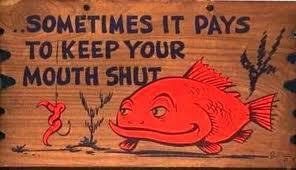
“El pez muere por la boca,” a Spanish saying my Mom was fond of quoting. Ironic since I’m a blogger and writing gives one the ability to “speak truth to power” and a voice to the disempowered…keeping your mouth shut is what you should NOT do when suffering injustice.
If you’ve ever wondered about what speaking up can do, consider Global Voices Online, “an international community of bloggers who report on blogs and citizen media from around the world.” Still, can we compare the reporting of Global Voice Online with the high school student that appears further down in this blog entry?
If there’s one thing my family knows about me, it’s that I abhor obscenities, foul language, and don’t believe that ANY situation is enough to result in the loss of control exhibited by a curse word. Of course, as a wordsmith, I recognize that the F-word has certain value in fiction, film and elsewhere.
“F*** is one of those F****** words you can F****** put anywhere in a F****** sentence and it still F****** makes sense.”
And, did the school even have the right to expel? Referring to my copy of The School Leader’s Guide to Social Media…here’s an excerpt from page 31:
There are 4 tests that courts often use to decide whether or not a school can restrict student speech. They are:
- Tinker Test: This test generally permits schools to restrict speech that is likely to cause a “substantial disruption or material interference with school activities” or “invasion of the rights of others” (Tinker v. De Moines, 1969)
- Fraser Test: School may also restrict speech that is “sexually explicit, indecent or lewd” and no disruption must be shown. (Bethel School District v. Fraser, 1986).
- Morse Test: Schools can regulate speech that “can reasonably be regarded as encouraging illegal drug use.” (Morse v. Frederick, 2007)
- Hazelwood Test: Schools can restrict “school sponsored” speech that is inconsistent with the school’s basic educational mission, particularly if it is part of the curriculum or supervised by a faculty member (Hazelwood School District v. Kuhlmeier, 1988).
I hadn’t heard of Fraser Test. Based on the information available, it doesn’t appear that the high school student causes a substantial disruption at school or serious harm, or encouraged illegal drug use. This also wasn’t school sponsored speech. Am I wrong? Does the school have any legal basis for expelling the student? Didn’t they just set themselves up for a lawsuit they will have to settle out of court (woohoo! college is paid for!)?
Imagine if instead of expelling the student, this had turned into a learning conversation?
Here’s a presentation I gave to school staff on “managing your digital footprint.”
Enter your email address:
Delivered by FeedBurner



Discover more from Another Think Coming
Subscribe to get the latest posts sent to your email.
 Another Think Coming
I'm not really sure that I understand the school's rational for expelling this student – even if he did tweet at school, which he did not. He didn't threaten anyone, disparage the school, or harass another student. I mean, his tweet wasn't exactly an original or especially witty observation, but that's hardly grounds for expulsion. It seems like the school decided to use this occasion to rid themselves of a long-standing thorn in their collective sides. And I'm fairly certain that it would have been much easier to just let him graduate because I'm also fairly certain that this going to backfire on them dramatically. Not to mention the fact that they seem to have missed a "teachable moment" and the chance to educate students getting ready to enter the real world about managing their digital footprint.
I'm not really sure that I understand the school's rational for expelling this student – even if he did tweet at school, which he did not. He didn't threaten anyone, disparage the school, or harass another student. I mean, his tweet wasn't exactly an original or especially witty observation, but that's hardly grounds for expulsion. It seems like the school decided to use this occasion to rid themselves of a long-standing thorn in their collective sides. And I'm fairly certain that it would have been much easier to just let him graduate because I'm also fairly certain that this going to backfire on them dramatically. Not to mention the fact that they seem to have missed a “teachable moment” and the chance to educate students getting ready to enter the real world about managing their digital footprint.
This school is heading for a ****ing lawsuit.
This school is heading for a ****ing lawsuit.