It’s easy for meetings to drift, to lose engagement, and become sources of dread. In this blog entry, I explore some ideas resulting from conversations with colleagues. I hope you’ll share your thoughts about how you approach meetings with large groups of staff (campus, department, district).
At the end of the blog entry, I’ll share the overall skeleton of this meeting planning effort.
 |
| Image Source: http://goo.gl/vz7wzN |
WHY MEETINGS FAIL
Some of the common reasons as to why meetings fail include the following:
- A failure to hold people accountable for what they have agreed to do but then didn’t deliver on.
- A failure to speak about the “real issues” because they are “hot to handle,” and people don’t want to damage relationships, or they feel that you should know about them because you’re the boss.
- A general malaise about what decisions have been made because people don’t feel like they’re listened to.
- Unresolved conflict in a meeting or
- A failure to address emotional needs of participants so there is little engagement.
- The sense that there is REAL work to be done elsewhere and let’s just go do that instead of meeting.

Some of the meeting styles I’ve tried:
- List your top 3 priorities for the week, then write down team priorities/problems on a whiteboard, then work your way through these items. When there aren’t any more items that the group wants to discuss, the meeting is over.
- Make an agenda of topics, invite others to edit it (e.g. GoogleDocs, wiki) to add stuff
Of course, you have to generate a who will do what by when for all of these meeting styles.
NESTED APPROACH TO MEETINGS
A friend–who happens to be a principal–suggested that meetings be considered in terms of 3 organizing principles, which are illustrated by the image below:
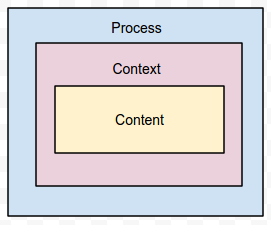
- Content: This is what the core of the meeting is about, but you can’t focus or start with this.
- Context: This has to do with the rules governing how the meeting is conducted.
- Process: Rules of the team and norms for interacting with each other.
Aside: Please be aware that this meeting structure was explained to me as if for campus principals, but it may very well be applicable to other departments or audiences.
Process, as referred to here, is really about setting norms. While there are various approaches for setting meeting norms, one approach shared with me was Hopes/Fears activity. In that activity, the team could anonymously submit responses to these two questions:
- When we work together, what do you hope for?
- When we work together, what are your fears?
The team would then organize hopes AND fears by theme, then create a norm about each of these. The norms would be phrased in a positive way that honors people’s contributions and fosters safety (two norms). The Hopes and Fears Activity actually sets the tone for how we work together.
Setting Context and Content
To address the Context of the meeting–which I understand as the framework or structure through which content will flow–the following approach arose. I’m not sure what the source of this is, but it certainly offers some ideas for structure. Note that aside from the up front work of identifying over-arching themes for meetings and assigning work, the “leader” or “meeting chair” has minimal participation.
Overarching Theme
To identify the overarching theme, one might ask, What are some things we need to focus on as a team that we can spend more time on over the next year?
Components
One key concept is that meetings are another form of professional learning, allowing for participants to learn from each other. You can see that content flows through each of the components below.
- Process: Have a standing agenda of questions and topics that must be addressed. These items get raised every meeting. I envision each meeting looking something like this:
- Standing agenda topics (10 minutes)
- Activities (60 minutes)
- Celebrations (5 minutes)
- Activities (60 minutes): After setting an over-arching theme for meetings that help guide discussions, the following activities govern time and topics:
- Learning Share Time (12 minutes): In this space of time, two team members meet and select an article, provide cross-training on a technical topic for the rest of the whole group team.
- Role Play (12 minutes): In this space of time, two different team members employ a skit or role play activity that highlights a problem relevant to the overarching theme.
- In the News (5 minutes): This is a quick-share about news relevant to the overarching theme or to the function/purpose of the meeting.
- Group Think (15 minutes): In this time, one or more than one team member present a problem then others brainstorm ideas/suggestions to solve this.
- Invites (4 minutes): Focuses on overt invitations to allow for visitations. In a technology situation, I’m not sure about how this might work…
- From Leader’s Perspective (5 mins): In this section, the meeting leader shares any special announcements, perspectives, ongoing initiatives, etc.
- Inspiration (7 mins): This is an inspirational video, quote or perspective.
Make Donations via PayPal below:

var _gaq = _gaq || []; _gaq.push([‘_setAccount’, ‘UA-3445626-5’]); _gaq.push([‘_setDomainName’, ‘mguhlin.org’]); _gaq.push([‘_trackPageview’]); (function() { var ga = document.createElement(‘script’); ga.type = ‘text/javascript’; ga.async = true; ga.src = (‘https:’ == document.location.protocol ? ‘https://ssl’ : ‘http://www’) + ‘.google-analytics.com/ga.js’; var s = document.getElementsByTagName(‘script’)[0]; s.parentNode.insertBefore(ga, s); })();
Discover more from Another Think Coming
Subscribe to get the latest posts sent to your email.
 Another Think Coming