One of the things I like to do is skim the past tweets of folks who follow me, or take the time to retweet me. I often find real gems–after all, if they RT’d MY blog entry, they must be brilliant folks!–and that is certainly true of Maria João’s tweets regarding higher education.
 |
| Image Source: http://goo.gl/e5bbYT |
At the start of the school year, a superintendent-speaker shared some interesting points regarding higher education and skills-based certifications. Mainly, that the latter were gaining prominence over traditional degrees. This raised the question, What should we be doing in schools to address this aspect and maximize future opportunities for students?
I immediately compared the path to success my children have been inculcated with–go to college, graduate school, work hard at internships along the way, then get a job in that field. I have made every effort to say little to nothing of any other career paths, even though I know many are successful in life without higher education.
Since I don’t typically keep up with higher education, I was fascinated to read Alastair Creelman’s (The Corridor of Uncertainty) Can Universities Change Course points about why higher ed model is exploding:
- “demand for higher education among working professionals is growing rapidly”
- “traditional target group could even shrink as more young people opt out of …over-priced higher education”
- “massive demand for lifelong learning opportunities from people who have no university background”
- “ The worldwide demand for higher education is exploding and projections show an increase from 100 million today to 250 million by 2025.”
- “The gold standard of the 3/4 year degree may not be relevant for tomorrow’s professionals and traditional examination forms will be increasingly questioned in favour of various forms of skills assessment. “
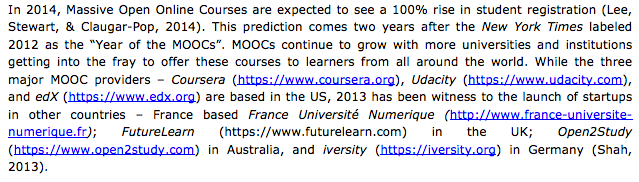 |
| Read the complete study – MOOCs: Emerging Trends in Assessment and Accreditation |
One of my least favorite experiences in college included walking into a library, going through the stacks of books about stuff I couldn’t give a hoot about. They were dusty tomes that someone had spent lots of time and money to produce, but I didn’t really care. But using the computers allowed me to research, to find content relevant to what I was interested in and learn–by engaging the content–independently. Now, you can do that AND interact with other people about the content while you’re reading it. The content includes video, audio, and you just can’t get bored if this is something of interest.
But it’s not all about college and higher education. When I think about the path ahead for my own children, Alastair’s blog title hits home–the corridor of uncertainty. It certainly is.
View my Flipboard Magazine.
Make Donations via PayPal below:

var _gaq = _gaq || []; _gaq.push([‘_setAccount’, ‘UA-3445626-5’]); _gaq.push([‘_setDomainName’, ‘mguhlin.org’]); _gaq.push([‘_trackPageview’]); (function() { var ga = document.createElement(‘script’); ga.type = ‘text/javascript’; ga.async = true; ga.src = (‘https:’ == document.location.protocol ? ‘https://ssl’ : ‘http://www’) + ‘.google-analytics.com/ga.js’; var s = document.getElementsByTagName(‘script’)[0]; s.parentNode.insertBefore(ga, s); })();
Discover more from Another Think Coming
Subscribe to get the latest posts sent to your email.
 Another Think Coming