 |
| Visit the Triple E Framework website |
A long-time proponent of educational frameworks, I learned about a new one. It’s not every day that an educational framework is born. If you’re not sure what I mean, check out popular frameworks like these:
- Levels of Teaching Innovation (LoTI)
- H.E.A.T.
- T.P.A.C.K.
Some folks often include SAMR, but it is only worth mentioning as a framework to NOT use. It lacks any foundation in research, serving more as an anecdotal tool. No teacher or educator should allow others to use SAMR to assess them. The lack of validity and reliability studies make SAMR-based assessments criminal. Don’t think so? Ask how yourself how many teachers have found themselves terminated. All due to the remarks of crackpot consultants.
A friend and colleague, Dr. Lucretia Fraga (@lucretiafraga), encouraged me to take a look at the Triple E Framework. When she mentioned Dr. Liz Kolb’s name, I couldn’t help but smile. Dr. Kolb had been kind enough to ask me to teach a webinar or two years ago. I confess I hadn’t kept up with her work. Listening to Lucretia, imagine my delight. Liz played a key role in developing the Triple E Framework.
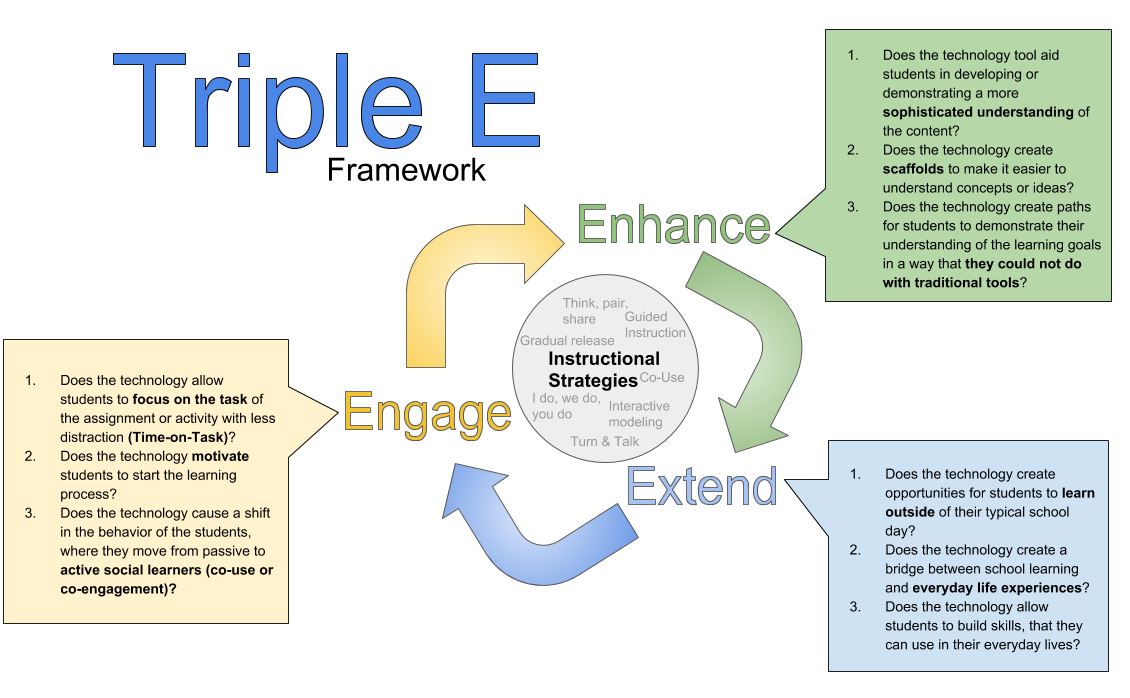
Triple E Framework Questions
The framework has three major components, each supported with research. Let’s review them:
- Triple E Level 1: Engaged Learning– This focuses on several questions such as:
- Does the technology allow students to focus on the task of the assignment or activity? (presumably with less distraction (Time on Task))?
- Does the technology motivate students to start the learning process?
- Does the technology cause a shift in the behavior of the students? This involves their move from passive to active social learners (co-use or co-engagement).
- Triple E Level 2: Enhanced Learning – Questions for this one include:
- Does the technology tool aid students in developing or demonstrating a more sophisticated understanding of the content? (creates opportunities for creation/production over consumption)
- Does the technology create scaffolds to make it easier to understand concepts or ideas?
- Does the technology create paths for students to demonstrate their understanding of the learning goals in a way that they could not do with traditional tools?
- Triple E Level 3: Extended Learning – Relevant questions include the following:
- Does the technology create opportunities for students to learn outside of their typical school day?
- Does the technology create a bridge between school learning and everyday life experiences?
- Does the technology allow students to build skills, that they can use in their everyday lives?
As fascinating as Triple E Framework is, I will have to spend some more time learning about it. Some things I like about it include:
- Each level has “examples of instructional strategies”
- Research informs each component
- Each support page includes a video with an extension checklist
WAIT, IS IT BETTER THAN OTHER FRAMEWORKS?
While my bias is still for the HEAT framework, selecting Triple E framework for use in lesson planning wouldn’t be a bad thing. Efforts such as ISTE Certification for Educators would do well to move beyond TPACK, often judged too complicated (if comprehensive), and SAMR. Using TPACK, LOTI/HEAT together, Triple E Frameworks can provide session participants with important learning and insights.
Discover more from Another Think Coming
Subscribe to get the latest posts sent to your email.
 Another Think Coming