Ready to maximize your school technology investments? Try this approach with campus culture initiatives. The approach? Juxtapose new technologies with strategies that close the growth gap.
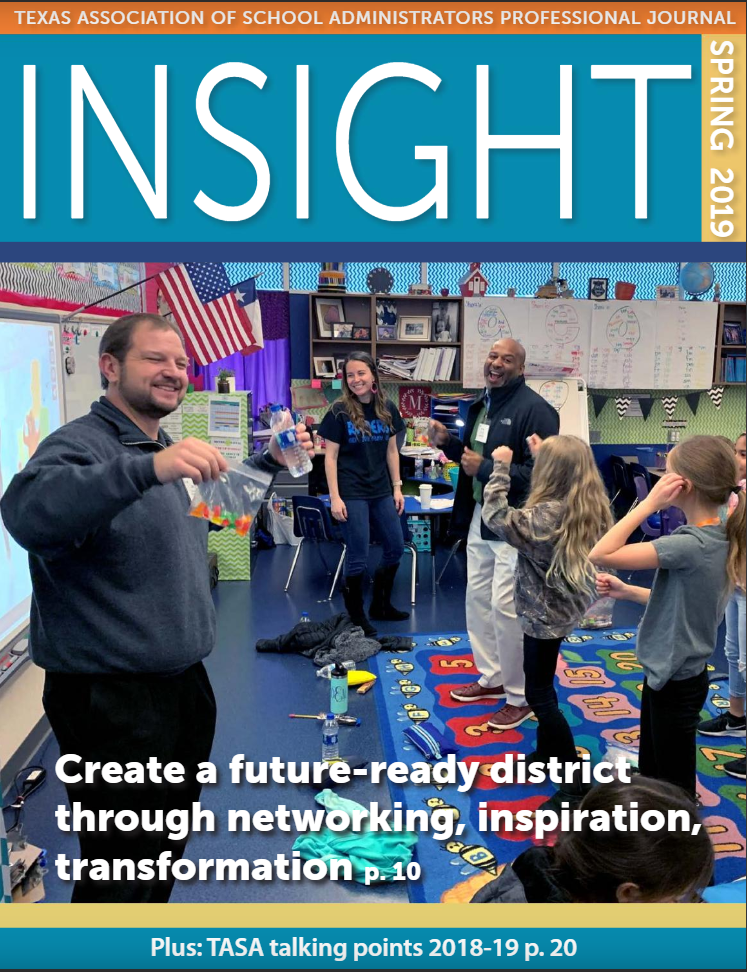
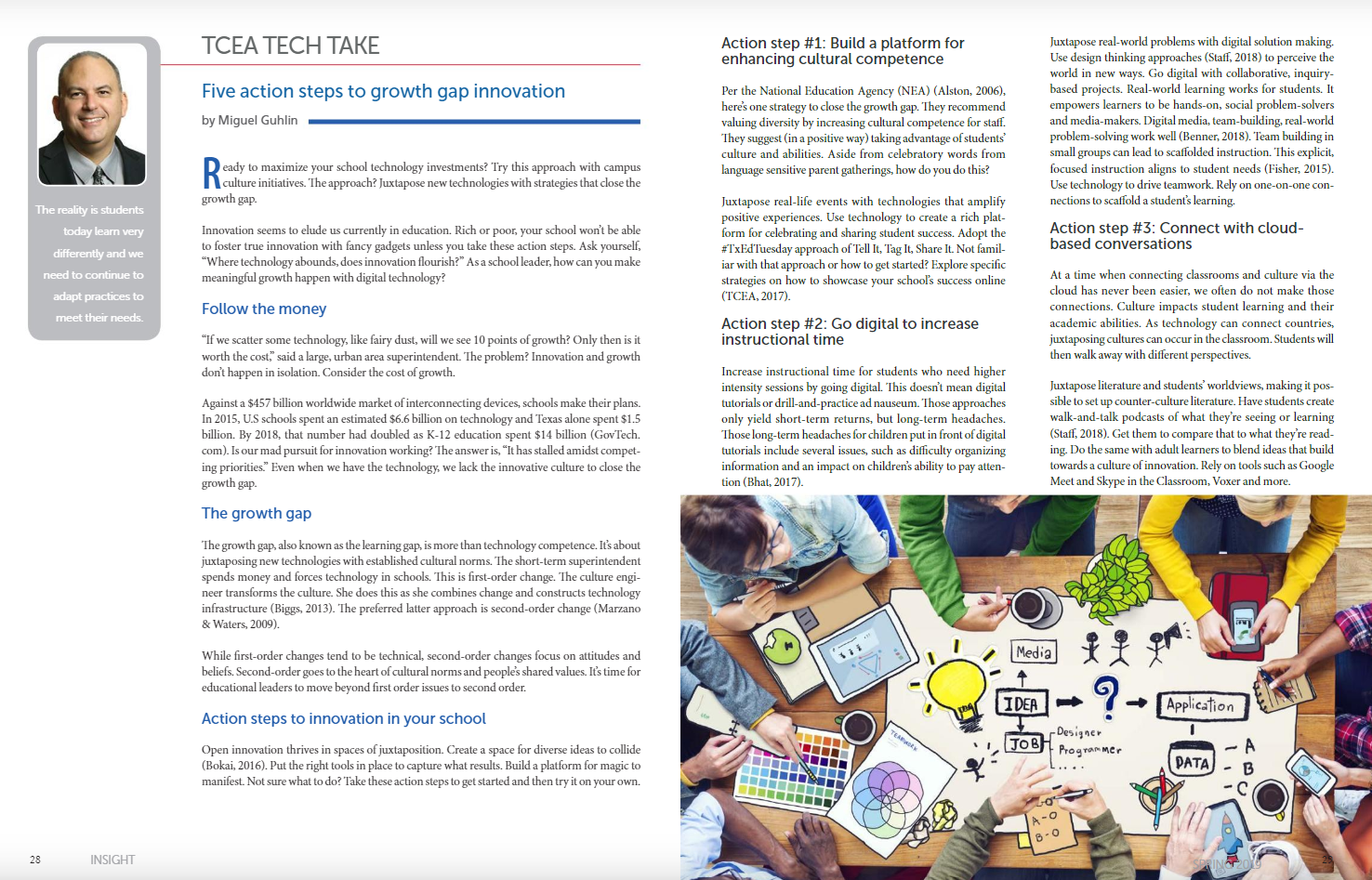
TASA’s Insight publication just published my article, Five Action Steps to Growth Gap Innovation. I was delighted to have the opportunity to write this article for TASA’s publication on behalf of TCEA.org. You can find the complete Spring, 2019 issue online.
I have to admit that I love the lead I wrote for this article, especially the question, “Where technology abounds, does innovation flourish?” It’s such a wonderful question to ask, especially in schools that have ample access to tech. The answer is as simple as this:
Juxtapose tried-n-true strategies with new technologies in this series of action steps.
Want to read the unedited version? Scroll down and check out my blog entry. Otherwise, click the link to see the final version (they’re not that different) in TASA’s Insight.
Want to read the article in text format? Here’s the unedited version:
Five Action Steps to Growth Gap Innovation
by Miguel Guhlin
Ready to maximize your school technology investments? Try this approach with campus culture initiatives. The approach? Juxtapose new technologies with strategies that close the growth gap.
Innovation eludes us. Rich or poor, your school won’t find it with fancy gadgets unless you take these action steps. Ask yourself, “Where technology abounds, does innovation flourish?” As a school leader, how can you make meaningful growth happen with digital technology?
Follow the Money
“If we scatter some technology, like fairy dust, will we see 10-points of growth? Only then is it worth the cost,” said my large urban area superintendent. The problem? Innovation and growth don’t happen in isolation. Consider the cost of growth.
Against a $457 billion worldwide market of inter-connecting devices, schools make their plans. In 2015, U.S schools spent an estimated $6.6 billion on technology. Texas spent $1.5 billion in 2015. In 2018, K-12 spent $14 billion (GovTech.com). Is our mad pursuit for innovation working? The answer is, “It has stalled amidst competing priorities.” Even when we have the technology, we lack the innovative culture to close the growth gap.
The Growth Gap
The growth gap, also known as the learning gap, is more than technology competence. It’s about juxtaposing new technologies with established cultural norms. The short-term superintendent spends money and forces technology in schools. This is first-order change. The culture engineer transforms the culture. She does this as she combines change and constructs technology infrastructure (Biggs, 2013). The preferred latter approach is second-order change (Marzano & Waters, 2009).
While first-order changes tend to be technical, second-order changes focus on attitudes, beliefs. Second-order goes to the heart of culture norms and people’s shared values are. It’s time to move beyond first order issues to second-order. The smart leaders have done so.
Does innovation elude you? Juxtapose tried-n-true strategies with new technologies in this series of action steps.
Action Steps to Innovation in Your School
Open innovation thrives in spaces of juxtaposition. Create a space for diverse ideas to collide (Bokai, 2016). Put the right tools in place to capture what results. Build a platform for magic to manifest. Not sure what to do? Take these action steps to get started, then try it on your own.
Action Step #1: Build a Platform for Enhancing Cultural Competence
Per the National Education Agency (NEA) (Alston, 2006), here’s one strategy to close the growth gap. To do so, they recommend valuing diversity, increasing cultural competence for staff. They suggest (in a positive way) taking advantage of students’ culture and abilities. Aside from celebratory from language sensitive parent gatherings, how do you do this?
Juxtapose real life events with technologies that amplify positive experiences. Use technology to create a rich platform for celebrating and sharing student success. Adopt the #TxEdTuesday approach of Tell It, Tag It, Share It. Not familiar with that approach or how to get started? Explore specific strategies on how to showcase your school’s success online (TCEA, 2017).
Action Step #2: Go Digital to Increase Instructional Time
Increase instructional time for students who need higher intensity sessions. Go digital. This doesn’t mean digital tutorial or drill-n-practice ad nauseum. Those approaches only yield short-term returns, long-term headaches. Long-term headaches for children put in front of digital tutorials include several issues. Issues include difficulty organizing information. Increased screen time can impact (long-term) children’s ability pay attention (Bhat, 2017).
Juxtapose real-world problems with digital solution-making. Use design thinking approaches (Staff, 2018) to perceive the world in new ways. Go digital with collaborative, inquiry-based projects. Real-world learning works for students. It empowers learners to be hands-on, social problem-solvers as media-makers. Digital media, team-building, real-world problem solving work well (Benner, 2018). Team-building in small groups can lead to scaffolded instruction. This explicit, focused instruction aligns to student needs (Fisher, 2015). Use technology to drive team work. Rely on one-on-one connections to scaffold a student’s learning.
Action Step #3: Connect with Cloud-based Conversations
At a time when connecting classrooms and culture via the cloud has never been easier, we do not. Culture impacts student learning and their academic abilities. As technology can connect countries, juxtaposing cultures can occur in the classroom. Students walk in with different perspectives
Juxtapose literature and students’ worldviews, making it possible to setup a counter-culture literature. Have students create walk-n-talk podcasts (Staff, 2018) of what they’re seeing or learning. Get them to compare that to what they’re reading. Do the same with adult learners to blend ideas that build towards a culture of innovation. Rely on tools like Google Meet and Skype in the Classroom, Voxer, and more.
Action Step #4: Speed Learning with Multimedia Text Sets
“Kids don’t know anything, why ask them to share?” asked a principal once. How do you build background knowledge K-12 or adult learners need? One approach could be team learning focused on multimedia content. Engaging students with team learning methods has positive achieement results (Slavin, Karweit, 1981). The same goes for adult learners. In this way, you combine varied, effective strategies. How can you use technology to speed diverse learner instruction?
For me, learning involves sense-making, mixing information and ignorance. You create an idea collider. What survives the force of many collisions is what results. Get faster learning with more content and learner interactions.
Juxtapose team learning with multimedia text sets. Using Lisa Highfill’s multimedia text sets, you can speed learning. Even more so, you can scaffold team learners. Create Multimedia Text Sets (MMTS) to ease introduction of new information. MMTSs help learners glean information and ideas from a rich variety of media sources. Learn more online at http://ly.tcea.org/mmts
Action Step #5: Make Learning Connections Visible
“Why does this matter? How is this going to be of value in my life?” Those are two questions that disarm most educators. In this final action step, make the impact of learning viewable to learners.
Several ways are possible. They range from inviting guest speakers to working with primary source documents. News stories sources abound online (http://ly.tcea.org/freenews).
Five Action Steps to Close the Growth Gap
Many schools are working hard to show growth for each students. Use the action steps to bridge the gap between learners’ present status and their future they are capable of.
Web Link to Article References
References
-
Alston, Denise (2006). “Closing Achievement Gaps: An NEA Association Guide.”
-
-
-
Biggs, Sharon M. (2013). “Superintendents’ Beliefs about Barriers That Can Influence Their District Technology Leadership Practices.” Seton Hall University Dissertations and Theses (ETDs). 1873. Available at https://tinyurl.com/y7qyle4o
-
-
-
-
-
Marzano, Robert J., Waters, Timothy (2009). “District Leadership That Works.”
-
-
Slavin, Robert E., Karweit, Nancy L. (1981). “Cognitive and Affective Outcomes of an Intensive Student Team Learning Experience.” The Journal of Experimental Education,50:1, 29-35. Available at http://tinyurl.com/y785lz6w
-
Staff, TCEA (2018). “Walk and Talk Podcasts.” Available at http://tinyurl.com/yahn3zl5
Everything posted on Miguel Guhlin’s blogs/wikis are his personal opinion and do not necessarily represent the views of his employer(s) or its clients.
Read Full Disclosure
Discover more from Another Think Coming
Subscribe to get the latest posts sent to your email.
 Another Think Coming