After following John Hattie’s work down the rabbit hole, I purchased a copy of Dr. Sonny Magana’s book, Disrupting Classroom Technology. The book outlines the need for educational frameworks, and offers a three-tiered model. Let’s take a quick look.
Of course, I’m still learning and working through my shock about Hattie’s points regarding Problem-Based Learning, which has an effect size of .35 and fails to accelerate student growth in one calendar year.
Update: Ok, now I have a much better understanding and realize that PBL is ineffective when it is used for Surface Learning, rather than Transfer Learning. When PBL does make its appearance in Transfer Learning, it does so under the moniker of “Problem-Based Teaching” and the effect size goes up.
Dr. Sonny Magana’s T3 Framework for Innovation
So what are the three tiers of Dr. Mangana’s T3? The three tiers include:
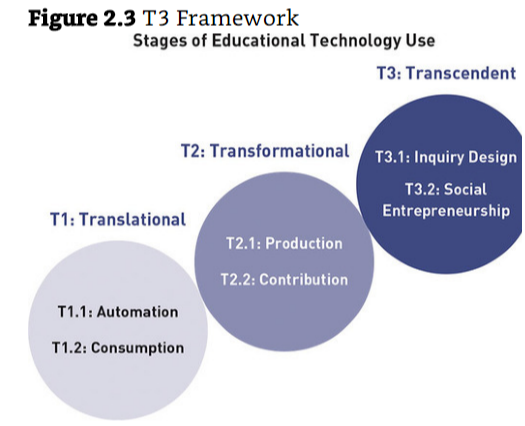
Here’s my quick summary, imperfect as it probably is:
T1: Translational Tech Use: This involves using technology to improve efficiency or accuracy, and/or increase quantity or quality. This tier focuses on Automation and Consumption. It seems equivalent to Substitution and Augmentation in the SAMR model. As you can imagine, the tools-heavy focus that characterizes the typical presentations one sees that focus on “60 tools in 60 minutes.” It’s all about the tools.
T2: Transformational Tech Use: Substantive disruption or changes in either the structure of the task itself, the role of the individual engage in the task, or the impact of the task on those who perceive the object of the task. From my perspective, this corresponds to SAMR Modification/Redefinition.
However, this also appears to include tracking student progress, providing feedback reminiscent of integrated learning systems (ILSs). Fortunately, Magana specifically writes against that type of tech use. He may be referring to better student achievement progress monitoring systems.
T3: Transcendental Tech Use: In this tier, educators engage students with an ill-structured problem. The use of “ill-structured problem” is code for Problem-Based Learning (PBL). Service learning falls into this as well. Social entrepreneurship that results in generating social good and generating value. 3D printing, coding, design thinking, makerspaces all fall into this level of tech use.
A Quick Review
Wondering what I thought of the Dr. Magana’s book? It was a quick look at much of what has happened in the past for edtech folks in schools. Dr Magana’s examples (e.g. iEARN) took me on a trip down memory lane. Not surprising, of course. One point that stuck with me is how much the idea of technology as a tool to enable activities NOT possible without it appeared.
Dr. Magana offers a valuable framework for consideration. I’ve featured them on this website so as to keep track of them. I definitely prefer this framework over SAMR.
Discover more from Another Think Coming
Subscribe to get the latest posts sent to your email.
 Another Think Coming