The September, 2019 issue of ASCD’s Educational Leadership publication has Mike Schmoker beating the drum again. What about? How we’re wasting our time and effort in average classrooms chasing after the novel instead of relying on known, research-based strategies.
 |
| H.P. Lovecraft’s Shoggoth…but I call “EdTech Eldritch Powers” wasting time in America’s schools |
Mike Schmoker says:
When I tour schools and classrooms with on-site administrators, we never lament the possible absence of instructional technology, personalized-learning strategies, or other popular (but largely unproven) “innovations.” (Source: ASCD)
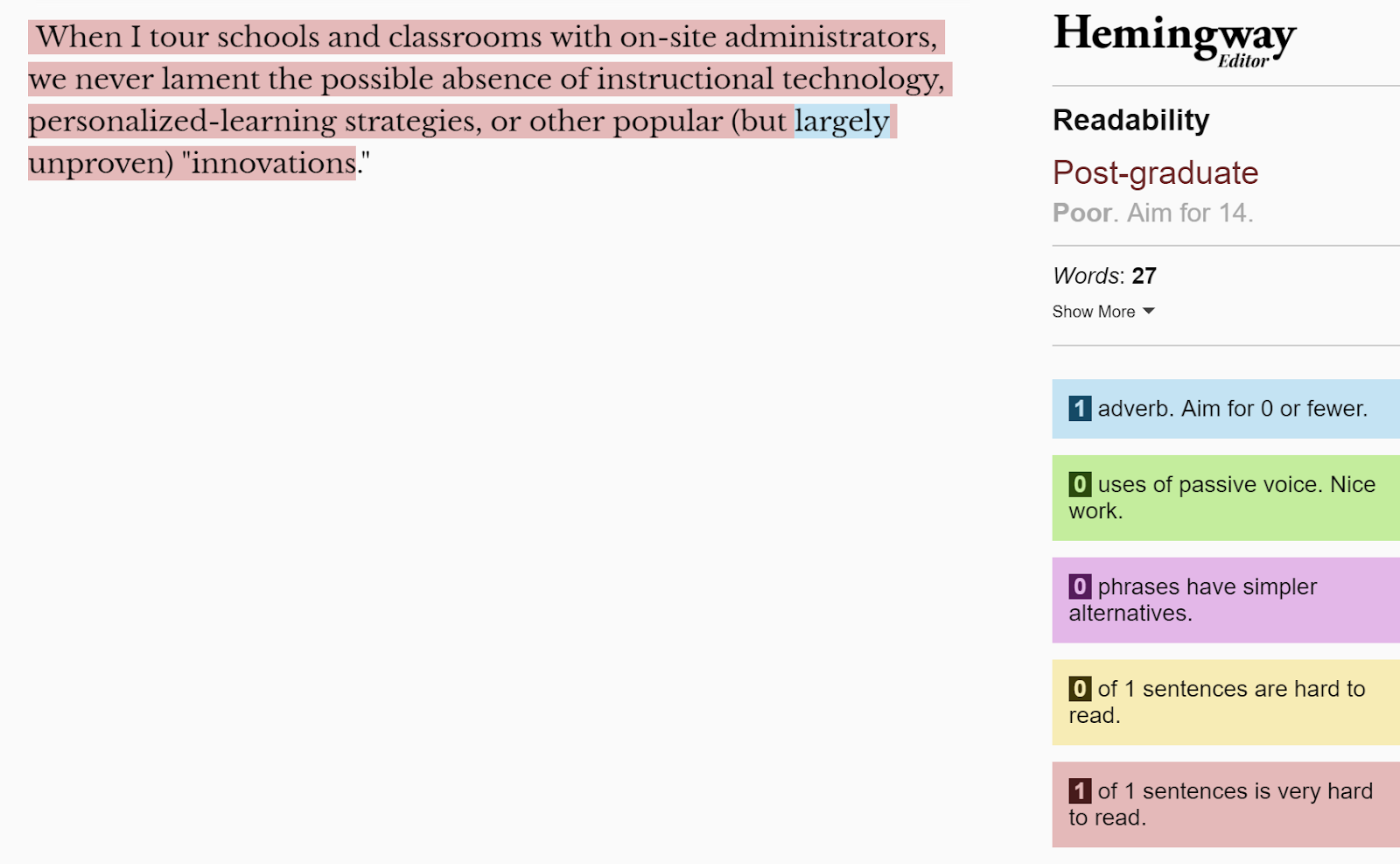
Gee, I have to revise that sentence. Put another way (because that HAS to be the most awkward sentence ever), Mike Schmoker says:
The absence of popular innovations in today’s classrooms never saddens me. Those unproven innovations include instructional technology, personalized-learning strategies and others. (Revision of Mike Schmoker’s writing, how bold is that)
For him, it is a matter of research, not passion:
We note the paucity of authentic reading and writing activities, even in courses where they should predominate. And we bemoan the near absence of the most critical elements of effective teaching, such as quick, frequent “checks for understanding,” which can double or triple the success rate on daily lessons.
The ubiquity of these poor practices is made evident by decades of classroom observation research (Darling-Hammond, 2010; Good & Brophy, 1997). They amount to “hundreds of hours of wasted class time” every year, in the great majority of schools (Kane & Steiner, 2019). For researchED’s Eric Kalenze (2014), these findings constitute an educational system that is “upside down”—in which the most potent, proven practices are the least implemented, even as ineffective, time-wasting practices are astonishingly common.
For Schmoker, the following is missing or so seldom used as to be absent:
- Checks for understanding –> Double or triple the success rate on daily lessons
- Reading, discussion, writing assignments–> Affect student learning
- Clear, student-friendly learning targets that clarify how the target will be assessed–>higher rates of success on daily lessons
- Compelling introductions for each lesson–>Make learning relevant to students
- Circulate while students practice before moving onto the next step
- Most potent, proven practices are least implemented–> Ineffective, time-wasting
- Phonics instruction: K-1 systematic instruction in phonics
- Quantity of reading and writing: Need more of both (60 minutes daily for reading, 40 mins for writing)
- Reading to learn: Teachers need to know how to scaffold/introduce text (e.g. Reciprocal Teaching comes to mind for me as one research-proven approach), craft higher-order guiding question for text, and model/instruct students in how to underline, annotate and take notes as they read.
- Discussion: Focused talk in pairs and discussion. Classroom discussion (e.g. Socratic Seminar is one approach) is a great way to approach this.
The EdTech Eldritch Powers
Why eldritch? Well, edtech has long been sinister and otherworldy in classrooms. Teachers have rejected the Appy Days of Edtech, fought against the technical expectations for using computers, and banned them from classrooms. Perhaps, it’s not they who are wrong, but edtech cultists pushing their unproven insidious innovations into schools. The desires of big edtech business have also tainted everything that happens in the classroom, turning teachers into edtech devotees to serve as ambassadors. Should it all stop? Have we truly been wasting our time?
Maybe, the cold research that can save us, the stop doing lists of ineffective instructional strategies that need to be pushed out. When I read blog entries like this one below, I ask myself, “Does it go far enough? Is it as honest as it could be?”
TCEA has been supporting the use of technology in education for almost 40 years now. As we get ready to celebrate that anniversary, we’ve spent time looking at the realm of classroom ed tech and how far it’s come. We know that the real power of any technology relies upon how it’s used. So how well is ed tech being implemented?
To our dismay, we found that we haven’t made the progress we had hoped for. Yes, there are pockets of excellence where the technology truly enhances student achievement. Source: Tech is only Part of the Picture
Imagine that for 40 years, you’ve been advocating for something that is “unproven” albeit “popular” innovations. Schmoker himself says:
To overcome such “awful inertia,” we should unashamedly inculcate “moral outrage at ineffective practices” and their disastrous consequences for students (Barth, 2002). Then providers of preservice and professional development should radically reorder their priorities to ensure that the [effective] practices…are taught first and that demonstrated mastery becomes the explicit aim of training.
Awful inertia. Moral outrage. Ineffective practices. Really? I do agree with a radical reorder of priorities. But what would that look like? How do you go back to the beginning when you’ve been doing something for so long? Isn’t it easier to simply walk away?
Back to Basics
When I ponder these points, I’m reminded of a quote I stumbled on earlier this month. It is such a powerful quote that I’ve pinned it to my twitter feed lest I fall under the spell of edtech eldritch powers:
“Put simply, ensuring that every child attains a baseline level of proficiency in reading and mathematics does more to create equal opportunities in a digital world than can be achieved by expanding or subsidizing access to high-tech devices and services.” As cited here
When I re-read Schmoker, Hattie, Fullan, I realize that we are back to ensuring teachers know how to teach reading, writing and arithmetic. Children need not learn edtech, rather they must use technology to do what Dr. Sonny Magana describes in his T3 framework.
Here’s my Wakelet on Dr. Magana’s work if you want to explore more deeply:
Loving the Unproven Innovations
For my entire career, I have done my best to facilitate the adoption of popular, unproven innovations like instructional technology. In my work as a person who facilitates professional learning, I see less time left to experiment and try unproven instructional technology approaches. Instead, I find myself lamenting the loss of time, time-wasted doing things in classrooms that failed to accelerate student learning.
Schmoker urges us all to focus on high-leverage strategies, ensuring that we, as leaders and professional learning facilitators, model the same effective strategies with teachers. Those same strategies that teachers must use with students.
What I Need To Learn More
Articles like Schmoker’s leave me asking myself, “What else do I need to learn to make this a reality?” Obviously, a deeper awareness of John Hattie’s effective instructional strategies. But what about curriculum and assessment design?
Discover more from Another Think Coming
Subscribe to get the latest posts sent to your email.
 Another Think Coming