Are we engaged in Orwellian doublethink in schools today? We may be when we imagine that pushing the use of ineffective instructional strategies into schools will improve students’ ability to read, write, analyze and think in schools today. How can we reconfigure what we are doing with technology in schools? In this blog entry, I explore this idea.
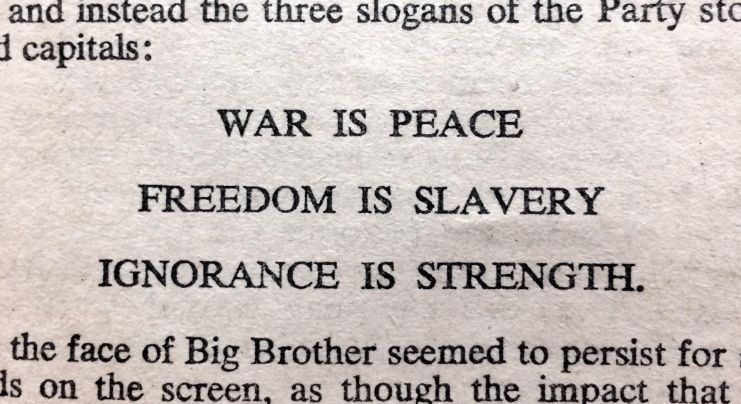 |
| Doublethink: Slogans from George Orwell’s 1984 |
Time Travel
Come back in time with me to the summer of 1984. The summer after my sophmore year in high school, I had the opportunity to participate in the University of Texas at San Antonio’s (UTSA) special program. I don’t remember what the name of this special program was. I do remember that it was focused on George Orwell’s book, 1984. That made sense to me because the book title matched the year. Some of my work that summer had to do with crafting a primer for younger learners on water conservation in the Edward’s Aquifer. That effort involved visiting a Ray Ellison waste treatment plant, and more. While it was supposed to be a STEM focused project, I learned more about writing in a committee.
What did stick with me? Orwell’s concept of doublethink.
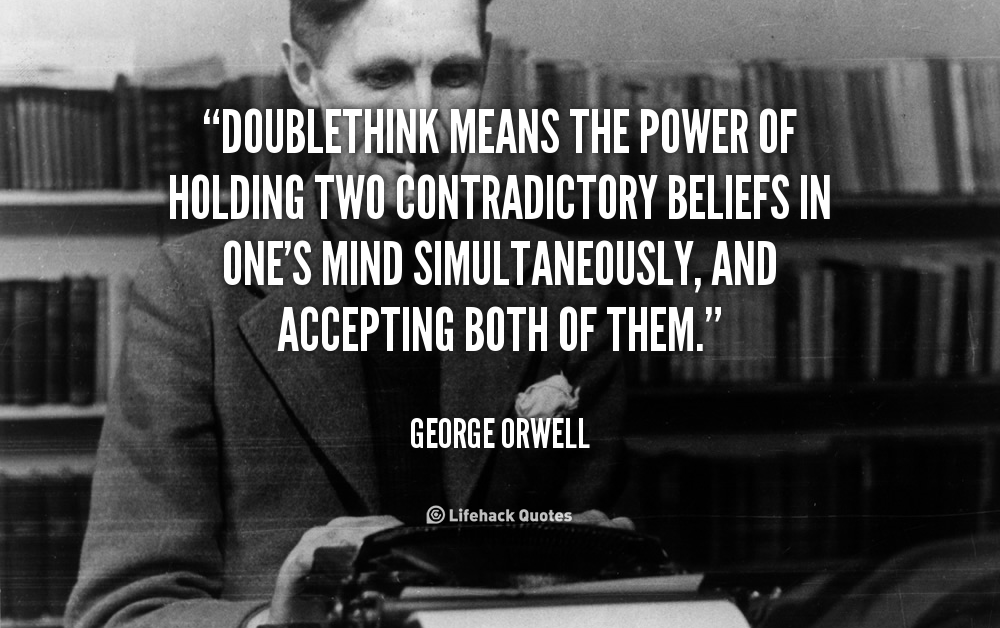
Doublethink
For many some folks, it’s easy to imagine the doublethink going on. In this case, the contradictory beliefs might include:
- Use of an ineffective instructional strategy (fill in the blank) in schools translates into significant, observable learning for children
- Adopting tablets (e.g. iPads, Android) results in higher student achievement
- Online learning will make a BIG difference for students
Research studies suggest the opposite. You don’t simply implement an instructional strategy and it is magically effective.It’s time to hold how we use technology-based instructional strategies in classrooms to a higher standard. Obviously, that will take time. We’ve spent SO much effort working to put technology in schools, now figuring out what works can be daunting.
Over the years, we’ve managed to hold in our minds two contradictory ideas…that some instructional strategies that make us feel good may make a difference. Some do, some don’t.
Let’s take a look at one example.
Blended Learning
“According to Visible Learning research by professor John Hattie, we know that the more face-to-face interactions teachers have with students, the greater the effect of learning becomes, as seen below,” says Caleb Allen. He goes on to write, “Technology, on its own, has very little impact on student learning. However, technology has proven to have great impacts on accelerating and enabling teachers to do more in the classroom. When teachers leverage technology effectively, to get more opportunities for face-to-face interactions, learning effects increase greatly.”
Caleb goes on to cite the following learning effects. Keep in mind that d => .40 puts a strategy in the “zone of desired effects.”
- Feedback: 0.70
- Response to Intervention: 1.29
- Classroom discussion: 0.82
- Small-group learning: 0.47
- Technology in math: 0.33
- Technology in reading: 0.29
- Online and digital tools: 0.29
- Technology in small groups: 0.21
As Caleb points out, that’s a pretty amazing gap considering face to face to technology on its own. That said, he has a great article on Rethinking Time in the Blended and Personalized Classroom. He writes:
Educators, the future of blended and personalized learning is bright. There are a lot of positives coming out of classrooms practicing these instructional models.
It’s well-worth a read.

What do you think?
Discover more from Another Think Coming
Subscribe to get the latest posts sent to your email.
 Another Think Coming