 |
| Source: https://live.staticflickr.com/2854/33566499814_afa7f754c2_b.jpg |
Do you see approaches like Design Thinking as unproven innovations (here’s one research report on it)? In the hazy, vagueness of reform fog, I keep wishing someone would make a list of these ineffective instructional strategies. When I read pieces like the one linked below, I can’t help but ask if those ineffective strategies are some “unknown monster lurking in the world.” Is it all just fear-mongering or is there some validity in these claims? I suspect there is given the wealth of research cited in my previous blog entries, which I’ve dubbed “the EdTech Heresies” given their warmed-over reception (like warmed over hot coals of the nether world).
The Popular, Unproven Strategies
ASCD published Mike Schmoker’s article, where he writes:
When I tour schools and classrooms with on-site administrators, we never lament the possible absence of instructional technology, personalized-learning strategies, or other popular (but largely unproven) “innovations.” (Source: ASCD)
The point is that these “innovations” lack research support. Note that Schmoker is referring to instructional technology and other popular innovations. It raised a few questions in my mind. So, for fun, I decided to ask a smarter guy what his thoughts were. I became familiar with Dr. Lichtman’s work as part of professional learning I’ve had the opportunity to participate in.
Grant Lichtman
Earlier today, I asked Grant Lichtman the following question and he was kind enough to respond.
@GrantLichtman How does your perspective on innovation connect to Mike Schmoker’s ideas that innovation is a time waster in classrooms? That we would see better growth from effective instructional strategies? THx in advance!
His response?
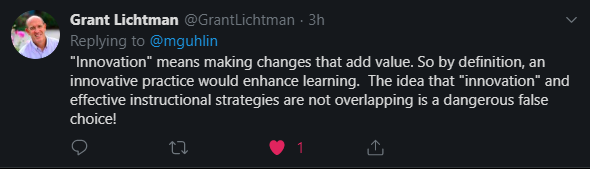
Of course, what a great response. Innovations are “changes that add value.” And, that means that changes that add value to instruction are effective instructional strategies. Right? Am I getting that correct?
So, why did I ask this question? Grant Lichtman makes some great points in his piece, Building Schoolwide Innovation: Two Critical Planes. He promises to expand on this in his soon to be released book, Thrive. Lichtman points out the following in his article:
For at least a decade K-12 educators have recognized that schools must change in order to prepare our students for the challenges of a rapidly changing world. The word “innovation” has become a catch-all for those changes. Unfortunately, for many schools, innovation remains a phrase or vague commitment, and substantive change that builds value for the school in a time of expanding choice and dynamic markets remains elusive.
What are some of the innovations Grant imagines? Based on his website and article, I suspect that Design Thinking, Makerspaces fall into that bucket of innovation.
But how do these fit into Mike Schmoker’s simplified classroom? I don’t recall seeing Schmoker refer to “Design Thinking” or makerspaces. Add other notables to the mix, such as John Hattie, Douglas Fisher, Nancy Frey, the Corwin club, and I’m plumb bewildered.
What’s an old instructional technologist to believe? Is there time to implement Design Thinking AND cover the three essentials Schmoker writes about in his ASCD article?
I need ask better questions. Perhaps, design thinking isn’t an innovation the way Schmoker dismisses them. Rather, it’s an approach that adds value.
Update: Please read Grant Lichtman’s reply at his blog. I’ll be posting a reply to his soon.
Discover more from Another Think Coming
Subscribe to get the latest posts sent to your email.
 Another Think Coming