 |
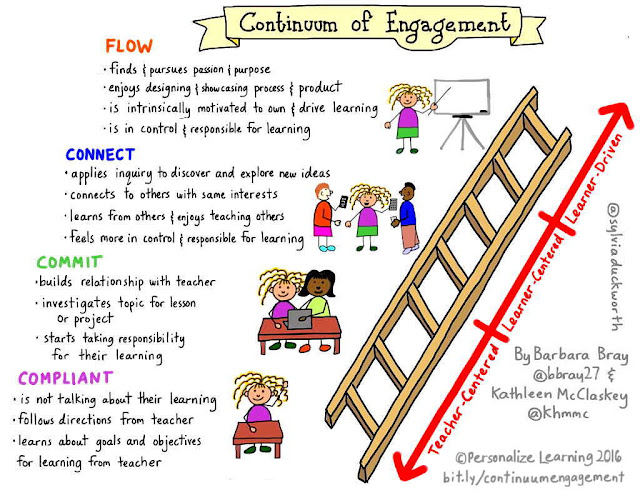
| Continuum of Engagement |
In the 2016 article, Are Classrooms becoming too dependent on technology?, the following questions are asked:
Is it all just too much? The concept of a human teacher standing in front of a group of students and delivering a lecture on a specific topic is still typical in many schools.
What if we did things differently?
The students listen, take notes, and discuss the material afterward.
Is there a need for dozens of different permutations of technological devices? In spite of the apparent advantages of virtual trips and online encyclopedias, some educators believe that too much tech is harmful to students.
It’s hard to imagine that we’re at a point now that there’s TOO much tech in the classroom. When I started my career in Cotulla ISD (Apple //e and IBM 8088) and Edgewood ISD (IBM 8088), there wasn’t enough tech. I didn’t have a computer in my classroom in Cotulla (I remember carrying my IBM 8088 clone in its HUGE box around in the backseat of my car. Sheesh) but students were able to move back-n-forth to the one computer lab (setup for faculty). It was there they typed in their poetry to create an anthology of writing. It’s a far cry from instant publishing available today.
In Edgewood ISD (Mac TV! No, I don’t know what I was thinking) and, later, Mt. Pleasant ISD (Mac TV), I had to push to have technology accessible in my classroom. There were only a handful of programs to work with (e.g. word processor, HyperStudio, Inspiration graphic organizer). Yes, believe it or not, it was slim pickings. Times have changed.
Just Too Much
In the article from EdNewsDaily cited above, various reasons are given as to why tech is just too much:
- Screentime is bad for children’s eyes. But, you know what, so is reading books. I can attest to that. Thank goodness for Lasik, otherwise, I’d be even blinder.
- Decrease in attention span. I can agree with that…it’s easier to read on a single purpose device (e.g. old fashioned book or Kindle) than it is on my phone given all the distractions. No such thing as multi-tasking, either.
- Rural and poor communities who can’t afford tech are left behind when instructional strategies rely on it so much.
- Minimal human interaction. Amazing, huh? Spend too much time with devices, you forget how to connect with others.
- Spend too much money on tech, teacher professional learning suffers. After all, there’s only so much funding to go around. If we’re spending it all on expensive tech, it’s less likely to be spent on professional learning that is effective and makes a difference.
What Kind of Engagement
Authentic engagement means that students do more than just answer a question during a session of “sit and get.” It means that they have dialogue with us, and ask questions at the same time they’re engaging in giving us an answer. It means that students are talking as much as we are. (Source: Student Engagement: Is It Authentic or Compliant?)
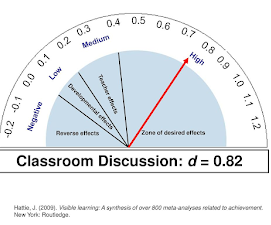
Hattie’s research found that classroom discussion (equal parts talking by students and the teacher) has an effect size of .82.
Discussion is a great way to understanding whether the engagement is authentic or compliant, and it also helps the teacher focus on formative assessment so they can change their instruction to meet the needs of students
True learning means that there are times when the teacher and students are learning at the same time. That takes authentic engagement.
Peter DeWitt says, “We set up a dynamic to truly engage students through strategies like flipping our classrooms, metacognitive activities, using engaging short video clips, setting instructional goals with students, providing time to go through questions with a small group of peers, and providing time where students get to ask questions of us as much as we ask questions of them.”
No Clear Answers
We have to figure out how to do it for much not much more than we are spending now, because there simply is no more money. We know this can be done because most of the countries that have been outperforming us have been spending less than we do. Source: Marc Tucker as cited here
Are we using tech in such a way that aligns to what works?
Discover more from Another Think Coming
Subscribe to get the latest posts sent to your email.
 Another Think Coming