Over the last few days, I’ve been checking out books on writing. At the library, I’m the guy juggling a stack of books about writing. I’ll read a few chapters. Then, put the book in the return bin. Most books are wordy, boring, and are too focused on teaching.
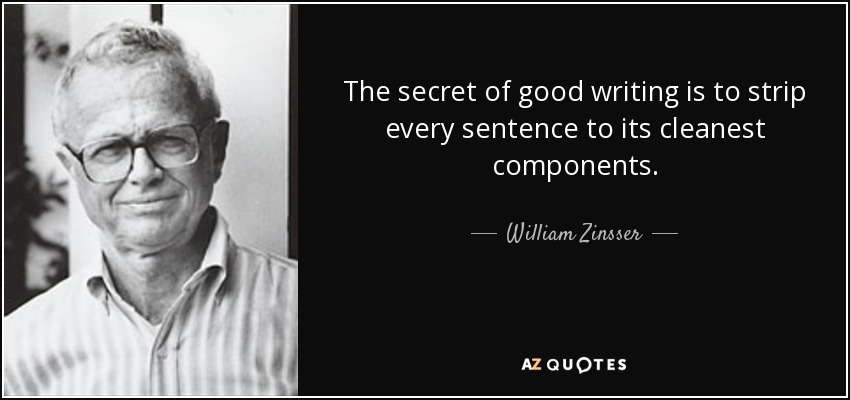
William Zinsser is only wordy when it suits his subject. His On Writing Well works because every sentence does what it must and not one thing more. I love this paragraph:
…the secret of good writing is to strip every sentence to its cleanest components. Every word that serves no function, every long word that could be a short word, every adverb that carries the same meaning that’s already in the verb, every passive construction that leaves the reader unsure of who is doing what…A clear sentence is no accident.
How can you argue with that? Reading this paragraph makes me want to go rip the guts out of something I’ve written. Then, put that piece back together with these points in mind.
WZ makes many valuable points. One of them suggests another idea.
Look for the clutter in your writing and prune it ruthlessly. Be grateful for everything you can throw away. Reexamine each sentence you put on paper.
Some Other Takeaways from On Writing Well:
- “The point is that you have to strip your writing down before you can build it back up. You must know what the essential tools are and what job they were designed to do. Extending the metaphor of carpentry, it’s first necessary to be able to saw wood neatly and to drive nails. Later you can bevel the edges or add elegant finials, if that’s your taste. But you can never forget that you are practicing a craft that’s based on certain principles. If the nails are weak, your house will collapse. If your verbs are weak and your syntax is rickety, your sentences will fall apart.”
- All writing is ultimately a question of solving a problem…whatever it is, it has to be confronted and solved.
- Every successful piece of nonfiction should leave the reader with one provocative thought that he or she didn’t have before.
- Narrative is the oldest and most compelling method of holding someone’s attention; everybody wants to be told a story.
- If something surprises you it will also surprise–and delight–the people you are writing for, especially as you conclude your story and send them on their way.
- A difficult problem in a sentence can be solved by simply getting rid of it.
- Keep paragraphs short. Writing is visual.
- There’s no subject you don’t have permission to write about.
- Paraphrase: When you follow your affections, you write well, and engage your readers.
- Science writing:
- Start at the bottom with the one fact a reader mus tknow before he can learn any more.
- The second sentence broadens what was stated first
- The third sentence broadens the second, so you can gradually move beyond fact into significance and speculation
- How a new discovery alters what was known
- what new avenues of research it might open
- where the research might be applied
- Use your own experience to connect the reader to some mechanism that also touches his life.
- Write like a person, not like a scientist
Discover more from Another Think Coming
Subscribe to get the latest posts sent to your email.
 Another Think Coming