Are you up to date on your copyright? How about your podcasting skills? This evening, I stumbled on a conversation that gave me the opportunity to revisit both. Mind if I share my journey with you?
Tweet
About The Global Read Aloud
You might think I’d know all about this, but aside from a brief look some time ago, I hadn’t really taken a deep look at Pernille Ripp’s program. She writes the following:
This is all run by me, Pernille Ripp, one person, who has a full-time job as a 7th-grade teacher, as well as speaks, trains, and writes outside of that. (Source)
It’s always amazing to see what one person can do. This seems to be a great program that involves some great opportunities to connect.
It seems to me that people sign up to read books live. Consider Pernille’s post:
The premise is simple; we pick a book to read aloud to our students during a set 6-week period and during that time we try to make as many global connections as possible. Each teacher decides how much time they would like to dedicate and how involved they would like to be. Some people choose to connect with just one class, while others go for as many as possible. The scope and depth of the project is up to you. While there are commonly used such as Skype, Twitter, Padlet, or Flipgrid, you choose the tools that will make the most sense for you. Teachers get a community of other educators to do a global project with, hopefully inspiring them to continue these connections through the year. (Source)
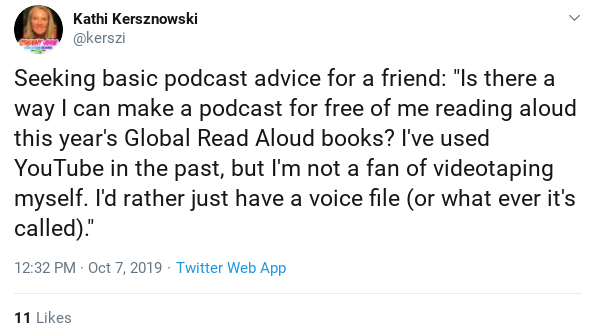
The Question
Podcasting Tools
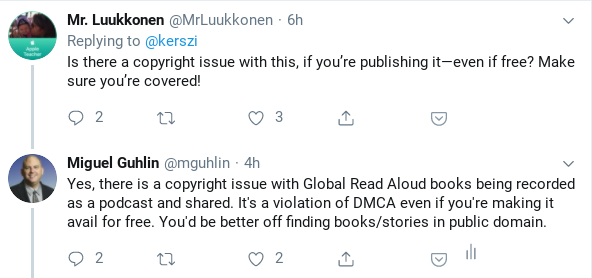
Copyright Issues
- Books selected were public domain or free from copyright
- Book authors had granted permission for the books to be read by anyone
Public Domain or Copyright-Free Books Wakelet
To satisfy the first item, I created a list of websites where folks could find public domain or copyright-free books that could be read aloud. You can see the Wakelet collection below:
Copyright Issue?
The fact that hundreds of storytime performances can be found on YouTube and Facebook gives you an indication that the risk is low, and more significantly, a lot of people do not think that digital storytime is against the law. The public’s behavior shapes the law and how we interpret it.
Yes, a rights holder could sue a librarian for reading on YouTube. A rights holder can decide to sue whomever they want. But this is ridiculous—who would sue a library or teacher for digital storytime? The case would be thrown out of court. The rights holder that brings the lawsuit would look despicable and get bad press.
Wait, Was I Wrong or Right?
However, reading the comments on the SLJ article reinforces my stricter interpretation of copyright. Since I’m not a lawyer, I only try to offer suggestions that align to best practice.
- Giving away a whole book to the world on YouTube, or even on a school intranet, is theft, plain and simple.YouTube has algorithms to find when you use copyright music. They will soon be able to find you and shut down your channels.At the very least, you should contact the copyright holder to let them know your intentions and ask permission. That is a common courtesy.
- For example, the claim that “The public’s behavior shapes the law and how we interpret it” after pointing out that, in essence, “everyone else is doing it.” It is very true that most people speed on the highway. However, I have not let that “shape my interpretation of the law,” and I think that a judge would find my argument that everyone else’s speed has changed the law somehow to be quite laughable. Using fair use guidelines, the criteria are not met. One is using the ENTIRE book, not an excerpt, and it does directly negatively impact the market value as it absolutely CAN (and does, for users who do not have access to a print copy or the published audiobook) serve as a substitute for the book.
My Recommendation
My recommendation? Don’t record copyrighted books to audio format and share them on the Internet via YouTube or anywhere else. At best, if you do violate copyright of books without author/publisher permission, share EXCERPTS of the books only in a walled garden environment that reflects the “closed nature” of a classroom, such as Google Classroom, Microsoft Teams, etc. that only students are allowed to access.
Perhaps, if books are to be recorded, have students create them and then perform them or record them for sharing with the world. That’s a better alternative.
Again, The Global Read Aloud program, as it involves synchronous performance, appears to be OK from my limited perspective.
Discover more from Another Think Coming
Subscribe to get the latest posts sent to your email.
 Another Think Coming