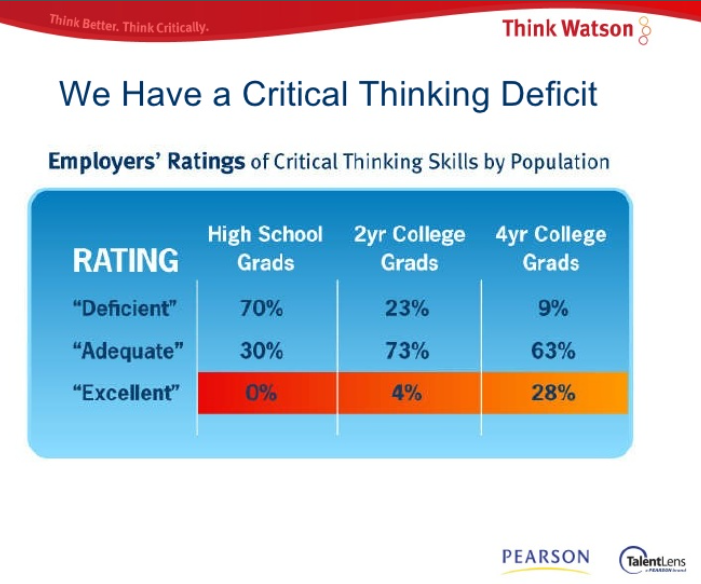
This morning, while reading on my phone (you know, that first day of the New Year’s Day where you vow to get a start on a resolution to read more scientific research about educational stuff), I saw more references to “critical thinking.” What the heck is that, I wondered? Everyone says it’s important but there are times I don’t know what they mean.
…even though research shows that critical thinking is typically listed among necessary outcomes at educational institutions, “it is not supported and taught systematically in daily instructions” because “teachers are not educated in critical thinking” (Source: Improve with Metacognition)
I love that quote above. It almost lets educators off the hook, right?
A Confession of Ignorance
When and where did I learn how to be a critical thinker, whatever the heck that means? And, is there a process or (fancy word alert) heuristic that makes critical thinking obvious to the ignorant (me)?
I’m not being too kind to myself. The truth is, I have learned a bit more about this.
NO OBVIOUS SOLUTIONS?
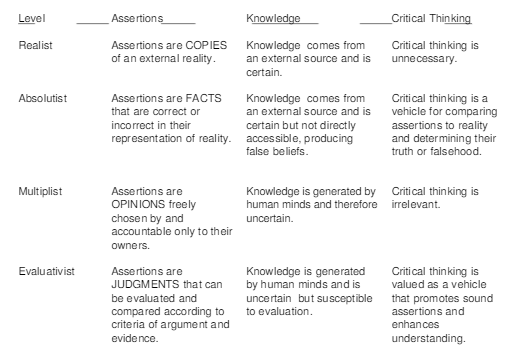
Heuristics, anyone?
- Formulate the question
- Gather information
- Apply the information
- Consider the implications
- Explore other points of view

This looked pretty straightforward to me, but now I realize, there’s a LOT more beneath the surface. I was running the rapids and giving no thought to the rocks and boulders hidden below the water’s surface.

Rapids, er, Fallacies Ahead
The Skeptic’s Guide to the Universe inoculates you against the frailties and shortcomings of human cognition. If this book does not become required reading for us all, we may well see modern civilization unravel before our eyes.”
—Neil deGrasse Tyson, Astrophysicist, American Museum of Natural History
Fallacies are mistaken beliefs based on unsound arguments. They derive from reasoning that is logically incorrect, thus undermining an argument’s validity.Fallacies are difficult to classify, due to their variety in application and structure. In the broadest sense possible, fallacies can be divided into two types: formal fallacies and informal fallacies (Source).
Exploring Critical Thinking
- STEP 1- IDENTIFY THE PROBLEM. Define the problem. Try to state it in a single declarative sentence. Then go through the pros and cons of the problem. Weigh the cost of not resolving it.
- STEP 2- ANALYZE THE PROBLEM. Look at it from different points of view. Is it real or perceived? Is it solvable? Can you solve it alone or do you need help? Be aware of bias or a narrow point of view that needs to be broadened.
- STEP 3- BRAINSTORM. Come up with several possible solutions. Brainstorm a list of several possible solutions. Do not reject any outright without further study. You never know when part of a solution that first seemed unlikely turns out to help the thinking go in a new direction.Write down anything that comes to mind. Then review the list before narrowing it down to the best options. In this way, you are more likely to get the best results.
- STEP 4- PICK THE BEST SOLUTION. Take some time to decide what will work best for the problem at hand. It is important to remember: What works in one situation, may not work in a similar one… in other words beware of always falling back on what’s worked in the past.
- STEP 5- IMPLEMENT THE SOLUTION. It’s important to understand that sometimes the solution may be to simply accept the situation. All problems that have been critically examined lead to personal growth opportunities.
Graphics
- Recognize assumptions: Assumptions are statements that are implied to be true in the absence of proof. Recognizing assumptions allows you to distinguish fact from opinion and sift out the relevance of the facts you are presented with. Identifying assumptions helps to discover information gaps, as well as enrich your view of issues. Once recognized, assumptions should also be examined through the eyes of different people (perspectives).
- Evaluate arguments: Arguments are defined as assertions that are intended to persuade someone to believe or act in a certain way. The ability to evaluate arguments is a key part of critical thinking. This ability consists of analyzing assertions objectively and accurately. There are patterns to “bad” arguments, and this part of the RED Model teaches you to recognize the tendency to look for and agree with information that confirms prior beliefs (known as a confirmation-bias). A key role in the evaluation of arguments is recognizing and separating out emotion, as high emotion clouds objectivity.
- Draw conclusions: This deals with arriving at conclusions that logically follow from the evidence available to you. People who possess this skill do not inappropriately generalize beyond the evidence. Furthermore, they will change their position when the evidence warrants doing so. They are often characterized as having “good judgment” because they typically arrive at a quality decision.

Discover more from Another Think Coming
Subscribe to get the latest posts sent to your email.
 Another Think Coming