Earlier this month, I took a stab at crafting a course on brain-based learning. I soon realized I was in over my head. The experience of being overwhelmed is not uncommon. A friend, designing a course on blended learning, found herself awash in all the information. Where to start, where to end, what to put in between?
One way that I tried to make sense of some of the information was to create a concept map out of it. It was surprisingly helpful. The map came about as a result of reading countless articles, and a few books on the subject. No doubt, it will take some time to but here are my notes from one book and some of the articles. I save it here so I can have ready access to it in the future and revisit some of my big takeaways.
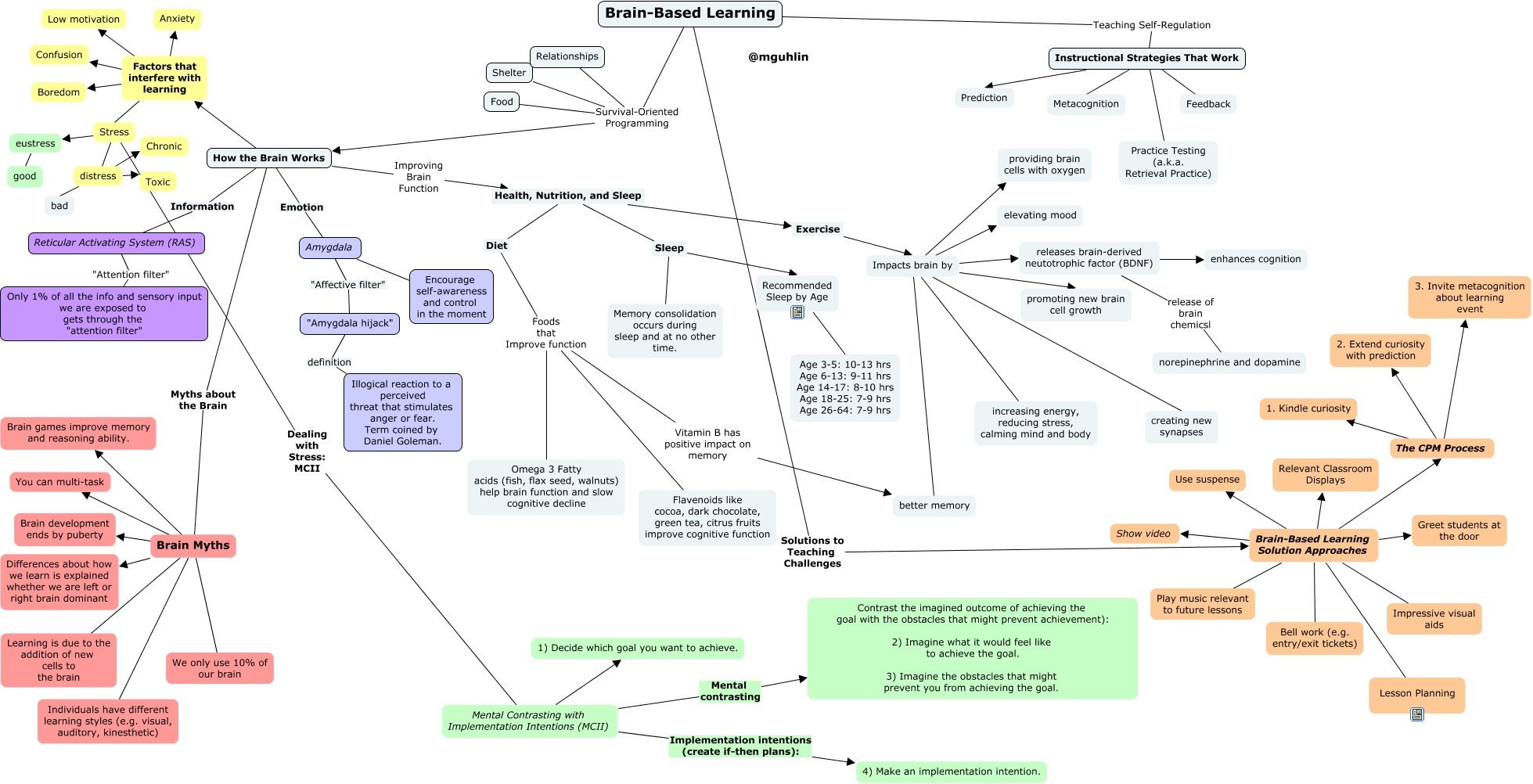
View CMAP full-size
A few key ideas jumped out at me. May I share them with you?
- There’s good stress and bad stress. One way to deal with bad stress is to use something called MCII. The MCII is an acronym for Mental Contrasting with Implementation Intentions. It’s a four step process you can use.
- Those that know me know I’ve been doing my best to eat Mediterranean, with an emphasis on fish at least two to three times a week. Imagine my surprise (ok, you probably already knew this) when discovering foods that improve brain function (and slow cognitive decline) include:
- Omega 3 Fatty acids (fish, flaxseed, walnuts)
- Vitamin B has positive impact on memory
Those were some quick takeaways, although there are more as you might guess from the CMAP above.
Everything posted on Miguel Guhlin’s blogs/wikis are his personal opinion and do not necessarily represent the views of his employer(s) or its clients. Read Full Disclosure
Discover more from Another Think Coming
Subscribe to get the latest posts sent to your email.
 Another Think Coming