As I mentioned in another blog entry, I had the opportunity to watch this webinar featuring Zaretta Hammond. Wow, what an amazing presenter and incredible insights with implications for diverse learners.
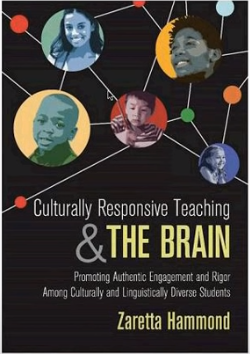 |
| Twitter: @ready4rigor | Get newsletter | Get book, Culturally Responsive Teaching and The Brain |
Here are my notes on the presentation. Any errors are my own. You can watch the presentation below:
MyNotes
- Equity is…
- Reducing the predictability of who succeeds and fails
- Interrupting reproductive practices that negatively impact struggling students of color, ELL, low income students
- Cultivating the unique gifts and talents of every student (Source: National Equity Project)
- Develop shared language about Culturally Responsive Pedagogy
- There are three terms in use now that need clarification. Those include:
- Multicultural education
- Social Justice Education
- Culturally Responsive Pedagogy
- Multicultural Education
- Focuses on celebrating diversity
- It is is centered around creating positive social interactions across differences
- ME concerns itself with exposing privileged stuents to diverse literature, multiple perspectives, and inclusion in the curriculum
- A part of its goal is to allow students of color to see themselves reflected
- Social Justice Education
- Focuses on exposing the social political context that education or student experience is situated in
- It is centered around raising student’s consciousness about inequity within the everyday social, environmental, economic and political aspects of life
- It concerns itself with creating lenses to recognize and interrupt inequitable patterns in society
- Culturally Responsive Pedagogy
- Focuses on improving the learning capacity of diverse students
- Centers around the cognitive aspects of teaching and learning
- Concerns itself with building resilience and academic mindset by pushing back on dominant narratives about people of color
- “Culturally Responsive Teaching provides the mechanisms to help students beome the leaders of their own learning” -Zaretta Hammond
- CRT builds student brainpower
- What is the connection between equity and instruction?
- “Inequitable outcomes happen because schools under-develop cognitive information processing skills of diverse students.”
- “The only way to create equity by design is to improve their information processing skills. How? Through powerful instruction that gets them ready for rigor.”
- Four Pillars of Ready for Rigor
- Information Processing (Start Here)
- Oral traditions
- Process new content
- Connect culturally relevant examples
- employ culturally relevant metaphors
- Teach cognitive routines and rely on formative assessments and feedback
-

Learning Partnerships
- Reduce social emotional stress, stress, micro-aggressions
- Build relationships
- Give care/push
- Awareness
- Be aware of how the brain learns, what the triggers (culture, race) are
- What are the three levels of culture (e.g. surface, shallow, deep)
- Cultural archetypes
- Community of Learners and Learning Environment
- Safe learning environment
- Give students voice and agency
- Communal talk and task structures
- Manage conflict and employ restorative justice
- Educators like to start with awareness. If you start there how do you make connections to instruction? Discussing privilege and bias is not doing culturally responsive work.
- Start with information processing. This becomes the WHY. Understand the role of culture and how we leverage students cultures.
- This is the shift from the way do things to equity work.
- “Children grow into the intellectual life around them.” -Lev Vygotsky
- Deeper learning has to embrace the affective and cognitive.
- Levels of student engagement
- Green: Engagement (High Attention and High Commitment)
- Blue: Strategic Compliance (High Attention, Low Commitment)
- Yellow: Ritual Compliance (Low Attention, Low Commitment)
- Orange: Retreatism (No attention, No Commitment)
- Red: Rebelion (Diverted attention, no commitment)
- Brain on Trust
- Sympathetic: Avoid this. Brain chemical: Cortisone
- Parasympathetic: Dopamine/seratonin
- Polyvagal: Connect. Oxytocin.
- Three levels of culture:
- Surface Culture: This area focuses on observable patterns and has low emotional impact on trust. As you might imagine, it’s based around “surface” stuff like clothes, literature, drama, food, art, etc. I can see that I haven’t read any books focused on this.
- Shallow Culture: “It’s shallow because it underlies the surface, not because it’s shallow” (That’s a paraphrase of what Zaretta said). This one has unspoken rules and high emotional impact on trust. I can definitely see that this area is where things to start to get serious. It’s focused on nonverbal communication, being honest, theories of wellness and disease, child rearing principles.
- Deep Culture: This area is described as “the collective unconscious” and includes beliefs and norms. You can guess that results in intense emotional impact on trust. Some of the characteristics include:
- Spirituality (concept of a higher power)
- Cosmology, or how the world began (origin stories, anyone?)
- Worldviews
- Notions of fairness
- Definitions of kinship and group identity
- Relationships to nature and animals
- Decision-making
- Individualism vs Collectivism
- Individualism is marked by:
- “Pull yourself up by your bootstraps”
- Focused on individual achievement
- Individual contributions and status are important
- Competitive
- Analytical
- Collectivism is defined by:
- “I am because we are” (isn’t that “ubuntu?”)
- Focused on interdependence and group success
- Group dynamics and harmony are important
- Collaborative
- Relational
- Students need both care and push from the teacher. The teacher uses the trust developed during the rapport stage as fuel. The result? Students give teachers permission to push them cognitively.
- Socio-Cognitive Norms:
- Errors are information, not confirmation of low intelligence
- The answers are important but not only the content counts. Pay attention to how you are processing the information to arrive at the answer.
- Use non-linguistic representations to think. Think with pictures, symbols, etc.
- Attention -> Elaboration (not to add more but to chew on it, to process) -> Consolidation
- Common Cultural Learning Tools
- Memory
- Puzzle & Patterns
- Perspectives
- Talk and Word Play
- Engagement that leads to deeper learning
- requires grappling, figuring out
- Is hands on and/or group oriented
- has to stretch the student
- Has to create “gentle disequilibrium” between what the student can do and what he can’t do
- Requires you to create challenge, puzzle, and ambiguity in order for the brain to grow, improve information processing, which equals engagement
- “If a students doesn’t see you as trustworthy, then no activities will get you in the door.”
- “What is that ONE thing that calms down students amygdala? This is uncontrollable to us…kids aren’t controlling their brain chemistry.”
- Question: If you focus on collectivism, do you disadvantage kids from individualism background?
Response: We all start out as collectivists. In the U.S. students who are white are individualistic. To be future ready, teamwork and collaboration are required. - There’s no shift to Culturally Responsive Teaching. All instruction is culturally responsive…it’s just to whose culture are you responding?
- Culture is not a code word for race and ethnicity. Individualism is a culture and schools are currently set up to accommodate folks coming from an individualistic culture. So, it’s being culturally responsive.
- This idea that there is normal teaching and culturally responsive teaching is participating in a mindset that this [CRT] is different or exotic. The idea that we will accommodate how students bring/leverage neural pathways…we are bringing balance into the classroom.
Everything posted on Miguel Guhlin’s blogs/wikis are his personal opinion and do not necessarily represent the views of his employer(s) or its clients. Read Full Disclosure
Discover more from Another Think Coming
Subscribe to get the latest posts sent to your email.
 Another Think Coming