 |
| Twitter: @ready4rigor | Get newsletter |
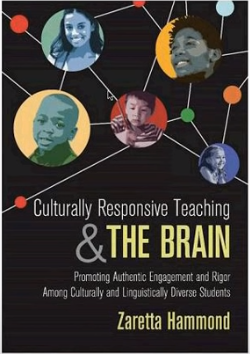
Want an introduction to Culturally Responsive Teaching, not to be confused with Critical Race Theory? You need to watch this 2017 webinar via Corwin. In anticipation of reading Zaretta hammond’s book, Culturally Responsive Teaching and The Brain, I decided to watch her webinar (twice, it was that good!).
I spent some time listening, and trying to write down every word (to help me remember better), to Zaretta Hammond’s (@ready4rigor) Corwin video recording from 2017. It seriously blew my mind. I found these points to commend it:
- Clear and concise
- Clarified vocabulary right from the start
- Made connection to John Hattie’s work
There’s so much amazing content and ideas, with implications for what happens in our schools. She said so much that was incredible.


 Zaretta asserts that all humans start out as “collectivist…” white students are predominantly individualistic, so they are at a disadvantage for future ready principles of teamwork, collaboration (which collectivism represents). Students of color have to negotiate both collectivist and individualistic skills. Wow.
One of the biggest points came in her response to a question at about 51 minutes, 48 seconds in. Her response was (my apologies for the accuracy, since I was taking notes):
There’s not a shift to Culturally Responsive Teaching. All instruction is culturally responsive…it’s just to whose culture are you responding?Culture is not a code word for race and ethnicity. Individualism is a culture and schools are currently set up to accommodate folks coming from an individualistic culture. So it’s being culturally responsive.This idea that there is normal teaching and culturally responsive teaching participating in a mindset that this is different or exotic. The idea that we will accommodate how students bring neural pathways…we are bringing balance into the classroom.
Those are some big ideas there, don’t you agree?
My Quick Takeaways
As I read her response to the question, I realized immediately that I have to adjust my own thinking about “culturally responsive teaching” or “culturally responsive pedagogy.” Those are that:
- Culture is NOT a code word for race and ethnicity.
- Schools reflect the dominant culture where they are situated, so the needs of children from other places that are more “collective” are not being met. Instead, they have to conform.
- We have to leverage the human brain’s cultural disposition (e.g. individualism vs collectivism) that children are most familiar with to assist them in their success.
The Tree
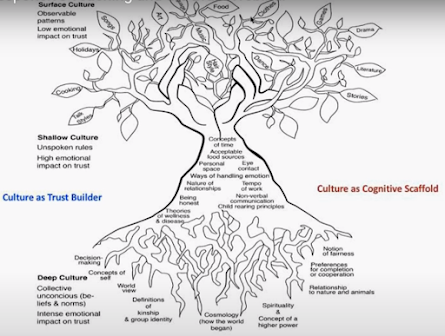
One of the most stunning visuals in her presentation was the tree shown below:
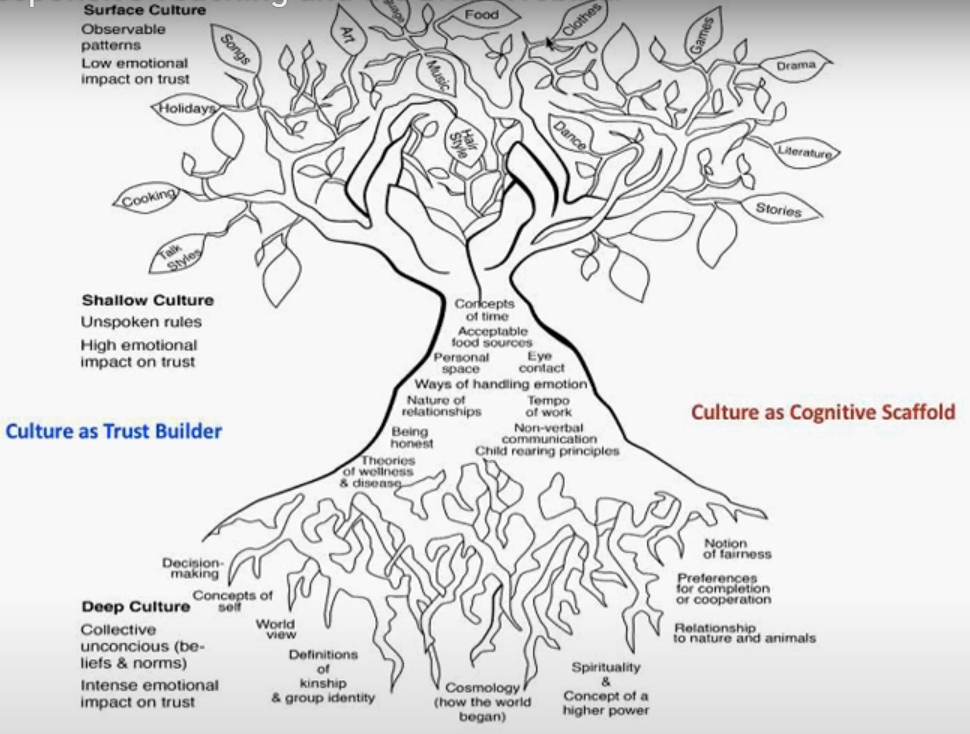
Oh, wow. I found myself immediately cataloging my reading list over the last few weeks, trying to figure out where I was spending a lot of time on. I found myself organizing some of my latest books read under three different areas. The areas range in their level of observability and impact on trust.
As you might guess, trust is critical to building rapport. Without that trust-based relationship, learning simply doesn’t happen. Zaretta reminded everyone of the Reticular Activating System (RAS) and how if students don’t feel safe, an amygdala hijack might occur. You can see it described in a portion of this Brain-Based Learning mind map I made a short time ago:
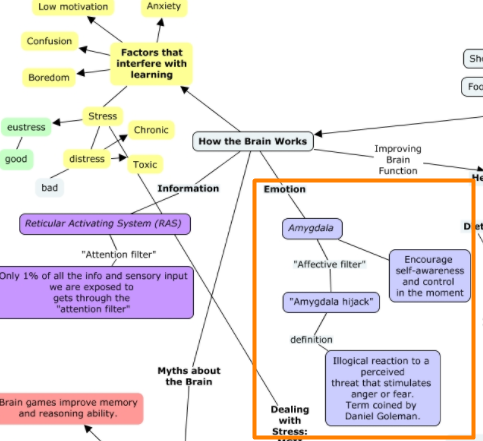
Amygdala hijacks (see orange square in diagram above) aren’t good because it’s an illogical reaction to a perceived threat that stimulates anger or fear. I’ve had my share of those, and the outcome is seldom positive.
Area #1: Surface Culture
This area focuses on observable patterns and has low emotional impact on trust. As you might imagine, it’s based around “surface” stuff like clothes, literature, drama, food, art, etc. I can see that I haven’t read any books focused on this.
Area #2: Shallow Culture
“It’s shallow because it underlies the surface, not because it’s shallow” (That’s a paraphrase of what Zaretta said). This one has unspoken rules and high emotional impact on trust. I can definitely see that this area is where things to start to get serious. It’s focused on nonverbal communication, being honest, theories of wellness and disease, child rearing principles.
Again, it’s been a long time since I’ve look at either surface or shallow culture…which makes me think I’ve just been on autopilot, absorbing changes on the go without serious re-evaluation.
Area #3: Deep Culture
This area is described as “the collective unconscious” and includes beliefs and norms. You can guess that results in intense emotional impact on trust. Some of the characteristics include:
- Spirituality (concept of a higher power)
- Cosmology, or how the world began (origin stories, anyone?)
- Worldviews
- Notions of fairness
- Definitions of kinship and group identity
- Relationships to nature and animals
- Decision-making
Just looking at that list, and I can imagine that if anyone tampers with deep culture, they are bound to trigger fear and anger (the amygdala hijack, right?). That certainly explains my being disturbed reading these books, such as Good Without God, Cassandra Speaks, and Lies My Teacher Told Me. Each addresses a deep culture topic.
“Stories set in store which values and temperments should prevail, what power looks like, and who gets to have it.” – Elizabeth Lesser, Cassandra Speaks
For example, Good Without God hits on spirituality and cosmology. Cassandra Speaks hits on spirituality, cosmology, worldview, notions of fairness. And Lies My Teacher Told Me on all of it or the failure of schooling to address them. Sheesh.
That said, I really appreciate Zaretta’s explanation here. It helps organize and explain my own meanderings and turmoil when reading the books. After all, as Elizabeth Lesser quotes Brene Brown:
“Clear is kind, unclear is unkind.”
I can’t wait to read Hammond’s book to get more clarity. In the meantime, this was interesting as well. The dichotomy of individualism and collectivism.
Individualism vs Collectivism or Finding a Balance
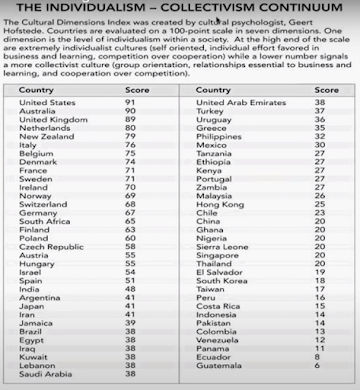
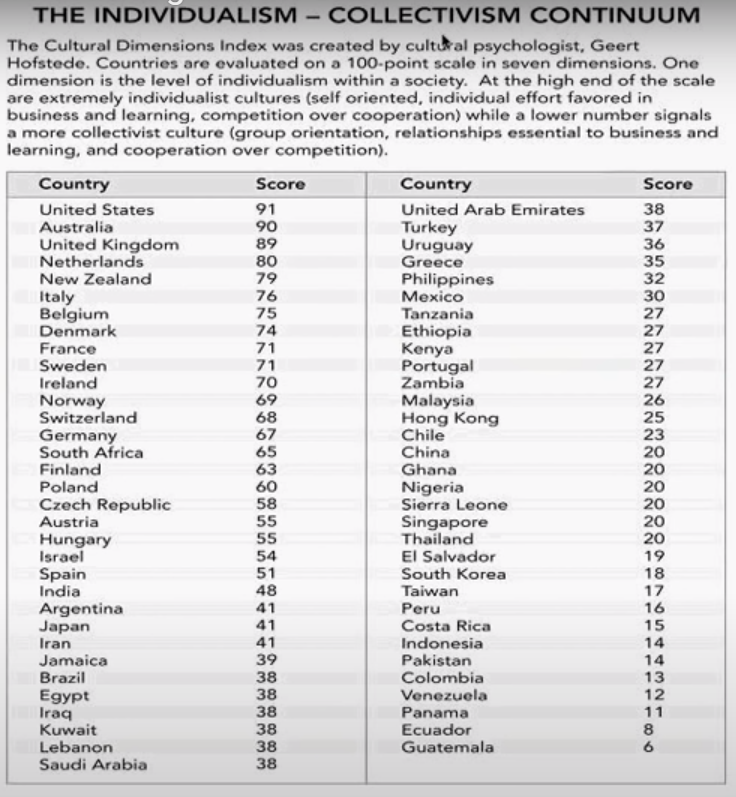
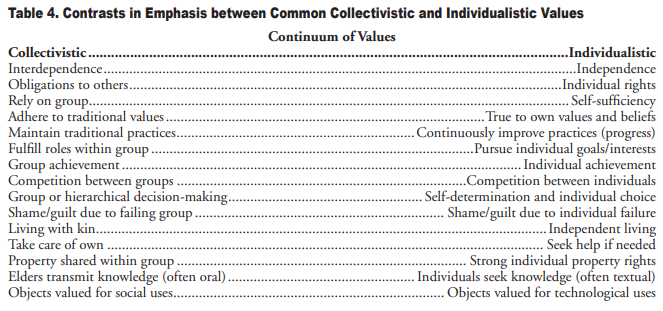
Here are two diagrams shared in the webinar that address the dichotomy.

My thoughts? I found this dichotomy fascinating because I am a product of two parents, one from the United States (individualist) and another from Panama (collectivist). The Individualism vs Collectivism Continuum (get PDF version of the chart) is a scale that shows the level of individualism in society. You can see the difference between the United States (91) and Panama (11). Wow, what a big gap between my two countries of origin. I can easily see which culture predominates in my life.
 Zaretta asserts that all humans start out as “collectivist…” white students are predominantly individualistic, so they are at a disadvantage for future ready principles of teamwork, collaboration (which collectivism represents). Students of color have to negotiate both collectivist and individualistic skills. Wow.
What’s also interesting is that in Elizabeth Lesser’s book, Cassandra Speaks, this dichotomy is represented in masculine and feminine. Masculine qualities are focused on individualism, while feminine qualities reflect a “communal” or collective approach.
Elizabeth Lesser describes this as doing power differently. That is, using a partnership model, interactive (not authoritarian), collaborative and connective, values, relationships, empathy, communication, and inclusivity.
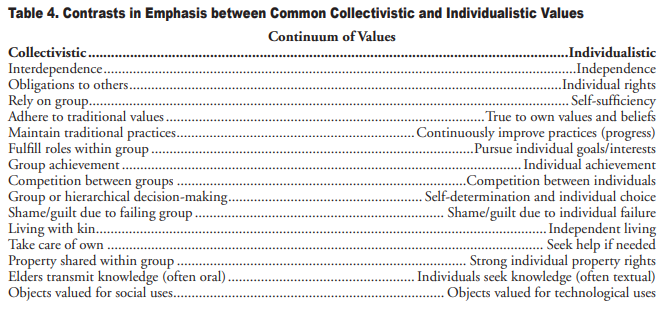
When I consider my reading of Dr. James Loewen’s Lies My Teacher Told Me, I can see how European power has had a profound influence on “how power is done.” You may find this document, Essential Tools: Improving Secondary Education and Transition for Youth with Disabilities helpful reading, especially starting at page 23. I found this chart of interest as well:
I found Zaretta Hammond’s presentation fantastic. I’ve only shared a few thoughts in this blog entry. I’m saving the rest, along with MyNotes version, for later this week.
Everything posted on Miguel Guhlin’s blogs/wikis are his personal opinion and do not necessarily represent the views of his employer(s) or its clients. Read Full Disclosure
Discover more from Another Think Coming
Subscribe to get the latest posts sent to your email.
 Another Think Coming