MyNotes
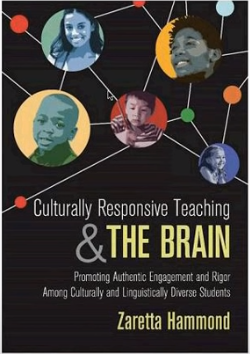
Foreword and Chapter 1 Notes
- Why are so many students of color underachieving? The most prevalent reason is…a lack of belief in the innate intellectual potential of those students. [From whence does this lack of belief come? is a question that pops into my head. I’ll drop questions remarks in square brackets]
- If all students are wired for expansive learning and self-determination, what is needed to activate that wiring for optimal connectivity for students of color?
- The answer is “Mediating learning through culturally responsive teaching.”
- When the brain encounters information, especially during the act of reading and learning, it’s searching for and making connections to what is personally meaningful and relevant.
- What is relevant and meaningful to an individual is based on his or her cultural frame of reference.
- Without the perspective, interests, attention grabbing and support in understanding, students can’t engage in “high intellectual processing activities.” Those activities include:
- conceptualizing
- reasoning
- theorizing
- Cultural relevance is the key to enabling the cognitive processing necessary for learning and imperative for engaging and unleashing intellectual potential for students of color.
- Neuroscience says it is the catalyst that activates the wiring for neural connectivity to be optimized for learning.
- There’s been “so much reform and so little change” –Charles Payne
- Building brain power is the missing link to closing the achievement gap for underperforming culturally, and linguistically diverse students.
- Cognition and higher-order thinking have always been at the center of culturally responsive teaching.
- Language is powerful. When you are able to name a thing, it moves out of the realm of mystery into concreteness.
- Think of CRT as a mindset
- “Education either functions as an instrument which is used to facilitate integration of the younger generation into the logic of the present system and bring about conformity [boo,hiss] OR it becomes the practice of freedom, the means by which men and women deal critically and creatively with reality and discover how to participate in the transformation of their world.” –Paulo Freire, Pedagogy of the Oppressed [Amen!]
- Classroom studies document that undeserved English learners, poor students, and students of color routinely receive less instruction in higher order skills development than other students.
- Instruction focuses on skills low on Bloom’s Taxonomy. This denies students the opportunity to engage in productive struggle. This productive struggle actually grows our brainpower.
- On his own, dependent learners are not able to do complex, school oriented learning tasks such as synthesizing and analyzing informational text without continuous support.
- “Read by Third Grade” Campaigns:
- Children are learning to read up to 3rd grade
- After 3rd grade they shift to reading to learn
- These campaigns serve as a metaphor for cognition.
- In the early grades, children learn habits of mind and build cognitive processing and structures. They do this so they can engage in complex thinking and independent learning.
- For dependent learners, cognitive growth is stunted.
- Many students of color are pushed out of school because they can’t keep up in class.
- Distinguishing between Dependent and Independent Learners [author has a nice chart, these are some short notes with word differences…read the book to get the exact version]
- Students with increased brainpower can accelerate their own learning, meaning they know how to learn new content and improve weak skills on their own.
- Dependent learners must develop:
- new cognitive skills
- habits of mind
- Dependent Learners
- Depend on teacher to carry cognitive load
- Unsure of how to attempt a new task
- Require supports/scaffolds for new tasks
- Passive if stuck
- Doesn’t retain information or doesn’t get it
- Independent Learners
- Rely for a short time on teacher to carry cognitive load before taking it on themselves
- Use strategies or processes when attempting a new task
- Attempt new tasks without scaffolds or supports
- Know cognitive strategies
- Have learned how to retrieve information from long-term memory
- “Pedagogy of Poverty”
- Coined by Martin Haberman
- Students leave high school with outdated skills and shallow knowledge. They cannot think critically and/or creatively
- Based on labels like “disadvantaged,” educators:
- underestimate students as intellectually capable of challenging work
- postpone motivating/interesting work until they master the basics
- deprive students of meaningful or motivating context for learning and practicing higher-order thinking skills and processes
A quick aside from Miguel:
A quick note about that “disadvantaged” label and what educators do as a result. As a third grade bilingual teacher in an East Texas school district (Mt. Pleasant ISD), I saw this firsthand. I still remember when I encountered it.
The paraeducator (white, if that is relevant) insisted that my students engage in drill-n-practice use of technology in the lab. I can still see her face as she explained this to me.
Having learned under the tutelage of my mentor, Mark Gabehart in Edgewood ISD all about HOTS, I knew that this wasn’t a good strategy. So, I took over computer lab activities for my students, focusing on HOTS activities. In time, HOTS activities became the rule for the computer lab, as success became evident.After the paraeducator saw the students succeed, she changed her tune and became supportive/positive. Of course, I wasn’t right about everything. At the time, I was not a phonics proponent due to some of the ideas my professors shared in my graduate degree studies (Master’s in BBL with ESL concentration), so I overruled her on that. I wish I had not.
So we were both right and wrong. Darn that phonics research. 🙂
What this does mean, though, is that this happens with students of color. I know it also was happening to differing degrees across the district with Black students. It is what led to Mt. Pleasant ISD’s investment in technology and staff (I was one of them) to make big changes. Kudos to the leadership then.
Ok, continuing…
- Definition of Culturally Responsive Teaching (CRT)
- An educator’s ability to:
- recognize students’ cultural displays of learning and meaning making
- respond positively to displays of learning
- use approaches that rely on cultural knowledge
- scaffold and connect students’ prior knowledge to new concepts and content
- promote effective information processing
- understand the power of relationships and SEL in creating a safe learning space
- CRT can strengthen student connectedness with school and enhance learning
- CRT is a pedagogical approach that is…
- rooted in learning theory and cognitive science
- helps students build intellective (a.k.a. “fluid”) capacity
- Intellective capacity is the increased power the brain creates to process complex info effectively
Miguel: You know, I was a bit surprised to see this idea of intellective capacity. I am looking forward to understanding how it works. I always imagined the brain had power, that we all had the same, and that it merely required learning new processes or ways to interact with information (a la information problem-solving) to gain the benefits.
Having read Willis and Willis’ Research-Based Strategies to Ignite Student Learning, I had a little understanding of the brain. I need to learn more, though. Looking forward to the exploration of the ideas here.
Ready for Rigor
- 1-Awareness
- Every CRT teacher develops a sociopolitical, consciousness, an understanding that we live in a racialized society that gives unearned privilege to some while others experienced unearned disadvantage because of race, gender, class, or race. (read my reflection about this in another blog entry)
- In addition, CRT teachers are
- Aware of the role schools play in perpetuating/maintaining this system of advantages for some, disadvantages for others
- Impact of their own cultural lens on interpreting and evaluating students individual/collective behavior that might lead to low expectations or under valuing the knowledge and skills they bring to school [ouch]
- 2-Learning Partnerships
- Building trust with students across differences so that the teacher is able to create a social-emotional partnership for deeper learning
- Establish authentic connections with students that build mutual trust and respect
- Leverage the trust bond to higher expectations
- Give feedback in emotionally intelligent ways
- Hold students to high standards
- 3-Information Processing
- How to strengthen students’ intellective capacity so that they can engage in deeper, more complex learning.
- The CRT teacher assists students in processing what they are learning. They do this by:
- mediating student learning (based on what they know about how the brain learns and students’ cultural models)
- Outlining processess, strategies, tactics, tools for engaging students in high-leverage social and instructional activities that over time build HOTS
- Teachers learn how to:
- understand how culture impacts the brain’s information processing
- orchestrate learning so it builds students’ brain power in culturally congruent ways
- Use brain-based info processing strategies common to oral cultures
- 4-Community Building
- Create an environment that feels socially and intellectually safe for dependent learners to stretch themselves and take risks
- The physical setup of our classroom is an extension of the teachers’s worldview or the dominant culture. [Emphasis mine. Wow, gobsmacked]
- Teachers need to:
- integrate universal cultural elements and themes into the classroom
- use cultural practices to create a socially/intellectually safe space
- set up rituals and routines that reinforce self-directed learning and academic identity.
- Students need to develop the cognitive skills and processes that help them become independent learners.
- Culturally responsive teaching is a powerful tool to help dependent learners develop the cognitive skills for higher order thinking
Reflections
Information processing also makes me think of the Big 6 Information Problem-Solving Process, not to mention critical thinking.
The Awareness portion ticks me off. It reminds me of how little I learned in school that was true, accurate, and I suspect that some teachers won’t be signing on if they have to understand that…
“…we live in a racialized society that gives unearned privilege to some while others experienced unearned disadvantage because of race, gender, class, or race.”
Of course, the first step in any change is acknowledging you have a problem. After all, you can’t get salvation if you don’t first see that you’re a sinner, right? Isn’t that how it goes? Admit, believe, commit?

🙂
Discover more from Another Think Coming
Subscribe to get the latest posts sent to your email.
 Another Think Coming