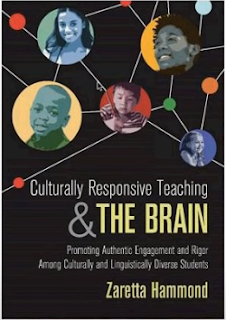
In a powerful book, Zaretta Hammond (@ready4rigor) connects Culturally Responsive Teaching and the Brain and answers longstanding questions. You may recall I took some notes on her Corwin webinar from 2017, and it was quite powerful. I’m working my way through it slowly, since I’m still reading Lies My Teacher Told Me (small doses of truth that shock is what I’ve had to resort to even though I typically gulp these books down). So apologies for more reflective MyNotes.
Looking Back: A Reflection
Powerful for me because it clarified my own confusion about the following terms: multicultural education, social justice education, and culturally responsive teaching. As I wanted to learn more about this topic, knowing what in my own experience and memory fell into what category, I found her explication calming. As I’ve begun the book, I’m able to make connections to my own work as a bilingual/ESL educator thirty years ago when I started in education.
As you may imagine, although the bulk of my teaching experience involved bilingual/ESL students, that is students of color from Latinx countries like the one I grew up in (Panama, in case you missed the previous blog post), I gave little thought to teaching with culture in mind or brain-based research. I don’t remember it coming up in my own teacher preparation courses. That said, I saw my work with them as a way to bridge their journey from ignorance to knowledge, a way to support students as they grew intellectually, academically. Now, I see it was a way to indoctrinate them in the dominant culture, perhaps at a loss of their own.
In some ways, seeing myself as a bridge from a students’ home country to America was a profound act of culturally insensitivity, even though I remember each of my students with profound fondness. I can go on about it, but I won’t hold myself responsible for things I had no clue about except my own privileged experience as a boy from Panama being introduced to the wealth and power of America and reaping its benefits, attending Catholic Private school from K-12, then having the option of undergraduate and graduate studies.
What You Accept as a Culturally Responsive Teacher
Discussing CRT is a dangerous subject, as
one school administrator in Texas discovered. It’s easy to mix the acronym, CRT, up. There are two ways to interpret it and they are “distinct” from one another:
- Critical Race Theory: According to the Britannica website, the definition is as follows:
- critical race theory (CRT), intellectual and social movement and loosely organized framework of legal analysis based on the premise that race is not a natural, biologically grounded feature of physically distinct subgroups of human beings but a socially constructed (culturally invented) category that is used to oppress and exploit people of colour.
Critical race theorists hold that racism is inherent in the law and legal institutions of the United States insofar as they function to create and maintain social, economic, and political inequalities between whites and nonwhites, especially African Americans.
- Culturally Responsive Teaching or Pedagogy: According to Understood.org, the definition is:
- Culturally responsive teaching (CRT) is a research-based approach to teaching. It connects students’ cultures, languages, and life experiences with what they learn in school. These connections help students access rigorous curriculum and develop higher-level academic skills.
These ideas appear distinct, separate from each other, right? While reading Zaretta Hammond’s book, I found myself highlighting this text in particular. It appears in the context of her discussion of the four pillars (Awareness) of the Ready for Rigor:
Every Culturally Responsive Teacher develops a sociopolitical consciousness, an understanding that we live in a racialized society that gives unearned privilege to some while others experience unearned disadvantage because of race, gender, class, or language.
As Zaretta points out in her 2017 webinar, Social Justice Education that focuses on righting sociopolitical aspects is different than Culturally Responsive Teaching. This is a head-scratcher for me and prompts the question:
What happens when “privileged” teachers do NOT develop an understanding, or choose to NOT agree on the foundations essential to this understanding? They might assert:
Americans do not live in a racialized society. Americans do not give unearned privilege to some while disadvantaging others. This flies in the face of American individuality and the ability to triumph in spite of naturally occurring obstacles. And, everyone knows that Americans do not discriminate as a result of race, gender, class, or language.
This single understanding of unevenly distributed privilege by corrupt powers is a key tenet of Ready for Rigor’s Awareness pillar. It is sociopolitical. It is evidence of Critical Race Theory. Book burning at midnight.
Please, make no mistake. After reading Clint Smith’s
How the Word is Passed, Dr. James Loewen’s
Lies My Teacher Told Me, living my life of privilege, blind to so much and in the process of washing the scales from my own eyes, I agree that critical race theory is accurate. How accurate is yet to be seen, but no doubt, others have taken its measure already. Thankfully, they did not wait on me to illuminate my ignorance.
Oh, you saw how that worked out for those in power. I have no sympathies for them, but implementing CRT in schools will be no cakewalk. Oh wait, that’s a problematic term to use given the historical connection to slavery in the United States:
The cakewalk or cake walk was a dance developed from the “prize walks” (dance contests with a cake awarded as the prize) held in the mid-19th century, generally at get-togethers on Black slave plantations before and after emancipation in the Southern United States. (source). Another source for your consideration: National Public Radio.
I wonder if
BandLab knows about this. That word is now forever struck from my vocabulary usage. Good riddance.
Everything posted on Miguel Guhlin’s blogs/wikis are his personal opinion and do not necessarily represent the views of his employer(s) or its clients.
Read Full Disclosure
Discover more from Another Think Coming
Subscribe to get the latest posts sent to your email.
 Another Think Coming