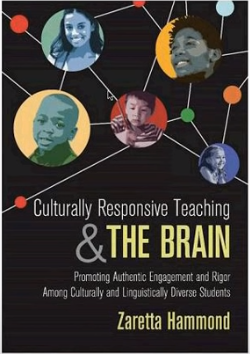
This continues my exploration of Zaretta Hammond’s Culturally Responsive Teaching and the Brain. You can read all preview entries in reverse chronological order. My goal is to capture those points, quotes that I have written down in my paper notebook so as not to lose access to them. I may also interject my own thoughts, so these notes should not be considered to be a perfect rendition of quotes appearing in Zaretta’s eye-opening text.
MyNotes – Chapters 2 and 3
- “Preservation of one’s own culture does not require contempt or disrespect for other cultures.” – Cesar Chavez
- Teachers need adequate background knowledge and usable info in order to know how to apply culturally responsive tools and strategies.
- Culture is the way that every brain makes sense of the world. The brain uses cultural information to turn everyday language into meaningful events (a.k.a. schema).
- If we want to help dependent learners do more HOTS, then we have to access their brains cognitive structures to deliver culturally responsive instruction.
- Culture works on three levels:
- Surface: Low emotional charge; observable, concrete. Examples: food, dress, music, holidays
- Shallow: Unspoken rules around social interactions and norms. Examples: courtesy, attitudes towards elders, nature of friendship, time, personal space, nonverbal communications, eye contact, appropriate touching
- Deep: Tacit knowledge, unconscious assumptions. View of good or bad that guides the mental models, interpret threats and rewards. Schema
- Schema represent the pieces of inert information we’ve taken in, interpreted, and categorized. It is a set of conceptual scripts that guide our comprehension of the world [as Frank Smith described it in Understanding Reading, our schema is our “shield against bewilderment,” our theory of how the world works…what a joy to re-encounter this in Culturally Responsive Teaching and the Brain].
- Cultural Archetypes are at the roots of culture. They include our worldview, core beliefs, and group values.
- Two fundamental archetypes exist, including collectivism (80% of the world) and individualism (20% of the world).
- Collectivism is a communal view of the world focused on enhancing survival and is observed in various countries/continents, such as Latin America, Asia, Africa, Slavic and Middle Eastern. Collectivistic societies emphasize relationships, interdependence within a community, cooperative learning.
- Individualism is composed of mostly European countries.
- Individualism is distinguished by:
- Focus on independence and individual achievement
- Emphasizes self-reliance and the belief that one is supposed to take care of himself to get ahead
- Learning happens through individual study/reading
- Individual contributions and status are important
- Competitive
- Technical/analytical
- Collectivism
- Focus is on interdependence and group success
- Emphasizes reliance on the collective wisdom or resources of the group and the belief that group members take care of each other to get ahead
- Learning happens through group interaction and dialogue
- Group dynamics and harmony are important
- Collaborative
- Relational

A quick aside here: While reading another book, C.F. Black’s The Land is the Source of the Law: A Dialogic Encounter with Indigenous Jurisprudence, I was struck by a few points. Black’s book was focused on Australian indigenous people. It’s worth mentioning how Black documents a collectivist vs individualistic approach, a fight that has played out in Australia among many other locations. Some key quotes from Black’s book that support Hammond’s work include:
- “What’s more important, the spider or the web? The web, of course.” [You can see the focus on the community (the web) or group over the individual (or the spider)]
- “When the people have heard all the relevant information in a language they understand, initiated a response or intervention that fits their cultural ways, and then physically brought into being what they have decided upon, the problem seems to fade and almost disappear.” [I love this idea of aligning responses or interventions to cultural ways…it is different from the radical individualism approach, which is focused on what works at all costs, forget the consequences to the group. Of course, any problem-solution combination must be balanced with the two approaches to work].
- When the sacred is revealed, the imagination is infused with creative power–Living Culture–but when life is devoid of ritual, the connection with one’s soul is lost and life begins to lose its meaning.
- When the soul is neglected, humanity loses its spiritual sensibility and is alienated from creation and thus from the self.
- The secularisation of life is one of the most effective forms of repression (De Ishtar, 2005 as cited by Black)
- “It is the role of the leader to persuade individuals to pool their self-power for the collective good” -Taiaiki Alfred (1995) as cited by Black
Ok, back to Hammond’s book. But I hope you see the connections here. There is a definite predisposition to communal, collectivist in indigenous cultures, one that was stamped out, crushed by European powers. I find it interesting that books like S.M. Stirling’s Islands in the Sea of Time explore (briefly) what might have happened if European approach hadn’t been so pervasive. Unfortunately, fiction is the only way to imagine a world based on a collectivist, communal approach to life. A quick inventory of my own culture reveals I am firmly in the individualistic culture, which could be seen as problematic if I wasn’t trying to be objective and nonjudgmental. 😉
- There is a Cultural mismatch in America. It is between typical American culture and communal culture. The former is focused on individual personal achievement and recognition. The latter emphasizes being in a positive relationship with others as a foundation for business, learning, and social interaction.
- You can see the score assigned from an extensive study that Hammond cites shows the differences. The higher the score, the more individualistic your culture/country. [Is there a correlation between your score and conquest of the indigenous peoples and spaces they held sacred, if this assessment could have been done at that time? I suspect there would be.]
- U.S. – 91
- Australia – 90
- United Kingdom – 89
- Netherlands – 80
- France – 71
- Sweden – 71
- Spain – 51
- Mexico – 30
- Portugal – 27
- Panama – 11
- Guatemala – 6
- Oral and Written Traditions
- By telling stories and coding knowledge into songs, chats, proverbs, and poetry, groups with a strong oral tradition record and sustain their cultures and cultural identities by word of mouth.
- The oral tradition connects the speaker and listener in a communal experience.
- Oral tradition relies on alliteration, movement, emotion as strong cognitive anchors
- Socio-political context refers to a series of mutually reinforcing policies. These policies/practices are social, economic and political.
- Together, they contribute to disparities and unequal opportunities for people of color (housing, transportation, education, health care) resulting in unequal outcomes along racial and class lines.
- Two key components of socio-political context:
- Implicit racial bias: Unconscious attitudes/stereotypes that shape our responses to certain groups. It is based on the dominant culture’s messages/memes over a lifetime. Implicit bias seems so “normal” that bias messages often go unchecked within larger society. [Wow, this makes those gut reactions you have that align to everything you grew up believing subject to amygdala hijack, right? Normal is wrong, no matter how firmly entrenched you are in its grip]
- Structural racialization: It is the idea that a series of benign or well-intended policies create a negative, cumulative and reinforcing effect that supports the status quo within institutions. Many factors interact to create and perpetuate social, economic, and political structures that are harmful to people of color and to our society as a whole. It is connected to where one lives and how location and geography affect one’s access to education and job opportunities.
- We have to move beyond one-dimensional, linear explanations of inequity in society and education.
- This leads to a domino effect that results in unearned disadvantages that obscure the real source of the inequity.
- In education, we subject our neediest dependent learners to inadequate instruction given their needs.
- Intellectual apartheid: Dependent learners who cannot access the curriculum and independent learners who have had the opportunity to build the cognitive skills to do deep learning on their own.
- Implicit bias reinforces the notion that people of color willingly live in poverty or are unmotivated to change their circumstances [This is the Republican, pull yourself up by your bootstraps and succeed in spite of the obstacles, escape the culture of poverty stuff I grew up hearing, was indoctrinated in, and held until I realized it was bunk…about the time I started working with inner city, disadvantaged, dependent learners…I rejected it without full understanding]
- Implicit bias reinforces the notion that people of color willingly live in poverty or are unmotivated to change their circumstances. [Wow, I typed it twice]
- Poverty is not a culture
- Coping skills are mistaken for norms and beliefs.
- Poor people do not normalize or glorify negative aspects of living in poverty.
- Culture of poverty and culturally responsive teaching are incompatible because the former promotes deficit thinking.
- At its core, culture of poverty says poor people are responsible for their lot in life because of individual/collective deficiencies. It does not acknowledge the impact of institutionalized racism, structural racialism, skin color privilege, or language discrimination.
Chapter 3
- When we don’t practice or use new dendrites shortly after a learning episode, our brain prunes them by storing and reabsorbing them. [The other three authors I mentioned also deal with this…sort of like wearing a path between old and new ideas. If you don’t revisit new ideas with frequency, your brain dumps it. Makes you appreciate instructional strategies like Spaced vs Massed Practice, retrieval practice (a.k.a. practice testing), and Rehearsal. They are all geared to move short-term memories and new info into long-term storage retrieval).
- Microaggressions are subtle everyday verbal and nonverbal slights, snubs, or insults which communicate hostile, derogatory or negative messages to people of color based solely on their marginalized group membership.
- Brain Rules
- The brain seeks to minimize social threats and maximize opportunities to connect with others in community.
- Positive relationships keep our safety-threat detection system in check.
- Culture guides how we process information. Neural pathways are primed to learn using story, art, movement, and music.
- Attention drives learning.
- All new information must be coupled with existing funds of knowledge in order to be learned. All learners have to connect new content to what they already know. What we already know is organized according to our cultural experiences, values, and concepts.
- We have to determine what students already know and understand, how they have organized it in their schema.
- The brain physically grows through challenge and stretch, expanding its ability to do more complex thinking and learning.
Discover more from Another Think Coming
Subscribe to get the latest posts sent to your email.
 Another Think Coming