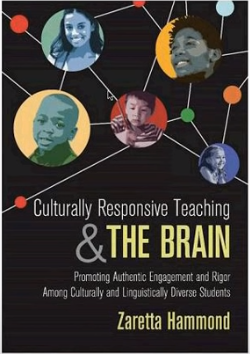
As I continue my exploration of Culturally Responsive Teaching and the Brain, an amazing 2017 book by Zaretta Hammond, I’m continuing to also dig into my own experience (or lack of it) with my Panamanian roots. You may have seen that interspersed with these blog entries on Hammond’s book, I’m also coming to terms with my own experiences.
Admit Your Sin, First
As I work my way through B.N. Rundell’s fictional mountain man 14-book series, Rocky Mountain Saint, I have to stop every few chapters. Amidst surviving as a mountain man in early America, the formula for converting someone to Christianity finds its way into each book in the series. When I got the massive digital volume, I didn’t realize that every one of the 14 books would have a spiritual exhortation that seemed out of place in the early West.
Then if you want to be saved, you must admit in your own heart, “I am a sinner. I am lost and need to be saved.” No one ever was saved without coming for salvation as a sinner. Source: Wholesome Words
Any Christian who has been preached at, asked to accept the Christ as their personal Savior, has had the experience of being forced to first acknowledge they are a sinner. In some ways, I see Culturally Responsive Teaching as doing the same thing. Simply, you have to admit that America’s education system, financial system, the very fabric of America, is privileged towards Europeans and descendants of Europeans. People of color, including Black, Native Americans, and those who present in ways that are not European looking, are discriminated against. If you don’t accept this single tenet of culturally responsive pedagogy/teaching, critical race theory, then you really are missing the whole story.
That’s why reading Chapter 4 of Zaretta Hammond’s book is such a powerful, almost liberating, experience. You begin to take inventory of what you “know,” understand, and it can be a bit of a shock. It really is almost like a Christian accepting their sinful state. In this case, people are asked to accept that they have implicit racial bias, that there IS a dominant culture. And, coming to grips with that won’t be easy. I imagine it as a evil, soul sucking presence that has worked its way into every aspect of what many believe to be right.
It is for this reason that there has been such a violent reaction to understanding the brutality of European conquest of peoples of color. As Hammond points out, “Implicit bias seems so ‘normal,’ that bias messages often go unchecked within larger society.”
My Notes for Chapter 4
- “The real voyage of discovery consists not in seeking new landscapes, but in having new eyes.” -Marcel Proust
- “When I dare to be powerful–to use my strength in the service of my vision, it becomes less and less important whether I am afraid.” -Audre Lord, African American Poet
- Culturally responsive teaching isn’t a set of engagement strategies you use on students. . .it is a mindset, a way of looking at the world.
- Engaging in reflection helps culturally responsive teachers recognize the beliefs, behaviors, and practices that get in the way of their ability to respond constructively and positively to students.
- We each must do the “inside-out” work, which includes…“developing the right mindset, engaging in self-reflection, checking our implicit biases, practicing social emotional awareness, and holding an inquiry stance regarding the impact of our interactions on students.”
- Paul Laurence Dunbar’s poem, We Wear the Mask
- Whatever the implicit biases you may have, manage them internally and don’t allow them to direct how you respond to students (paraphrased).
- Before you can leverage diversity as an asset in the classroom, you must reflect on the challenges that can interfere with open acceptance of students who are different from you in background, race, class, language, or gender.
- The lizard brain (amygdala and reticular activating system (RAS)) are designed to keep us safe. It will ring an alarm when we encounter the edge of our comfort zone, and will resort to scare tactics such as stress hormones (cortisol and adrenaline to short circuit more rationale thought processes) [amygdala hijack]
- It will try to keep you in check with narratives such as “you need to be color-blind, not calling attention to racial, cultural, or language differences” or “we are all the same inside. Skin color doesn’t matter anymore.”
[ouch. Hammond brings up a few other powerful responses, flowing from the lizard brain, that people will say to protect themselves from exploring the truth. I suppose the one most relevant to me is “This isn’t for me. I am a person of color so I already know this” and even closer to the mark, “I don’t have a culture so this is just a waste of time.” I found Hammond’s point about dealing with emotions, controlling the reactions of the lizard brain on target. If you can’t control your emotions as you research this and discuss it, there’s no way you can make significant changes.]
- The next stage (after learning how to prevent amygdala hijacks) is to examine your own cultural identity. What feels “normal” is molded by ingrained social habits and ways of valuing and evaluating what we are scarcely aware of.
- Learning about one’s own culture is far more challenging than learning about the culture of others.
[Hammond’s discussion with citations, much of which I’ve left out in these notes, reminds me of points that Cassandra Speaks author, Elizabeth Lesser, makes in discussing cosmology (which is deep culture according to Hammond). Lesser says, “Becoming familiar with our culture’s origin stories and tracing their influence is an effective way to take stock of our lives and to claim an authentically powerful voice.”]
- There are three internal tasks every teacher has to work through to uncover implicit bias and prepare to work with culturally and linguistically diverse students:
- Identify your cultural frame of reference: Accept and understand yourself as a cultural being. It shapes our mental models about teaching, learning, and dependent learners.
- Widen your cultural aperture: Expand your awareness of your own cultural frame of reference, as well as the frames others employ to avoid cross-cultural issues. A three step process, Mindful Reflection Tool, is suggested (Description, interpretation, evaluation). Hammond also describes Sharroky Hollie’s “situational appropriateness” as a guide to determining positive/negative behavior in the evaluation step; it is suggested one ask, “Do you do that in front of your grandmother?”
- Identify your key triggers: Suggests we keep track of our reactions to perceived threats or things that might cause social embarrassment, emotional pain and send us into flight mode when involved in cross-cultural communication. Be sure to manage emotions and reframe potential threats. Practice mental strategies and use physical tools to prevent or de-escalate the amygdala’s reaction. Be aware of the five social interaction elements that activate threats in the brain
- The brain has a negativity bias, meaning that the brain is more than 20 times more focused on negative experiences than on positive ones. A few ways to deal with this include asking questions such as:
- “What am I trying to do in this situation and how do I need to show up to make that outcome likely?”
- “How do I want to respond when that person does something that pushes my anger button?”
- What feeling am I experiencing and how might I label it then reframe it?
- What physical reactions am I experiencing that signal an amygdala hijack is taking place or about to happen?
- The SODA Strategy
- Create new neural pathways that shift your cultural programming as you grow in awareness and skill.
Reflections
I left a lot out of my notes since Hammond covers so much ground that I simply must refer you to the book for a lot of it. I had the ooportunity to read this chapter AFTER I engaged in a conversation with a family member and wrote this blog entry, Discovered Ignorance. It reaffirmed my exploration and the questions I was asking, while underscoring how much MORE I need to reflect and learn about.
This has really been a powerful chapter, offering a variety of strategies for dealing with the unpleasantness of shifting your cultural programming. Having gone to Catholic school most of my life, I still remember the “de-programming” videos featuring cult members being dragged kicking and screaming out of a cultish way of thinking.
Given that every person has deep culture, and it’s probably safe to say, all of the world has suffered subjugation by a dominant culture, there’s a lot to be aware of and “reframe.” Whether it’s the five social interaction elements that activate threats in the brain or the SODA Strategy, you could spend a lot of time in Chapter 4.
One interesting exercise appears in this Ohio Leadership website, a PDF document that takes Zaretta Hammond’s questions and puts them in a format you can fill out.
For fun, I’ve taken some of the questions and put them into a Wakelet (prior to reading Chapter 4). You can see it and add your contributions to this Wakelet.
What are your thoughts and takeaways about Chapter 4?
Discover more from Another Think Coming
Subscribe to get the latest posts sent to your email.
 Another Think Coming