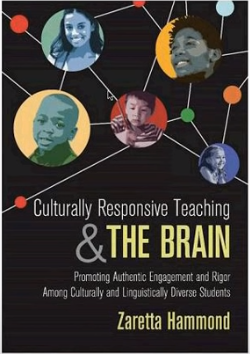
In this entry, I continue sharing my notes of Zaretta Hammond’s Culturally Responsive Teaching and the Brain. In this entry, I share my takeaways from Chapter Six.
My Notes
Notes for Chapter 6: Establishing Alliance in the Learning Partnership. Again, all uses of the acronym “CRT” refer to Culturally Responsive Teaching rather than Critical Race Theory. My own comments appear in square brackets, and I’ve tried to use quotes to capture exact wording. Most of the time, I’m trying to paraphrase to make it easier for me to remember ideas and shorten text.
- “Every child deserves a champion: an adult who will never give up on them, who understands the power of connection and insists they become the best they can possibly be.”–Rita Pierson, Educator
- The point of CRT isn’t just about getting along with students. It is to use that connection to stretch and empower students as learners.
- This is the ultimate goal of the CR teacher is to provide resources and personal assistance so students cultivate positive:
- self-efficacy beliefs
- academic mindset
- “Loving children should not become a proxy for teaching them” (Gay, 2010).
- If education is to empower culturally and linguistically diverse student, it must be transformative. That is, “students develop the knowledge, skills, and values needed to become social critics who can make reflective decisions and implement their decisions into effective personal, social, political, and economic action.” (James Banks, 2002)
- Empowerment can be described as:
- student academic competence
- self-efficacy
- initiative
- This begins with helping marginalized students increase their intellective capacity (Edmund Gordon, 2004, All Students Reaching the Top)
- An alliance is more than a friendship…it is “a relationship of mutual support as partners navigate through challenging situations.” [this really reminds me about Crucial Conversations…the necessity of building mutual respect and mutual purpose]
- The alliance phase of the learning partnership speaks to the realities of education in the sociopolitical context that creates unequal academic outcomes for students of color, English learners, and poor students.
- The education system has historically underserved culturally and linguistically diverse students of color.
- Due to institutional inequities, students have underdeveloped “learn-how-to-learn” skills as well as weak foundational skills in reading and analytical writing.
- What looks like lack of motivation is in reality the student losing hope that anything can ever change because the academic hurdles seem insurmountable [this happens around middle school…that’s why dropout rates are so high]
- Research finds that unconsciously teachers reinforce learned helplessness among low performing student of color
- “Stereotype threat is a type of racially-charged amygdala hijack…it happens when a student becomes anxious about his inadequacy as a learner because he believes his failure on an assignment or test will confirm the negative stereotype associated with his race, socioeconomic status, gender, or language background.”
- Black kids aren’t good at math
- Spanish speakers can’t develop academic language
- “Internalized oppression…whereby the student internalizes the negative social messages about his racial group, begins to believe them, and loses confidence.”
- To overcome these two (stereotype threat and internalized oppression), teachers practice validation:
- Acknowledge the realities of inequity that impact students
- Validate the personhood of the student and legitimize ways of speaking or being that have been branded “wrong” in mainstream school culture
- Empowerment through validation is a critical feature of culturally responsive teaching because it helps restore students’ sense of hope (Ladson-Billings, 2009)
- Restoring hope is is one of the main jobs for the teacher as ally (Duncan-Adrade,2007)
- Jeffery Duncan-Andrade (2009) different types of hope are highlighted. [What a fascinating idea]
- Therapeutic alliance components that Hammond identifies:
- The pact: a formal agreement between teacher and student to work on a learning goal and a relational covenant between them…Power with the student, as Jim Knight points out.
- Teacher as Ally and Warm Demander: Teacher acts as an ally, offering both care and push as needed with the goal of cultivating skills to push students into their zone of proximal development. This results in students taking more academic risk while gaining confidence.
- Student as Driver of His Own Learning: Student commits to being an active participant in the process and taking ownership of his own learning. This is done as student works towards his learning goals.
- Hammond recommends specific steps to take for each alliance component that are worthy of study and use.
- It is eay to think that just being firm and authoritarian is the key to increasing student achievement for marginalized students. Research has found the opposite is true.
- Care and insistence on excellence in academic effort are required.
- She shares a chart worth exploring professional distance and passive leniency. Various types of teaching result, such as:
- Elitist: a teacher who sees dependent students of color as less intellectual and favors students whom he deems smart and more like him
- Technocrat: a teacher who focuses on the technical side of teaching and doesn’t try to build relationships or help students develop self-confidence as learners. He is successful with independent learners and some dependent learners.
- Sentimentalist: Teacher who makes excuses for students’ lack of performance, over scaffolds instruction or dumbs down the curriculum, and allows students to engage in less than desirable behavior.
- Warm Demander: Teacher who shows personal regard for students, builds relationships, holds high standards and encourages productive struggle. This is the preferred approach at the Active demandingness and personal warmth quadrant.
- Dependent learners are conditioned to be passive about making decisions about their own learning.
- Things students need from allies [think about Hattie strategies when reading this list…they overlap quite well]:
- kid-friendly vocabulary for talking about their learning moves
- checklists to help hone decision-making skills during learning and focus their attention during data analysis
- tools for tracking their own progress toward learning targets
- easily accessible space to store their data
- Practice engaging in metacognitive conversations about learning and strategy
- a clear process for reflecting on and acting on teacher or peer feedback
- “According to education researchers hattie and Timperley (2007), feedback is one of the most powerful tools we have to improve learning. The brain needs feedback or it will keep doing the same thing over and over even if that move doesn’t result in improved skill or performance.”
- “The very act of reviewing and applying feedback stimulates the growth of neurons and dendrites in the brain. This action grows more grey matter” (which is more brainpower).
- How do you make feedback culturally responsive?
- Students of color often did not receive timely, actionable feedback from teachers
- Wise feedback has the teacher conveying faith in the potential of the student while being honest about the gap between current performance and the standard he is trying to reach.
- The wise educator adds three specific elements to feedback:
- An explicit holding of high standards
- A personal assurance that student is capable and can improve with effort
- Specific actionable steps to work on
- Hammond has created a feedback protocol she calls “asset-based feedback protocol.” Here’s a quick, brief overview:
- Begin with a check in. Reconnect with student, explore feelings.
- State the purpose of the meeting and affirm student’s capacity as a learner, giving evidence of progress and growth in other areas.
- Validate the student’s ability to master the learning target while acknowledging high demands of the task. Have student analyze the task, identifying easy/hard parts.
- Deliver feedback that is specific, actionable, and timely.
- Create space for the student to react
- Give students specific action to take
- Ask the student to paraphrase what he heard you say
- Offer emotional encouragement and restate your belief in him. Don’t skip this.
- Set up a time to follow-up and check progress.
Reflection
Hammond’s Asset-Based Feedback Protocol offers a powerful way to provide students feedback. As I read it, i can’t help but wish I’d had access to something like it. What I really found interesting about this chapter is how Hammond expands or elaborates on some of the points I’ve read from John Hattie. Feedback is obviously one of those areas, but so is the use of checklists, self-tracking tools, and metacognition.
Everything posted on Miguel Guhlin’s blogs/wikis are his personal opinion and do not necessarily represent the views of his employer(s) or its clients. Read Full Disclosure
Discover more from Another Think Coming
Subscribe to get the latest posts sent to your email.
 Another Think Coming