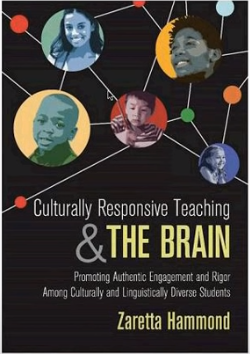
In this entry, I continue sharing my notes of Zaretta Hammond’s Culturally Responsive Teaching and the Brain. In this entry, I share my takeaways from Chapter Seven and Eight. I have to admit that I’ve been running out of steam reading Hammond’s amazing text.
Instead, I’ve been watching videos and compiling them (and other resources) in this Wakelet Collection, Culturally Responsive Teaching. Watching Zaretta Hammond present and respond to audience questions has really given me a heightened sense of how savvy she is in responding to tough questions. I’m continually impressed at the work in this book, as well as how she speaks.
Please remember that I don’t include everything, only those things that jump out at me. There’s an education in what’s left out and what I’ve included below. Buy her book and make sure to study it with a group of folks. One thing I wish I had done was start a book study.
Finally, this will probably be my last entry. I’ll leave you to finish the book (only a few more chapters) on your own.
My Notes
Chapter 7
- Components of an academic mindset:
- I belong to this academic community
- I can succeed at this
- My ability and competence grows with my effort
- This work has value for me
- Mindset Cycle
- Academic mindset: Student begins with belief that learning is relevant and is worth paying attention to. His belief is reinforced by evidence of progress
- Engagement: Brain is captured by positive emotion, physical energy, curiosity, or a puzzle signaling the brain to engage.
- Effort: Engagement gives way to assessing, managing, and regulation of mental energy needed to complete the task, under the concept, or solve puzzle.
- Task performance: Student applies various cognitive routines to complete the task or to understand the concept based on mental energy assessment. Student willing to adjust perseverance and tenacity (effort and grit, respectively)
- Most schools have structural inequities that are predictive of who will be a high achiever and who will be a low achiever along racial lines. Over time, these structural inequities shape a student’s internal story about himself as a learner.
- When teachers frame student difference as deficits rather than assets, a microaggression is ignited for the student.
- Micro-aggressions are those seemingly innocuous brief verbal behavioral or environmental indignities that send hostile, derogatory, denigrating, and hurtful messages to people of color…they are small, nonverbal snubs, dismissive looks, gestures, and a condescending tone of voice.
- Negativity bias–your brain remembers and responds to negative experiences 3x more than positive experiences
- When negativity bias is activated in classroom, it only reinforces and amplifies a students’ negative academic script, leading him to believe school is an unwelcoming place where he cannot be himself
- Micro-assaults: Involve misusing power and privilege in subtle ways to marginalize students and create different outcomes based on race or class.
- Micro-insults: being insensitive to culturally and linguistically diverse students and trivializing their racial and cultural identity such as not learning to pronounce their name.
- Micro-invalidation: involve actions that negate or nullify a person of color’s openness such as ignoring each student’s rich fund of knowledge. They are also expressed when we don’t want to acknowledge the realities of structural racialization or implicit bias. It takes the form of tivializing and dismissing students’ experiences, telling them they are being too sensitive or accusing them of playing the race card.
- The key to helping students push back and build a strong academic mindset is by strengthening self-efficacy.
- Strategies:
- Help students create a counter narrative about their identity as learners to create a counter-narrative
- Introduce the notion of a counter-narrative
- Lead a discussion of how a piece of literature contrasts with the way the students’ culture is depicted in the mainstream media
- Set up a narrative redesign task as a collaborative writing exercise. Help students identify two or three dominant beliefs that are relevant to academic mindset
Chapter 8
- The power of culturally responsive teaching to build underserved students’ intellective capacity rests in its focus on information processing.
- Processing is the act of taking in information with the intent to understand it, relate it to what you already know, and store it in a way that you can easily retrieve it [a nice definition of blogging, huh?]
- Input–>Elaboration–>Application
- Neural pathways are built during application. We have 24-48 hours to revisit, review, and apply.
- macro level instructional strategies:
- Ignite – Get the brain’s attention
- Chunk – Make information digestible
- Chew – Actively process new information
- Review – Apply new learning
- Ways to ignite:
- Crick – Crack
- Call – response
- Music
- Provocations
- Talk – Give each student a slip of paper with quote or word. Have them share that quote with someone else and discuss their reaction. Swap paper and repeat. [I actually did a digital version of this with a Glides app…lots of fun]
Discover more from Another Think Coming
Subscribe to get the latest posts sent to your email.
 Another Think Coming