
Struggles Teams Face
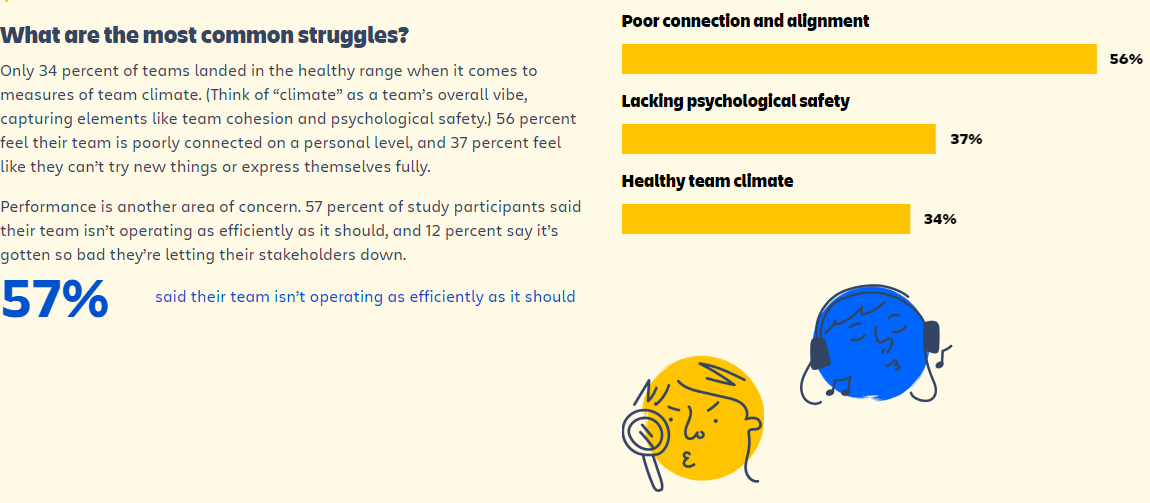
Isn’t that fascinating? Tom Barrett, in his email newsletter, shares results of a study that resonated with my experiences over the years:
The Australian software company Atlassian recently published results of a study into the health of teams with evidence from 1,500 team members outside of Atlassian in the US and Australia. They found that 88% of participants are operating in an ‘unhealthy’ environment.
56 percent feel their team is poorly connected on a personal level, and 37 percent feel like they can’t try new things or express themselves fully.
Tom narrows in and asks, “Why can’t 37% of participants express themselves fully?” He offers a few reasons, such as “Perceived lack of impact or influence” and “fear of not looking like a team player.” In my past experience, it’s usually due to the fact that the manager/leader/admin has already decided what the course of action will be. They are only going through (painfully obvious) motions of soliciting team feedback, then “guiding” everyone to where things were going anyways.
In those cases, you’re offended, not by the manipulation, but the lack of honesty. Just say, “This is what we’re going to do, but I’m not sure what you have to contribute. You have to do something, so let’s work together to figure out how your strengths align to this new initiative.”
Tom makes a really important point, and I have seen this as well and experienced it:
A team member shares something new, and others require an immediate response in the group. Someone questions it confidently (because decades of experience tell them it’s not worth exploring), and the others on the team nod (because they’re too afraid to be the first one out). The new idea is squashed. Read more on Tom’s perspective
While not every new idea works, I’ve seen ideas get “squashed” then resurface years later to wild success. Then, when others notice, they say, “Well, conditions weren’t right then.” But the truth is, some team members didn’t want to do the work that came with a new initiative. Others didn’t want to do something that flew in the face of established practice.
Bertrand Russell’s Top Ten
Do not fear to be eccentric in opinion, for every opinion now accepted was once eccentric.
- Do not use power to suppress opinions you think pernicious, for if you do the opinions will suppress you.
- Never try to discourage thinking, for you are sure to succeed.
Unbiased discussion is a useful thing. People should be free to question anything if they can support their questioning with solid arguments.
The opposite view? The truth is already known and questioning it is subversive. (Read the original version at Open Culture).
- Find more pleasure in intelligent dissent than in passive agreement.
- Have no respect for the authority of others, for there are always contrary authorities to be found.
- Be scrupulously truthful, even when truth is inconvenient, for it is more inconvenient when you try to conceal it.
Discover more from Another Think Coming
Subscribe to get the latest posts sent to your email.
 Another Think Coming