Statement of Bias
I’d like to take a moment to share my bias. I am a Latinx who grew up enjoying the benefits of private, Catholic schools in two countries (e.g. Panama, and United States). I have served as a bilingual educator in an urban city and a rural school district. My perspective has expanded to include issues that address people of color. In the past, my focus was on technology in education, which has its own challenges and issues. For example, children of color may have less access to technology, or see their access to technology dominated by drill-n-practice types of uses. Affluent children enjoy the use of technology to create and make. I have seen these differences firsthand in my work, and hoped that changing how technology is used in low socioeconomic settings would result in transformative change. I am no longer certain of that assertion.
Rather, evidence-based instructional strategies can make a bigger difference. Technology can amplify the effect of accelerated learning grounded in evidence-based instructional strategies, but is not needed if accelerated learning is the only need. That’s a big change in my perspective from the 1990s and early 2000s. Finally, I quote some numbers and say things in this blog entry some may find controversial. As always, sharing these reveals more about my biases and incorrect thinking.
If you disagree, find what I state below to be outright wrong, please, correct that thinking in the comments in a professional manner with appropriate citations. My opinions may be based on wrong information, and my biases may blur my perspective. I am OK with being corrected.
A Quick Reflection
As a white privileged American of Swedish and Panamanian descent, I enjoyed a private school education, receiving indoctrination in religion, values, culture, and language. I can state with confidence that I labored most of my life enjoying the benefits of this indoctrination, unaware that my own ignorant acceptance of what I was taught had consequences for others. I enjoyed my privilege at the expense of others, most of whom I was told, had failed to step or earn what they had. I found experiences around me to justify this, watching other children with darker skin suffer and fail. I also saw my share of lighter skinned individuals triumph without doing the requisite work.
So often I asked myself, “How did that person succeed and another, more qualified, fail?” It took years to see the consequences of success for a Latinx colleague who ascended to leadership, only to have it revoked when no longer convenient.
White Flight
In East Texas, I saw the backlash against a colleague who had stood up for the poor, Spanish-speaking immigrants. My colleague, a Director of Bilingual Education, enjoyed support from the overwhelmingly white leadership. While it never occurred to me to notice, blind as I was, I listened to her struggles to advocate. At that time, I heard terms like “white flight” without really understanding them. After all, I had led a sheltered life, half of it in Panama’s Canal Zone, unaware of the socio-political realities of Texas.
White flight or white exodus is the sudden or gradual large-scale migration of white people from areas becoming more racially or ethnoculturally diverse (source).
The families in East Texas, Mt. Pleasant in particular, did engage in a white flight of sorts. As low socio-economic children of color flooded East Texas schools, students of white families were withdrawn. You can see this in these statistics:
1988: White 65.9%, Black 20.0%, His 13.7%
2010: White 28.3%, Black 12.5%, His 58.2% (
source)
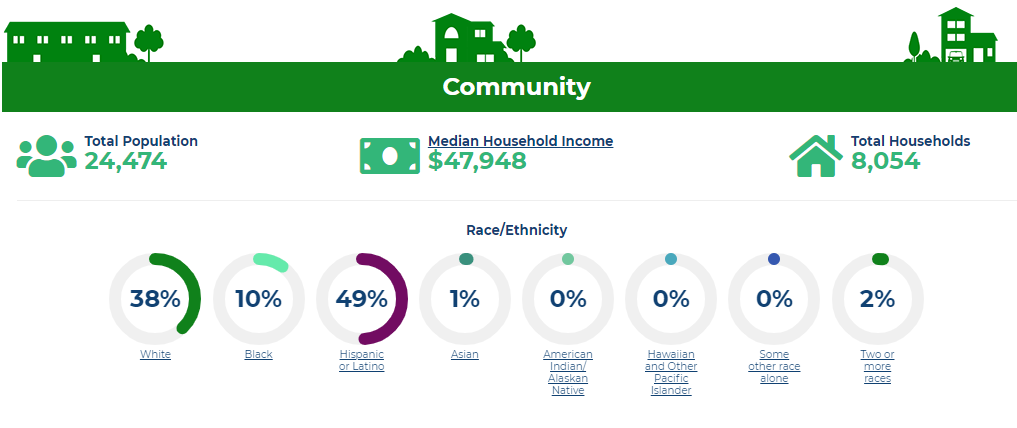
Considering recent years, it makes one wonder, what are the numbers for these three groups now? A look at the Community composition shows:
A quick look (and I may have messed up my math), suggests the following:
2020: White 14.8%, Black 13.6%, His 68.7% (Source)
Again, I could be wrong but it looks like the trend has continued. This is pretty dramatic shift, no?
“White flight.” That’s a term I heard for the first time from a superintendent there who told me this. At the time, I was more interested in showing children how to use technology. My ability to speak Spanish gave me more options as a bilingual educator sans cultural baggage.
When the leadership changed, more conservative individuals came to power, and colleagues reported in visits over the years that they had sought to strip away services, defund programs for bilingual education. This is hearsay, so I can’t say for sure, but I did find my friend, former director of bilingual education, working in another East Texas town at a church.
The implication from some was that the pushback immediately weakened the programs that had benefited children of color, and removed my colleague from her role as director. Whatever was done, resulted in her leaving education, angry, disappointed, and ashamed.
Given the massive changes over the years in terms of population, it suggests that there may have been some animosity to the changing demographics. Schools that were mostly white went brown.
A Fair Process?
Fifteen years ago, I wrote a column titled Don’t defend that book Library Media Connection, August/September 2007. In it, I argued for individuals’ rights to ask that material be removed from library collections.*
He goes on to write that his belief is that…
I believe most of our country’s problems can be solved through open and good-willed discussion and compromise
Some may see this as a view that was prevalent during a time when schools were mostly white. Now, that there are Black, Hispanic children in schools in larger numbers, it may be that the open and good-willed process fostering discussion and compromise has failed. Or, perceived to having failed. Open discussion doesn’t change the facts that schools have grown more diverse, and people have resisted that change.
As I reflect on my experiences in East Texas, I realize that there were several forces working to meet the needs of students at work. Some of them were “apolitical” but that others represented forces in the community that rejected the core goals of public schools. I met some of them in my time there, but I was blind to them. Now, a little older and wiser, I can look back and see the blatant racism that I completely missed given my privileged background.
The goal for these folks was to strip away resources usurped by children and families of color, to spend precious limited funding on those who did not need special services. That is, the offspring of the dominant culture.
Culture Wars
My prediction? Culture wars are going to get worse. That may or may not be a bad thing. Sometimes, a bit of argument can bring out long-held incorrect or fallible beliefs into the open. We can learn to see how we’re wrong. I have made an increasing list of personal ideas I held for many years but have now come to realize–with new information–that they were wrong.
To suggest that parents have no place in school decision-making is to deny the fundamental role of public schools as places for the teaching and practice of democratic values. Schools should want more parental involvement, not less, a matter of equal concern on both sides of the cultural divide. (Source: Fight the School Culture Wars by Embracing Parents [and Supporting Ethnic Studies])
It may be that the process we had in place was biased towards one demographic group or the dominant culture. Times are changing. Maybe it’s time to reconsider how we resolve conflict. Until we do, I suspect these meetings between parents, school boards, will become even more violent.
Due for Change? Movement Towards a New Process
It is certain that change has arrived in large numbers. Schools are having to change their approach, and there’s no place to run for the poorer White folks in schools. They can’t afford to pay for private schools, and there are
hidden expenses to attending charter schools. I actually heard White folks share this perspective in my most recent experience as a technology director in Texas public schools. As a result, given the scarcity of resources, the perceived GAP in culture, not to mention LGBTQ+, I am not surprised that “open discussions” are not working.
People want what they want and aren’t afraid to fight. That goes for all the stakeholders involved, I suspect.
What new process could we adopt instead of whatever we have now? Certainly, what’s there doesn’t appear to be working.
Everything posted on Miguel Guhlin’s blogs/wikis are his personal opinion and do not necessarily represent the views of his employer(s) or its clients.
Read Full Disclosure

 Another Think Coming