 |
| Image Source |
A colleague recently asked me, “What is the future of education?” Here are some of my ruminations.
Separating Technology and Innovation
We must reject technology as the gauge of innovation. Instead, the future of education is a return to philosophy, logic, and critical thinking without sophistry. Unless clear minded, critical thinking becomes our present, we have no future. We are children playing with technologies we are unable to leverage to achieve our brightest aspirations.
While so many are focused on surviving the pandemic, some are worried about innovating to thrive during the pandemic in spite of obstacles. One innovative thing learned is really an old thing. What is that? I keep coming back to a definition of how to define innovation. One person (Grant Lichtmann) said:
“Innovation is a change that adds value.”
All the other stuff (e.g. technology, revised standards) must lead to a situation where “students learn better. Therefore, changes in practice that result in better learning are innovative and those that don’t, are not,” says Grant Lichtmann.
The Most Important Strategy
The importance of building relationships with students FIRST before attempting to do anything else. That includes acknowledging and affirming a student’s schema (deep culture) and social-emotional dimensions. This is a change that adds value (the definition of innovation) because it helps us see learning in a new way, informed by brain research and evidence-based teaching practices.

All the other stuff (e.g. technology, revised standards) might be so much discarded by learners if no relationship is in place…if the student’s Reticular Activating System (RAS) has decided, “Blah blah blah.”
 |
| Image Source |
School is based on certain assumptions of what students get/learn at home. What happens when students who didn’t get what society expected them to get, raise their own children, and send them twice as deprived as before of what Society expected them to have?
 |
| Image source |
Better School Management
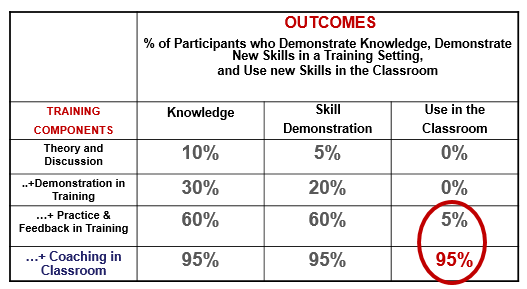
Needs imply that teachers’ needs aren’t being met to achieve worthwhile goals, which may not be in place. I might ask instead, “How can we rethink how schools are managed? Do those practices align to research now? How are we preparing preservice teachers in alignment with evidence-based practices, providing support for in-service teachers through coaching?”
 |
| Image Source |
Too Much Innovation?
But, back to innovation. Innovation is only valuable if it adds value. Is there a limit to how much “value” or “innovation” you have in schools that it obscures or interferes with learning and teaching?
How can we strip away non-essential, non-working instructional strategies, leadership practices, evaluative assessments to better achieve our goals? Becoming innovative, being future-focused are means to an end, but what is the desired end point? Let’s determine that for schools, for learners, then design backwards from that point.
Educational technology is the structure you stand on to reach for what you aspire to. With technology that facilitates collaboration, community goals for education, and empowers increased access to resources that allow individuals to see themselves represented in them, students can grow and develop.
At the core of any educational experience is the need for philosophy, scientific thinking and critical thinking processes. Technology amplifies these, but without classical training, you have a high-powered engine pulling a square-wheeled wood cart.

Ok, so I had too much fun wondering about the steps of Socratic Elenchus or the Socratic Method. Was there some heuristic, some infographic? Here is something I stumbled on:

George Polya’s Four Steps to Solving a Problem:
- Understand the problem: Read the problem over carefully and ask yourself:
- Do I know the meaning of all the words?
- What is being asked for?
- What is given in the problem?
- Is the given information sufficient (for the solution to be unique)?
- Is there some inconsistent or superfluous information which is given?
- By way of checking your understanding, try restating the problem in a different way.
- Design a plan for solving the problem: In essence, decide how you are going to work on the problem. This involves making some choices about what strategies to use. Some possible strategies are:
- Draw a picture or diagram — making a picture which relates the information given to what is asked for can often lead to a solution.
- Make a list — this is a strategy which is especially useful in problems where you need to count the members of a set.
- Solve smaller versions of the problem and look for a pattern — almost any problem can be made simpler in some way. By working out simpler versions, you can often see patterns which help solve the original problem.
- Decompose the problem — Many problems can be broken into a series of smaller problems. This strategy can turn a problem which on first glance seems intractable into something more doable.
- Use variables and write an equation — the method of algebra. Very useful in a lot of problems.

- Carry out the plan:
- Spend a reasonable amount of time trying to solve the problem using your plan.
- If you are not successful, go back to step 2.
- If you run out of strategies, go back to step 1.
- If you still don’t have any luck, talk the problem over with a classmate.
- Look back: After you have a proposed solution, check your solution out.
- Is it reasonable?
- Is it unique?
- Can you see an easier way to solve the problem?
- Can you generalize the problem?

 |
| Image Source |
Everything posted on Miguel Guhlin’s blogs/wikis are his personal opinion and do not necessarily represent the views of his employer(s) or its clients. Read Full Disclosure
Discover more from Another Think Coming
Subscribe to get the latest posts sent to your email.
 Another Think Coming