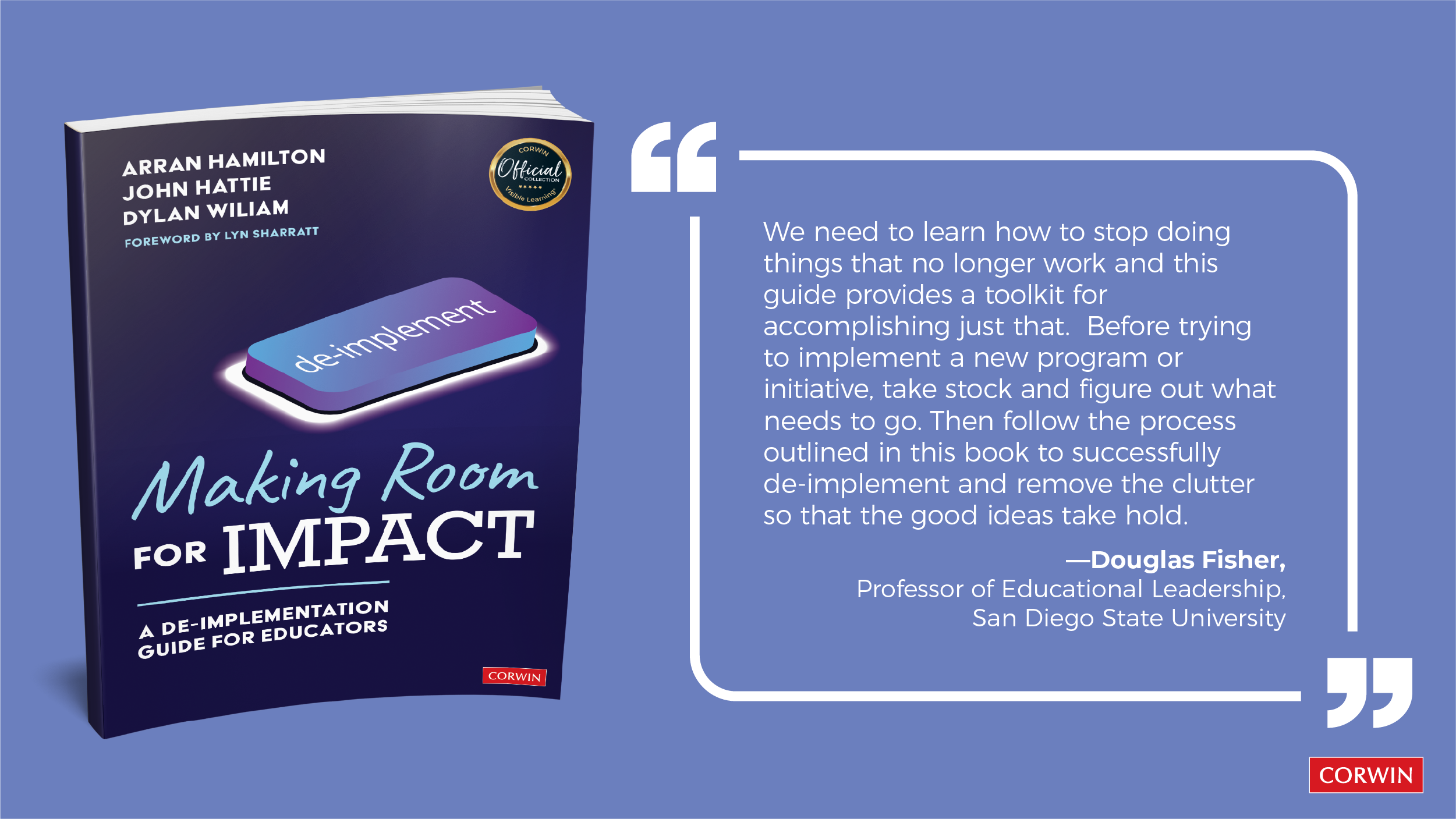
This past month, I bought a book, Making Room for Impact. I immediately was engaged in the first few chapters. You can watch Corwin’s video where the authors discuss the book:
For fun, here’s an AI-generated summary using Summarize.tech:
In this section of a webinar about educational improvement, the presenters discuss the importance of deimplementation, a process in which ineffective education programs or initiatives are removed or replaced with higher value ones. They argue that deimplementation is essential to creating space for more impactful initiatives and should be a crucial component of any educational improvement strategy.The presenters then move on to discuss the different types of deimplementation activities that can be undertaken to reduce teacher workload and burnout, and the importance of choosing new practices carefully and considering their impact on student learning. They also discuss the challenges of the deimplementation process, including the cognitive bias of addition, the difficulty of unlearning or deleting learned or practiced behaviors, and the importance of recognizing and re-engineering regulations and restrictions in order to reduce burden and maintain impact.The presenters emphasize the importance of an explicit deimplementation process and the need for constant review and pivoting in order to ensure that deimplementation leads to increased efficiency and impact in education.
The chart below is kinda cool:
 |
| Source: On Smoking, Corwin Press video linked above |
Applying this to education, and edtech in particular, was what caught my imagination. How many technology operations processes/procedures are in place in districts that could be simplified?
DeImplementing EdTech Solutions
I immediately wrote it up as a blog entry for another blog, but that won’t appear for awhile yet. I also worked it into an upcoming webinar I’m doing on Google Drive Sync. Imagine applying the following steps to some edtech process.
In their book, Making Room for Impact, the authors point out four reasons for getting serious and focused about de-implementing:
- Substitute less effective practices with those that have more evidence and probability of impact
- Replace more expensive interventions with less expensive and equally effective solutions
- Streamline practices that have become over-designed
- Scale down use of a still needed process with less frequent use or being more selective about who gets to use it
- Stop doing things that cause unnecessary stress and that give us time to do other things better.
How might we apply this process to edtech work we do every day?
DeImplementing EdTech
Take a moment and ask yourself a few questions about your work as a technology director:
- What am I (or my team) doing that could be substituted because it’s not as effective as something else?
- Wireless network configurations (first one to come to mind)
- Asset management
- Device management
- Physical servers at every campus (replaced with virtualized servers at a central location)
- Providing reports when a KPI Dashboard would work
- What expensive technology are we using that could be replaced?
- Replace iPads, iPad carts with managed Chromebooks (ouch, sorry, but it’s true)
- Replace Network hubs and switches
- High-priced learning management system (LMS) that could be replaced with an open source solution (or, vice versa)
- What practices could we streamline that have too many steps?
- eRate asset management
- Ordering equipment and tracking it from vendor to warehouse to end user
- Security patches and updates to end-user machines
- What is everyone doing now that could be scaled down to only a few people?
- Account management…too many people are working to manage accounts when what you really need is an identity management/SSO solution managed by one person
- HelpDesk support
- Giving admin rights to everyone so they can install software, then get infected with malware/ransomware.
- What are some things we need to stop doing that are unnecessary and stressful for all involved?
Please share your responses to these questions in the comments.
Everything posted on Miguel Guhlin’s blogs/wikis are his personal opinion and do not necessarily represent the views of his employer(s) or its clients. Read Full Disclosure
Discover more from Another Think Coming
Subscribe to get the latest posts sent to your email.
 Another Think Coming