Watching news on television, reading articles about **[how the melting polar ice caps are changing the Earth’s mass enough to affect how our clocks](https://www.sciencealert.com/melting-polar-ice-is-having-a-concerning-impact-on-the-length-of-our-year)**, I have to admit, it’s a bit much. It almost makes you wish for a checklist, right?
– [x] Heatwave
– [x] Increased hurricanes
– [x] Forced human migration
– [x] Infectious diseases
I could go on…but, well, you get the idea.
## Measuring Progress Towards an Objective
What’s the end of the world look like? When will it arrive? These are serious questions. They pop into my head every time I read an article on climate change, view videos of melting polar ice caps, and polar bears trying to figure out what happened to their habitat. This is what I got:
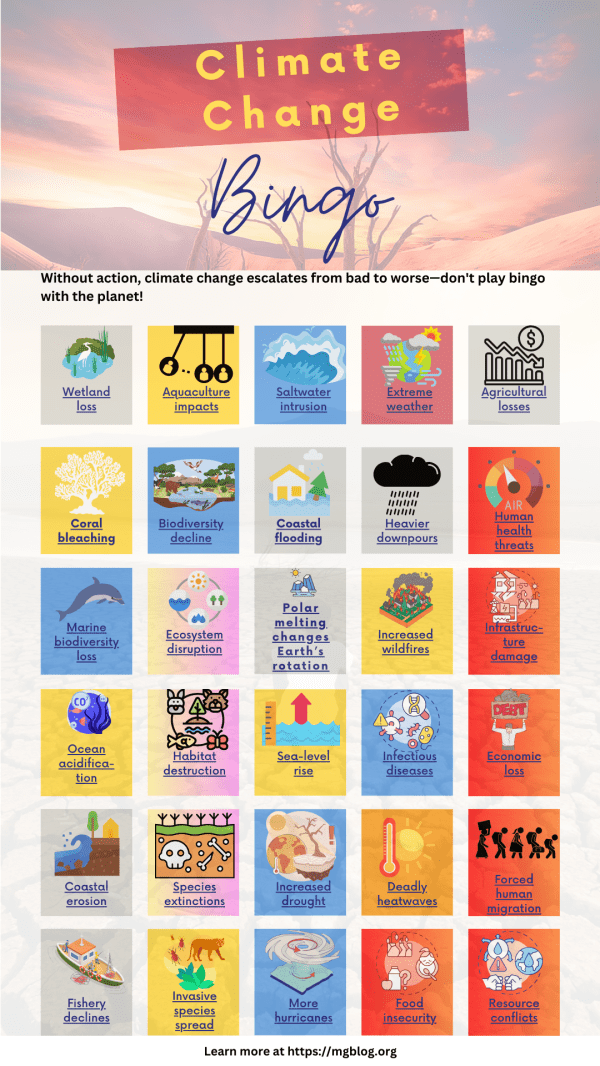
This image generated in Canva by Miguel Guhlin ( **[mguhlin@zirk.us](https://zirk.us/@mguhlin)** ) with data
from **[Perplexity.ai Pro version](https://perplexity.ai/pro?referral_code=DMX9OZJ4).** Citation links appear at the end. **[View the Google Slides version here](https://drive.google.com/drive/folders/1TKRhQ0uRuJGmezqFCnzGISKjqWwqq7ye?usp=sharing)** (or **[get a copy](https://docs.google.com/presentation/d/1BoSjNO1gbeaJh9o-sWXvcPMrzubNXfvAdvdD6zHKW2o/copy?usp=sharing)**). **[View PDF version](https://drive.google.com/file/d/14KQPQB0foV85A2JN5IccxkBYg4GbE2jm/view?usp=sharing)**.
## Prompt
With that in mind, I decided to ask Perplexity.ai Pro (**[get a referral from me for $10 off](https://perplexity.ai/pro?referral_code=DMX9OZJ4)**, if you want to check it out), the following prompt. I’ve incorporated follow-up prompts in the selection below. I didn’t spend a lot of time on this prompt, as you can see, since I was just playing around.
> make a list of all the bad things that could happen with climate change. Each bad thing should be one to three words, max. Organize these in order of severity from 1 to 30 (30 being the worst) and by category (nature vs human). Without changes to current trends, estimate the year that each impact will appear.
The results were sobering. I’ve broken them up by Nature-related effects and Human-related effects, but obviously, what affects nature affects us all.
## Nature-Related Effect
Nature-related effects and estimated timeline for impact:
1. Wetland loss – Already occurring, will accelerate by 2050
2. Coral bleaching – Already occurring, most reefs affected by 2030-2040
3. Marine biodiversity loss – Already occurring, significant losses by 2050
4. Ocean acidification – Already occurring, significant impacts by 2050
5. Coastal erosion – Already occurring, will accelerate by 2050
6. Fishery declines – Already occurring, significant declines by 2050
7. Aquaculture impacts – Already occurring, significant impacts by 2050
8. Biodiversity decline – Already occurring, accelerating by 2030-2040
9. Ecosystem disruption – Already occurring, widespread by 2050
10. Habitat destruction – Already occurring, accelerating by 2030-2040
11. Species extinctions – Already occurring, accelerating by 2030-2040
12. Spread of invasive species – Already occurring, accelerating by 2030-2040
13. Reduced ecosystem services – Already occurring, significant impacts by 2050
## Human-Related Effects
14. Saltwater intrusion – Already occurring in some areas, widespread by 2050
15. Coastal flooding – Already occurring, will accelerate by 2050
16. Sea-level rise – Already occurring, major impacts by 2050-2100
17. Increased drought – Already occurring in some regions, widespread by 2050
18. More hurricanes – Possible increase by 2050, definitive increase by 2100
19. Extreme weather – Already occurring, more frequent and intense by 2050
20. Heavier downpours – Already occurring in some areas, widespread by 2050
21. Increased wildfires – Already occurring, more frequent and intense by 2050
22. Infectious diseases – Some impacts by 2030, significant spread by 2050-2070
23. Deadly heatwaves – Increasing by 2030, common in many areas by 2050
24. Food insecurity – Impacts felt by 2030, more severe and widespread by 2050
25. Agricultural losses – Increasing by 2030, major losses by 2050
26. Threats to human health – Increasing by 2030, significant impacts by 2050
27. Infrastructure damage – Increasing by 2030, severe and costly by 2050
28. Economic losses – Increasing by 2030, major drag on economies by 2050
29. Forced human migration – Increasing by 2030-2040, large-scale by 2050-2100
30. Resource conflicts – Possible by 2030-2040, more likely and severe by 2050-2100
# Citations
## Nature-related effects:
1. Wetland loss[1]
2. Coral bleaching[2][4]
3. Marine biodiversity loss[4][7][8]
4. Ocean acidification[4][7][8]
5. Coastal erosion[1][2]
6. Fishery declines[4][7]
7. Aquaculture impacts[4][7]
8. Biodiversity decline[9][10][11][12][13]
9. Ecosystem disruption[9][10][12][13]
10. Habitat destruction[10][12][13]
11. Species extinctions[9][10][12][13]
12. Spread of invasive species[12][13]
13. Reduced ecosystem services[9][13]
## Human-related effects:
14. Saltwater intrusion[1][2]
15. Coastal flooding[1][2]
16. Sea-level rise[1][2][3]
17. Increased drought[3][5]
18. More hurricanes[3][5]
19. Extreme weather[3][5]
20. Heavier downpours[5]
21. Increased wildfires[5]
22. Infectious diseases[3]
23. Deadly heatwaves[3][5]
24. Food insecurity[3]
25. Agricultural losses[3]
26. Threats to human health[9][10][11]
27. Infrastructure damage[5]
28. Economic losses[9][11]
29. Forced human migration[3][11]
30. Resource conflicts[3][11]
## Citations:
* [1] [www.nature.com/collectio…](https://www.nature.com/collections/icdbhbbibg)
* [2] [www.nrdc.org/stories/w…](https://www.nrdc.org/stories/what-are-effects-climate-change)
* [3] [www.ncbi.nlm.nih.gov/pmc/artic…](https://www.ncbi.nlm.nih.gov/pmc/articles/PMC8470032/)
* [4] [www.nature.com/articles/…](https://www.nature.com/articles/s41562-022-01490-9)
* [5] [www.epa.gov/climatech…](https://www.epa.gov/climatechange-science/impacts-climate-change)
* [6] [climate.ec.europa.eu/climate-c…](https://climate.ec.europa.eu/climate-change/consequences-climate-change_en)
* [7] [science.nasa.gov/climate-c…](https://science.nasa.gov/climate-change/effects/)
* [8] [www.epa.gov/climatech…](https://www.epa.gov/climatechange-science/causes-climate-change)
* [9] [climatechange.chicago.gov/climate-i…](https://climatechange.chicago.gov/climate-impacts/climate-impacts-human-health)
* [10] [www.who.int/news-room…](https://www.who.int/news-room/fact-sheets/detail/climate-change-and-health)
* [11] [health2016.globalchange.gov/climate-c…](https://health2016.globalchange.gov/climate-change-and-human-health)
* [12] [www.nrdc.org/stories/w…](https://www.nrdc.org/stories/what-are-causes-climate-change)
* [13] https://serc.carleton.edu/integrate/teaching_materials/food_supply/student_materials/933
* [14] [www.epa.gov/climate-i…](https://www.epa.gov/climate-indicators/weather-climate)
* [15] [www.whitehouse.gov/ostp/news…](https://www.whitehouse.gov/ostp/news-updates/2023/11/09/fact-sheet-fifth-national-climate-assessment-details-impacts-of-climate-change-on-regions-across-the-united-states/)
* [16] [www.un.org/en/climat…](https://www.un.org/en/climatechange/what-is-climate-change)%5B1%5D [www.nature.com/collectio…](https://www.nature.com/collections/icdbhbbibg)
Discover more from Another Think Coming
Subscribe to get the latest posts sent to your email.
 Another Think Coming