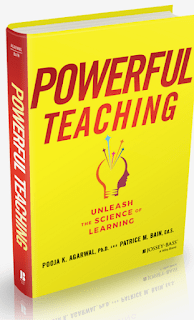
These are my notes on [_**Powerful Teaching**_](https://www.powerfulteaching.org/). I’d like to say I finished the book, but I only made it 3/4ths of the way through before I ran out of time. I may add more content below, but these are my big take-aways.
This was a great book on four powerful teaching strategies. It’s well worth it to master their usage in K-Adult classrooms. **[Be sure to view the companion website to the book](https://www.powerfulteaching.org/).**
# **Four Powerful Teaching Strategies**
There are four powerful strategies that boost student learning. These include the following:
## **1-Retrieval Practice**
This strategy occurs when learners recall and apply multiple examples of previously learned knowledge or skills after a period of forgetting.
* It boosts learning by pulling information out of students’ heads (e.g. quizzes/flashcards)
* It works by enabling students to practice bringing information forward to remember it better.
* Helps students remember what to transfer
* Learning strategy, not assessment strategy
* Retrieval practice boosts transfer learning
* Students do better when they are quizzed versus not quizzed, as much as 13% more.
* Provide a mix of fact-based and HOTS retrieval
* Multiple choice questions are as, or more effective than short answer questions
* Writing down works better than concept mapping for retrieval practice
## **Retrieval Practice Activities**
### **Brain Dumps/Free Recall**
* Pause lesson, lecture
* Write down everything you can remember
* Continue lesson
* Ask students to swap Brain Dump with a peer.
_Then, do a Think-Pair-Share:_
* Is there eanything in common that both of us wrote down?
* Anything new that neither of us wrote down?
* Any misinformation?
* Why do you think you remembered what you did?
### **Two Things**
* Pause lesson
* Ask, “What are two things you learned yesterday? Today?”
* Ask, “What are two things you’d like to learn more about?”
### **Retrieve-Taking**
* Pause lesson
* Students write down what they want to study
* Give feedback on what they wrote
* Continue with lesson
### **Daily MiniQuizzes**
* Formulate questions
* Put clues on slips of paper
* Students write down answers
* Collect clues
* Analayze Mini-Quizzes
### **Retrieval Routines**
#### **Colored index cards**
* Label cards with “A” “B” “C” “D”
* Have students hold cards up in response to questions
#### **Bell work/exit tickets**
### **Retrieval Guides**
* Provide students with an outline of your lesson
* Read text aloud
* Retrieve and write down information in Retrieval Guide
* Think-Pair-Share
### **2-Spaced Practice or spacing**
Boosts learning by spreading lessons and retrieval opportunities over time so learning isn’t crammed all at once.
### **3-Interleaving**
Mixes up related topics and encourages discrimination.
### **4-Feedback**
* Provides student opportunity to know what they know, and know what they don’t know
* This increases students’ meta-cognition or understanding their learning progress.
* Helps students apply knowledge correctly
## **Benefits of Strategies**
Research shows that there are various benefits. These include
* Enhance higher order thinking skills and knowledge transfer
* Raise student achievement by a letter grade or two
* Boosts learning for diverse students and subject areas
* Increases use of effective study of strategies out of class
* Improves mental organization of knowledge
* Increases student engagement and attention
* Blocks interfering information
* Improves learning of related information
* Increases HOTS and transfer learning
* Identifies gaps in students’ knowledge
* Increases meta-cognition and awareness of learning
## **Stages of Learning**
There are several stages of learning. These include the following:
### **1-Encoding**
When we meet information for the first time, or initially learn something.
### **2-Storage**
Keeping encoded information and how long it is retained.
### **3-Retrieval**
When we reach back and bring out of our minds the information we previously learned. When we access information and bring it to mind.
## **Connections**
### **Social-Emotional Learning**
* Investigates how we interact with the world around us, or what happens outside our heads.
### **Cognitive Science/Psychology**
* Behind the scene behavior in our heads or invisible behavior
Discover more from Another Think Coming
Subscribe to get the latest posts sent to your email.
 Another Think Coming