I love Abir Haddoud’s post about the book, so I am reposting it from social media (LinkedIn) below:
## Quote
> I’ve read “Thinking, Fast and Slow” by Nobel laureate Daniel Kahneman twice.
> It has profoundly changed the way I perceive decision-making and human behaviour.
Here are some key takeaways:
—-
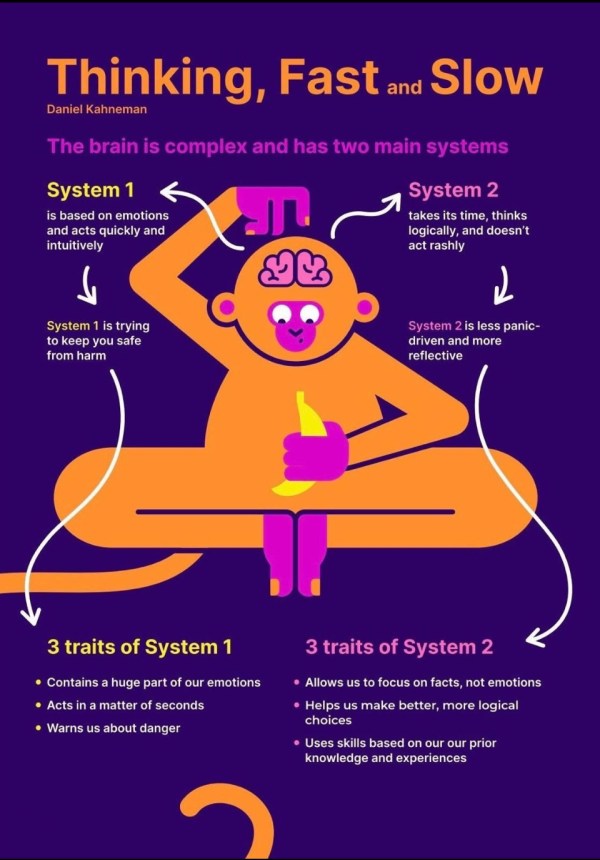
1. Two Systems of Thinking: Kahneman introduces us to System 1 and System 2
– System 1: Fast, intuitive, and emotional. It operates automatically with little or no effort.
– System 2: Slow, deliberate, and logical. It requires more mental energy and is used for more complex decisions.
—-
2. Cognitive Biases: Our reliance on System 1 often leads to cognitive biases—systematic errors in thinking. For example:
– Anchoring Effect: We rely too heavily on the first piece of information we receive.
– Availability Heuristic: We overestimate the likelihood of events based on their recent occurrence in our memory.
—-
3. Prospect Theory: Kahneman’s groundbreaking work in behavioural economics shows that people value gains and losses differently, leading to irrational decision-making.
>
– We are more sensitive to losses than gains, a concept known as loss aversion.
—-
> 4. Overconfidence: We often overestimate our knowledge and abilities, which can lead to poor decisions. Recognizing the limits of our understanding is crucial for better judgment.
—-
> 5. Framing Effect: The way information is presented significantly affects our decisions. For example, we react differently to a 90% survival rate vs. a 10% mortality rate, even though they mean the same thing.
—-
> 6. Endowment Effect: People ascribe more value to things merely because they own them. This can impact financial decisions and negotiations.
> 💡 Why It Matters: Understanding these concepts can help us make more rational decisions in our personal and professional lives.
> By being aware of our cognitive biases and the limitations of our thinking, we can strive for better outcomes and avoid common pitfalls.
> 📚 Recommendation: I highly recommend “Thinking, Fast and Slow” to anyone interested in psychology, economics, or improving their decision-making skills.
> It’s a fascinating exploration of the human mind and a valuable resource for both personal and professional growth.
Discover more from Another Think Coming
Subscribe to get the latest posts sent to your email.
 Another Think Coming