As an educator with friends in K-12 education, responsible for teaching writing, much as I did when I worked in a classroom, I am sympathetic about the turmoil that AI causes. For me, the division between AI for workers vs AI for students is straightforward.

Seizing the Moment
For workers, you use whatever tools at your disposal to get the product done and to market. While some question the ethics of AI usage, saying any use is unethical due to the human, environmental impact, I balance that criticism with human history. Human history is replete with facts and stories about bad technologies exacting a toll on our environment. While I can’t point to some specific point in history when a decision was made about this, it’s clear that a decision was made to prioritize the benefits of technology over the dangers and disadvantages by those who had the job of directing nations. In some cases, the bad effects of technology adoption are mitigated by newer technologies, but in others, they are not and things continue to get worse. One has only to look at the dire consequences (e.g. rivers and lakes turning rust colored in Alaska, Greenland) of having humans satisfying their needs and wants with technologies.
While it is tempting to say that a past that led to a future with more indigenous people’s leadership would be different, that worldview did not endure. The reality is that perspective didn’t make it, much to our detriment. We live in the world we have. OpenAI vs DeepSeek is an example of what is in store for us.
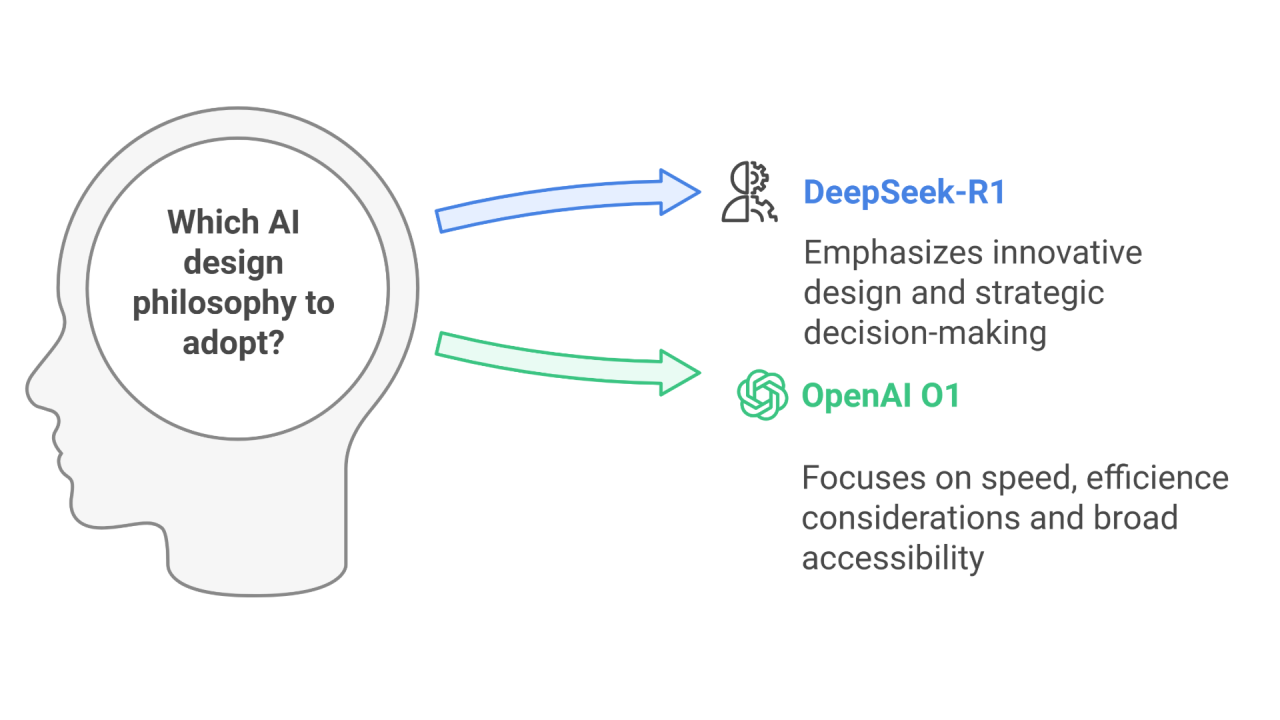
The technology gets easier to use, allowing people who do not want to, to avoid thinking. And, for those who make poor choices (our children), it’s easy to see why this is a problem.
Educating the Meat Brain
For students, for learners, the reality is different. AI is anathema to learning, that slow process of educating our meat brains. Anything that detracts from productive struggle is a problem for educators to be solved…it’s as if in AI, students find a “Cheating Avatar” that is 1000x better than crib sheets. To combat that AI avatar, it’s natural that some educators will reach for AI detectors to counter it.
My writing this blog entry is my effort to educate my own brain, to make sense of everything I see. That’s why I see the value in writing blog entries like these:
- AI and SOLO Taxonomy: A Path to Deeper Learning
- PRISM: See Thinking in a New Light
- PRISM: Support Student Thinking
- Teach Critical Thinking with These Action Writing Strategies: Part One
- Teach Critical Thinking with These Action Writing Strategies: Part Two
They emphasize understanding when AI is most useful, and how to encourage critical thinking a la paper-n-pencil.
AI Detection and Why We Write
To my friends who teach writing, I would point out that AI detection software is ineffective. That still leaves the issue with AI generated content. For some, pulling back from technology use is an option. To be honest, technology hasn’t really found itself critical, essential to learning as a way to improve student achievement. It remains an implement, “a tool” like a desk or whiteboard that enhances the teaching and learning environment.
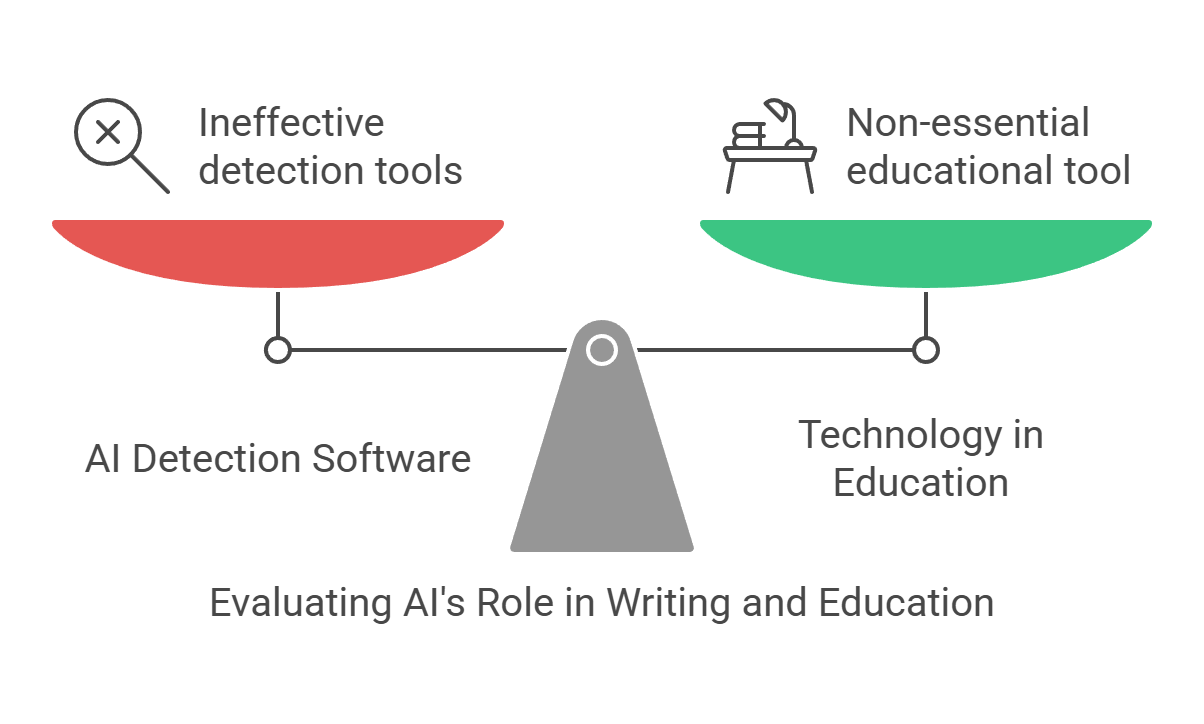
As I look over that scale, I can see it doesn’t quite work. That’s less a reflection of the AI tool used to generate the image, and more my first paragraph. The dichotomy isn’t between AI detection and technology. It’s between outsourcing our thinking and developing critical life skills like critical thinking, problem-solving, decomposition.
Or, another way to refer to it? Self-regulated learning.
Self-regulated learning (SRL) involves goal-setting, planning, monitoring, and reflecting, which aligns with structured outlining and organizing strategies. High-performing students in the study used structured study plans, self-monitoring, and evaluation, while low-performing students relied on unstructured memorization—a key distinction that highlights the power of organization in learning.
Source: ChatGPT analysis of Self-Regulated Learning and Academic Success study
The suggestion is that writing plays a key part in developing self-regulated learning. One strategy is Outlining and Organizing (d=0.84). Metacognition (d=0.58) is also key.

We teach writing for several reasons. One key skill that seldom gets taught anymore is outlining, but I found it to be quite useful in my Master’s work when reading books and articles. Over time, I lost my prowess with outlining and that has impacted my presentation development skills. I recall the lost prowess, and I wondered why this happened.
But teaching students to write, especially outlining and organizing, can be quite powerful:
- Breaking down tasks into manageable steps (Outlining).
- Structuring knowledge into meaningful categories (Organizing).
- Using cognitive and metacognitive strategies to enhance learning efficiency.
So if that’s true, what do we do in the face of AI short-circuiting the productive struggle?
Highlighting the Struggle
Here’s my perspective on why writing is important. It facilitates:
- Getting insight into student thinking (make thinking visible). An alternate approach is Classroom Discussion approaches.
- Developing students’ critical thinking through the writing process, visually manipulating ideas and concepts to arrive at improved thinking. It makes metacognition easier. This is an individual journey but also a communal one. The group of peers discussing writing can hold each other accountable.
- Assessing students’ thinking processes and understanding of content for a grade
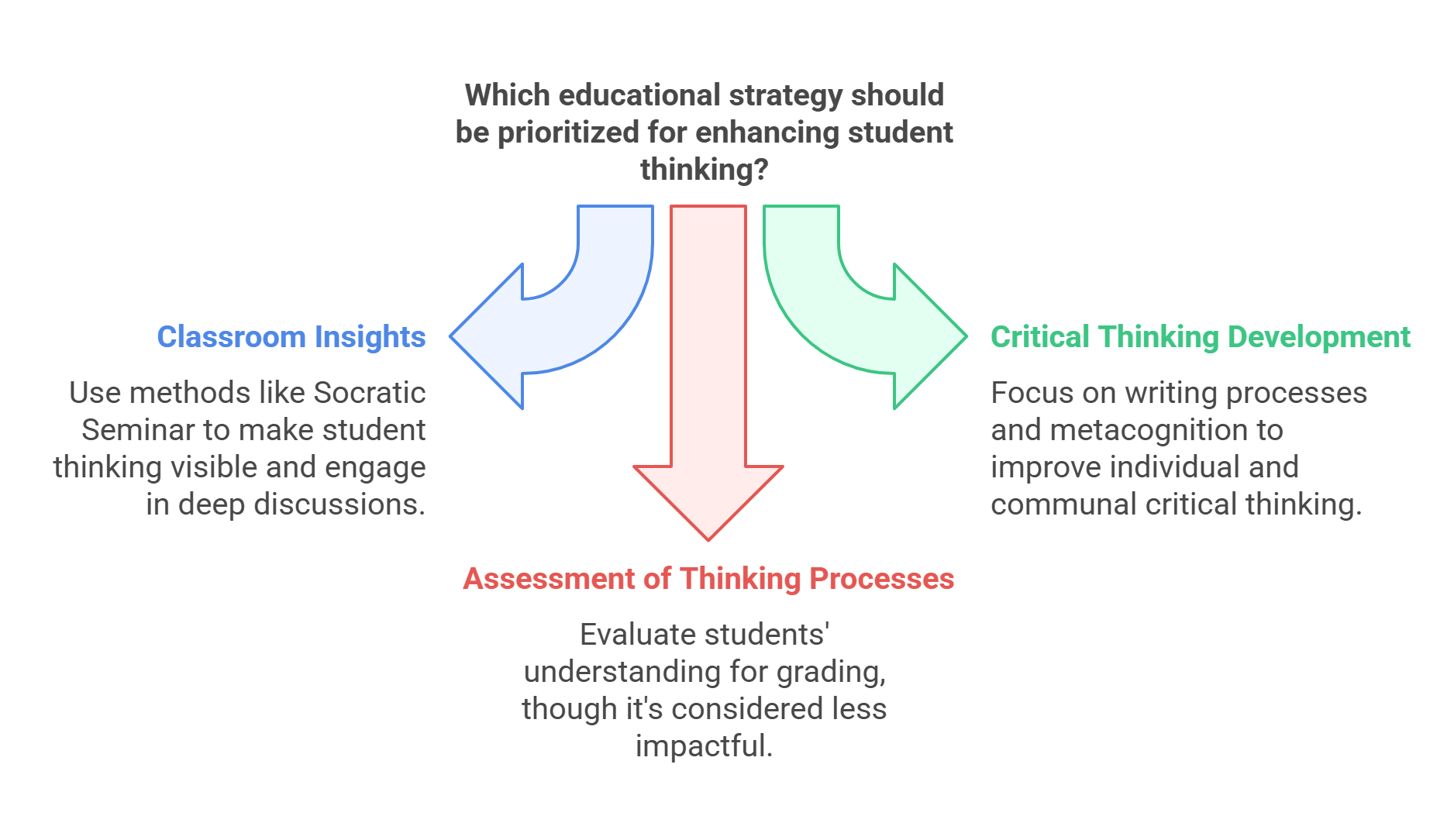
The weakest use is the third one. The first one can be achieved in the classroom through a variety of methods (e.g. Socratic Seminar, Think-Puzzle-Explore, Talk Read/Talk Write, TQE).
For me, the real value in teaching writing is in that second bullet. That’s where we really need to push strategies like Outlining and Organizing, Metacognition, and Summarization.
The SOLO Taxonomy
How could the SOLO Taxonomy manifest in a writing classroom? Here’s one way it could:
SOLO Stage: Prestructural
Lacks understanding or prior knowledge.
- Activity: Quizzes to gauge understanding.
- AI Guidelines:
- Allowed: Basic prompts or vocabulary lists.
- Focus On: Student explanations and connections to the topic.
- Community Building: Sharing Circle – Discuss connections.
SOLO Stage: Unistructural
Single ideas with limited connections.
- Activity: Write thesis statements or summaries.
- AI Guidelines:
- Allowed: None.
- Focus On: Peer and teacher feedback for developing independent writing skills.
- Community Building: Talk Read, Talk Write – Group discussion before writing.
SOLO Stage: Multistructural
Multiple ideas but no integration.
- Activity: Collect and analyze evidence.
- AI Guidelines:
- Allowed: None.
- Focus On: Independent research, analysis, and organizing ideas manually.
- Community Building: Sharing Circle – Share sources and justify choices.
SOLO Stage: Relational
Ideas are connected into a coherent whole.
- Activity: Draft essays linking multiple arguments.
- AI Guidelines:
- Allowed: AI for outline refinement after a full draft.
- Focus On: Building connections and arguments independently.
- Community Building: Talk Read, Talk Write – Peer feedback on outlines.
SOLO Stage: Extended Abstract
Applies knowledge creatively or to novel situations.
- Activity: Apply writing to new scenarios.
- AI Guidelines:
- Allowed: AI for brainstorming refinements or counterarguments post-draft.
- Focus On: Original ideas and creative problem-solving.
- Community Building: Sharing Circle – Peer Q&A on solutions.
For those not familiar, “Sharing Circle” is where students sit in a circle, and share a part of their writing with the group. The large group offers positive feedback and a suggestion for improvement if it’s desired by the author.
Discover more from Another Think Coming
Subscribe to get the latest posts sent to your email.
 Another Think Coming