
I stumbled on this quote below by Paul Graham over at Henrik Karlsson’s blog, and it immediately resonated. I don’t include the full quote but it is shortened in the title of this blog entry.
Note: If you're attending my session at TCEA 2025 Convention and Exposition, then know that I wrote this post for you. Ok, maybe a little for me. It gets at the burning question, "How to Outline and Organize ideas/info for long-term information retention?"Graham’s point reenforces my commitment to do a lot more writing. But also, to do more “Outlining and Organizing.” Here’s the quote.
Writing Refines Thinking
If writing down your ideas always makes them more precise and more complete, then no one who hasn’t written about a topic has fully formed ideas about it. And someone who never writes has no fully formed ideas about anything nontrivial.
It feels to them as if they do, especially if they’re not in the habit of critically examining their own thinking. Ideas can feel complete. It’s only when you try to put them into words that you discover they’re not. So if you never subject your ideas to that test, you’ll not only never have fully formed ideas, but also never realize it.
—Paul Graham
In one of my upcoming presentations, I will be discussing “Perfecting Summarization” (actually, that’s the revised title…the old one focused on “Mastering Summarization,” and I’m not comfortable being the master of anything these days…my ignorance is a vast chasm, and I can only focus on watching my footing). In it, I focus on Outlining and Organizing, which is a high-effect size instructional strategy with an effect size of 0.84.
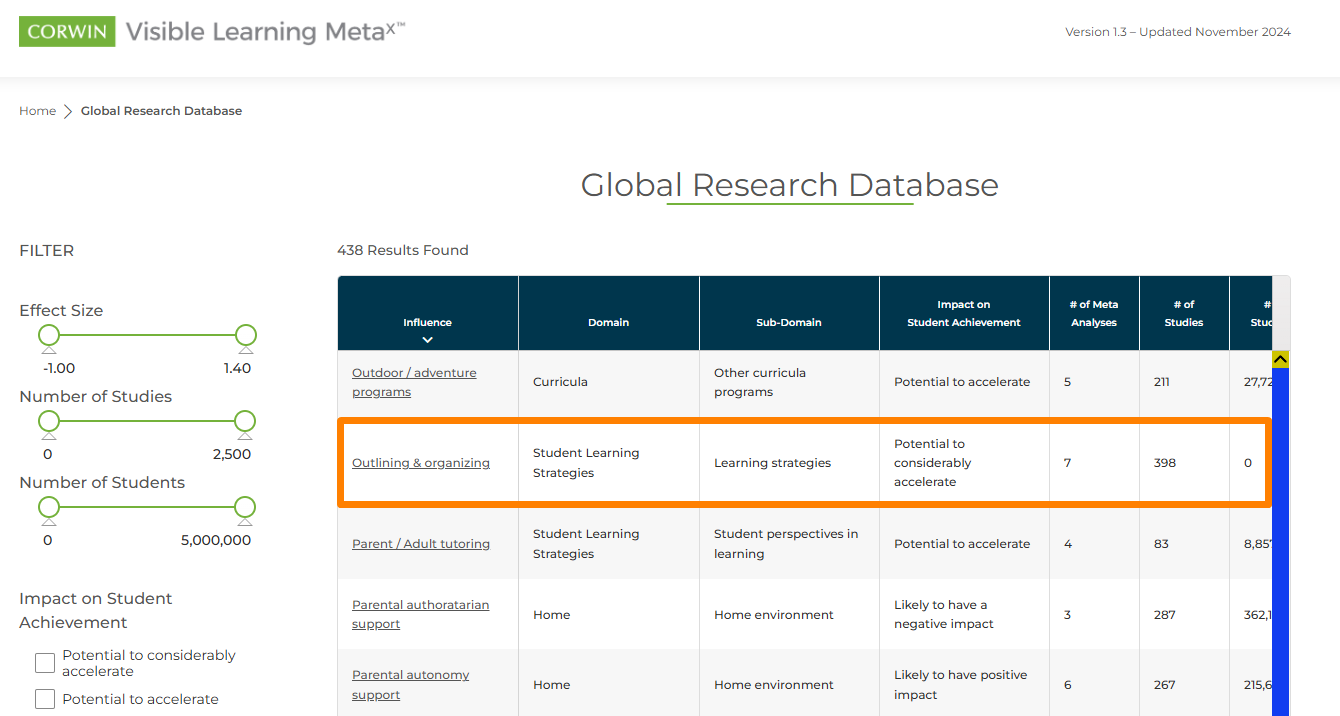
If you read the explanation of the strategy at the Visible Learning Meta X database, you’ll see the definition of summarization:
Involves identifying the main ideas and rendering them in one’s own words. The core skill is being able to distinguish between the main ideas and the supporting ideas.
That makes me think someone switched the price tags, so to speak, by accident. Summarizing loses its definition and drops in effect size to .45. Maybe they sorted a row or something in the SQL database and terms and definitions got mismatched. Who knows.
What Is It?
We improve our own learning when we take specific action…we have to do the work ourselves, no AI:
- Break information/tasks into manageable components/steps.
- Structure knowledge into categories.
- Using metacognition to reflect on and adjust learning strategies.
What would your thinking process a la DeepSink AI if you had to organize information into an outline?
How to Outline and Organize
If writing refines thinking, as Graham suggests, and we don’t fully understand an idea until we’ve processed it through writing, then how do you do that efficiently or is messy better? Well, we already know we need to be metacognitive, adjusting our learning strategies to get the most out of the effort our brains are going through to outline and organize ideas.
This makes me ask the question:
What are some specific ways to Outline and Organize in such a way to maximize brain engagement and long-term information retention?
When I pondered this question, I listed a few strategies (e.g. 3-2-1, concept mapping, outlining), but there are actually many more strategies that work. Consider this AI-generated list. I’ve also included whether they are surface, deep, or transfer learning strategies. As you might imagine, most note-taking involves Surface Learning. A refresher for you:
- Surface Learning: Basic knowledge absorption, pattern recognition, and organization for recall.
- Deep Learning: Actively making connections, generating meaning, and structuring ideas beyond memorization.
- Transfer Learning: Applying knowledge in new contexts, using social learning, storytelling, and teaching others.
| Strategy | How It Works | Why It Works for Retention |
|---|---|---|
| Color-Coded Outlines (Surface Learning) | Use colors to differentiate topics and subtopics. | Activates pattern recognition and memory cues. |
| Chunking Information (Surface Learning) | Group related concepts into small, meaningful units. | Reduces cognitive load and improves processing speed. |
| Cornell Note-Taking Method (Surface Learning) | Divide notes into cues, main ideas, and summaries. | Encourages active engagement and self-questioning. |
| 3-2-1 Strategy (Surface Learning) | Summarize with 3 key points, 2 questions, 1 takeaway. | Promotes retrieval practice and reflection. |
| Mind Mapping (Deep Learning) | Visually connect ideas using a central concept and branches. | Engages both visual and spatial memory for better recall. |
| Concept Mapping (Deep Learning) | Show relationships between ideas with connecting lines. | Reinforces association-based learning. |
| Retrieval Practice Outlining (Deep Learning) | Write an outline without looking at notes, then compare. | Encourages active recall, which improves retention. |
| Flowcharts & Diagrams (Deep Learning) | Represent processes or relationships with visuals. | Leverages dual coding (verbal + visual learning). |
| Dual Coding Strategy (Deep Learning) | Combine text with related images or icons. | Enhances encoding in both verbal and visual memory. |
| Sketchnoting (Deep Learning) | Mix doodles with notes to represent ideas. | Engages creative and spatial thinking for retention. |
| Feynman Technique (Deep Learning) | Explain concepts in simple language, as if teaching a child. | Strengthens deep understanding and long-term memory. |
| Progressive Summarization (Deep Learning) | Summarize once, then refine and condense further over time. | Reinforces learning through spaced repetition. |
| Storytelling Framework (Transfer Learning) | Organize concepts as a narrative (beginning, middle, end). | Makes abstract concepts memorable through emotion and context. |
| Quadrant Note-Taking (Transfer Learning) | Split information into four sections (Main Idea, Key Details, Examples, Takeaways). | Helps categorize and prioritize key information. |
| Jigsaw Method (Transfer Learning) | Students summarize sections, then teach peers. | Involves social learning, boosting retention and engagement. |
| Exit Tickets (Transfer Learning) | Used at the end of a lesson to help students summarize learning. | Encourages reflection and application of knowledge. |
A new one I didn’t know about? DICE Notes. I’ll have to give this one a try when at a learning event, like TCEA’s 2025 Convention and Exposition. Read the backstory on DICE Notes online, which is also the source of this diagram (below):

Wait, How Do You Craft an Outline and Organize?
For fun, I wondered, “How exactly do you craft an outline and organize?” Is there a model or acronym? This is one of the reasons why I love AI…it makes crafting a model so easy:
S.T.A.C.K. Process for Outlining and Organizing
| Step | Action | Why It Works | 💻 Digital Tools |
|---|---|---|---|
| S – Start with a Big Idea | Identify the main topic or question. | Helps focus learning on key concepts. | Google Docs, Notion, OneNote, Joplin Notes, Stackedit.io (for brainstorming and writing ideas) |
| T – Think in Categories | Break down the topic into key sections. | Organizes ideas logically for better recall. | Trello, Coggle, MindMeister (for mind maps and organizing sections) |
| A – Add Supporting Details | Include examples, explanations, or evidence. | Strengthens connections and deepens understanding. | Microsoft OneNote, Google Keep (for collecting research and evidence) |
| C – Create Logical Flow | Arrange sections in a clear, structured order. | Makes information easier to follow and apply. | Lucidchart, Canva, Google Slides (for creating structured outlines and flowcharts) |
| K – Keep It Concise & Revise | Remove unnecessary info, simplify, and review. | Improves retention by focusing on essentials. | Hemingway Editor, Grammarly, ChatGPT (for refining content and simplifying explanations) |
Well, there you go! An easy enough process to follow. You can follow it on paper and pencil or use it when writing on a computer.
What About the Previous Strategies?
I was thinking, wouldn’t it be interesting to see how the strategies mentioned earlier fit into the STACK approach? Here’s the AI response and it maps out the ideas well. It bears more study on my own part, though.

S.T.A.C.K. Outlining & Organizing Framework with Strategies
The S.T.A.C.K. framework helps structure Outlining and Organizing strategies to maximize brain engagement and long-term retention. Below, each strategy is placed within the appropriate S.T.A.C.K. step to enhance learning.
| S.T.A.C.K. Step | Strategy | How It Works | Why It Works for Retention |
|---|---|---|---|
| S – Start with a Big Idea | Cornell Note-Taking Method (Surface Learning) | Divide notes into cues, main ideas, and summaries. | Encourages active engagement and self-questioning. |
| Chunking Information (Surface Learning) | Group related concepts into small, meaningful units. | Reduces cognitive load and improves processing speed. | |
| T – Think in Categories | Mind Mapping (Deep Learning) | Visually connect ideas using a central concept and branches. | Engages both visual and spatial memory for better recall. |
| Concept Mapping (Deep Learning) | Show relationships between ideas with connecting lines. | Reinforces association-based learning. | |
| Quadrant Note-Taking (Transfer Learning) | Split information into four sections (Main Idea, Key Details, Examples, Takeaways). | Helps categorize and prioritize key information. | |
| A – Add Supporting Details | 3-2-1 Strategy (Surface Learning) | Summarize with 3 key points, 2 questions, 1 takeaway. | Promotes retrieval practice and reflection. |
| Flowcharts & Diagrams (Deep Learning) | Represent processes or relationships with visuals. | Leverages dual coding (verbal + visual learning). | |
| Dual Coding Strategy (Deep Learning) | Combine text with related images or icons. | Enhances encoding in both verbal and visual memory. | |
| C – Create Logical Flow | Feynman Technique (Deep Learning) | Explain concepts in simple language, as if teaching a child. | Strengthens deep understanding and long-term memory. |
| Progressive Summarization (Deep Learning) | Summarize once, then refine and condense further over time. | Reinforces learning through spaced repetition. | |
| Jigsaw Method (Transfer Learning) | Students summarize sections, then teach peers. | Involves social learning, boosting retention and engagement. | |
| K – Keep It Concise & Revise | Exit Tickets (Transfer Learning) | Used at the end of a lesson to help students summarize learning. | Encourages reflection and application of knowledge. |
| Color-Coded Outlines (Surface Learning) | Use colors to differentiate topics and subtopics. | Activates pattern recognition and memory cues. | |
| Retrieval Practice Outlining (Deep Learning) | Write an outline without looking at notes, then compare. | Encourages active recall, which improves retention. | |
| Sketchnoting (Deep Learning) | Mix doodles with notes to represent ideas. | Engages creative and spatial thinking for retention. | |
| Storytelling Framework (Transfer Learning) | Organize concepts as a narrative (beginning, middle, end). | Makes abstract concepts memorable through emotion and context. |
How This Structure Helps
- Start (S): Establishes the core big idea with structured note-taking and chunking.
- Think (T): Encourages categorizing information, using mind maps and note-taking frameworks.
- Add (A): Incorporates visual tools and summarization techniques for better comprehension.
- Create (C): Develops logical flow through simplification and self-explanation.
- Keep (K): Refines, revises, and reinforces knowledge through retrieval, color-coding, and peer teaching.
Discover more from Another Think Coming
Subscribe to get the latest posts sent to your email.
 Another Think Coming
[…] Writing Refines Thinking #TCEA #EduSky […]