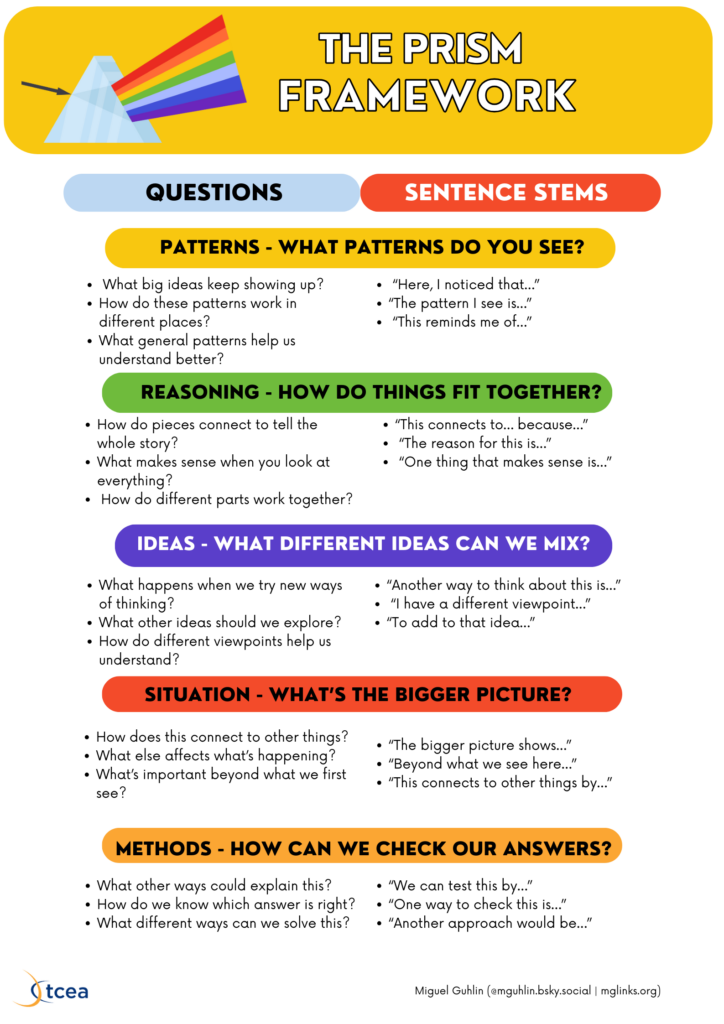
In the ever-evolving landscape of education and technology, AI literacy is quickly becoming an essential skill. Greg Kulowiec’s work highlights the need for increased understanding and strategic use of generative AI, focusing on the importance of literacy before widespread adoption. Using the PRISM framework—Patterns, Reasoning, Ideas, Situation, and Methods—we can explore AI literacy in a structured and critical way.
Considering AI Literacy
Greg Kulowiec does a phenomenal job in this webinar (I listened to it at 1.25 speed and it was a mad dash through his ideas and information). This blog entry is based on running a transcript (created with Whisper Desktop) of Greg’s presentation in the webinar through custom GPT to analyze via PRISM. I hope he doesn’t mind this interpretation.
PRISM, in case you’re not familiar with it, is a tool that aligns to the SOLO Taxonomy and I use to assist me in better understanding complex topics. A quick overview of PRISM is available here.

Ok, let’s apply PRISM to Greg’s webinar. This analysis is AI mediated.
PRISM Overview
Here’s a quick takeaway in case you don’t want to read everything:
- Patterns: “AI doesn’t think—it predicts; recognize the pattern before you trust the answer.”
- Reasoning: “Question AI like a detective—don’t just take its word for it.”
- Ideas: “Use AI as a spark, not a crutch—creativity still belongs to you!”
- Situation: “AI shapes the world, but understanding its impact lets you shape it right back.”
- Methods: “Test, tweak, and challenge AI—because smart users make smarter machines.”
Ok, with those in mind, let’s take a closer look.
Patterns: Recognizing Trends in AI Literacy
Kulowiec identifies a clear pattern: as AI literacy increases, the indiscriminate use of generative AI tends to decrease. This counterintuitive observation suggests that deeper understanding leads to more intentional, thoughtful applications. His model encourages educators and students to analyze the output of generative AI rather than just accepting it.
One example is the use of Tokens for Education, which visualizes AI-generated text probabilities. This helps users understand that AI doesn’t “know” information but rather predicts words based on statistical likelihoods. Recognizing these patterns allows educators and students to develop a more nuanced approach to AI tools.
Reasoning: Connecting the Dots in AI Usage
Kulowiec emphasizes the need to leverage AI tools with intention. He presents a structured AI Use Spectrum (Version 4.0) that categorizes AI interactions based on human effort and ownership of ideas. The spectrum ranges from full automation (e.g., using AI to complete entire assignments) to more reflective, interactive uses (e.g., generating discussion questions based on student work).
A great example of critical reasoning in AI literacy comes from The Frayer Model for Vocabulary Learning. This model enhances AI-assisted learning by helping students define, categorize, and apply new concepts within structured parameters. It ensures students engage critically rather than passively accepting AI-generated responses.
Ideas: Expanding Thoughtful AI Integration
How can we use AI in more meaningful ways? Kulowiec suggests that AI should not replace human cognition but enhance it. For example, rather than relying on AI to generate entire essays, students can use it to receive structured feedback on their own writing. Another innovative approach involves using AI to generate discussion questions that push students toward deeper reflection and synthesis.
Examples by grade level aligned with the SOLO Taxonomy:
- K-2 (Prestructural – Unistructural): Using AI-assisted read-aloud programs to help young learners develop phonemic awareness while ensuring engagement with interactive storytelling. This supports early foundational skills through structured guidance.
- 3-5 (Multistructural): Implementing AI-generated reading comprehension questions tailored to student ability levels, providing personalized support and challenge. At this stage, students can identify multiple relevant ideas but may not yet link them conceptually.
- 6-8 (Relational – Extended Abstract): Leveraging AI chatbots to simulate historical figures, allowing students to engage in critical thinking through role-play discussions. This promotes deeper connections between ideas, synthesis, and application in new contexts.
I like the idea of embedding the SOLO Taxonomy levels since it really makes a difference in appreciating these grade level examples. One could ask, What would grade level activities at all levels of SOLO look like?
Situation: Understanding the Larger Context
AI literacy is not just about using AI responsibly in the classroom; it’s about preparing for an evolving digital landscape. Kulowiec warns against rigid AI policies, advocating instead for adaptable frameworks that account for rapid technological shifts. Schools often struggle with policy development because AI evolves faster than bureaucratic decision-making.
An example of this adaptability is The Amazing Lesson Design Outline (ALDO), which incorporates high-effect size instructional strategies to help educators plan for AI integration. This model ensures AI is contextualized within best teaching practices rather than being used haphazardly.
Methods: Testing and Refining AI Strategies
To build true AI literacy, educators must provide students with hands-on experiences that encourage skepticism and verification. Activities like comparing multiple AI models or challenging AI-generated top-10 lists with pushback and revisions teach students that AI outputs are fluid and adaptable.
Another approach is using Human Bingo as an Interactive Icebreaker, where AI tools could be integrated to help customize and adapt the game to different educational settings. Some ideas relevant to Human Bingo:
- AI-Generated Prompts: Use AI to create diverse and engaging bingo card statements tailored to your audience.
- Automated Card Creation: Develop an AI tool to automatically generate and distribute personalized bingo cards.
- Real-Time Matching: Implement an AI-driven app to help participants find matches in real-time during the game.
- Post-Game Analysis: Use AI to analyze the connections made during the game and provide insights for future collaboration.
- Adaptive Learning: Integrate AI to adapt the game’s difficulty or content based on participants’ engagement and feedback.
- Virtual Gameplay: Create a virtual version of Human Bingo using AI to facilitate online or hybrid learning environments.
- Personalized Feedback: Use AI to provide personalized feedback to participants based on their interactions and discoveries during the game.
Kulowiec also highlights the benefits of local AI models (e.g., GPT for All, Olama) that allow users to engage with AI without contributing to environmental concerns or exposing private data. These tools offer an alternative to cloud-based generative AI, ensuring more control and transparency.
Conclusion: Empowering Educators and Students Through AI Literacy
By applying the PRISM framework, we can move beyond surface-level AI engagement and cultivate a more sophisticated, critical understanding of generative technologies. Greg Kulowiec’s approach underscores that AI literacy is not about increasing AI use—it’s about making that use intentional, ethical, and context-aware.
As AI continues to shape education, equipping students with these skills will be crucial. The goal is not to reject AI, nor to embrace it blindly, but to develop thoughtful strategies that integrate AI into learning in ways that enhance, rather than replace, human thought.
Discover more from Another Think Coming
Subscribe to get the latest posts sent to your email.
 Another Think Coming