On Monday, 04/21/2025 (actually, at noon today), I get to present to a Texas university via a webinar. It’s been fun curating the content and finding a way to make it available online. I decided to convert my slide deck to a PDF, convert it to text, then drop it into AI tools to see what could be done with it.
Note: You can find my actual presentation and supplemental links/resources online at https://go.mgpd.org/shsu
Notebook LM
I’m not spending a lot of time on Notebook LM. Others are going to cover this tool at future events, but I got the idea from a Facebook chat about using Notebook LM to create study guides, quizzes, etc. with it. Let’s take a look.
Exploring Notebook LM
Google’s NotebookLM makes it easy to create a study guide, etc. for content you give it. It even creates a concept map you can dig into.
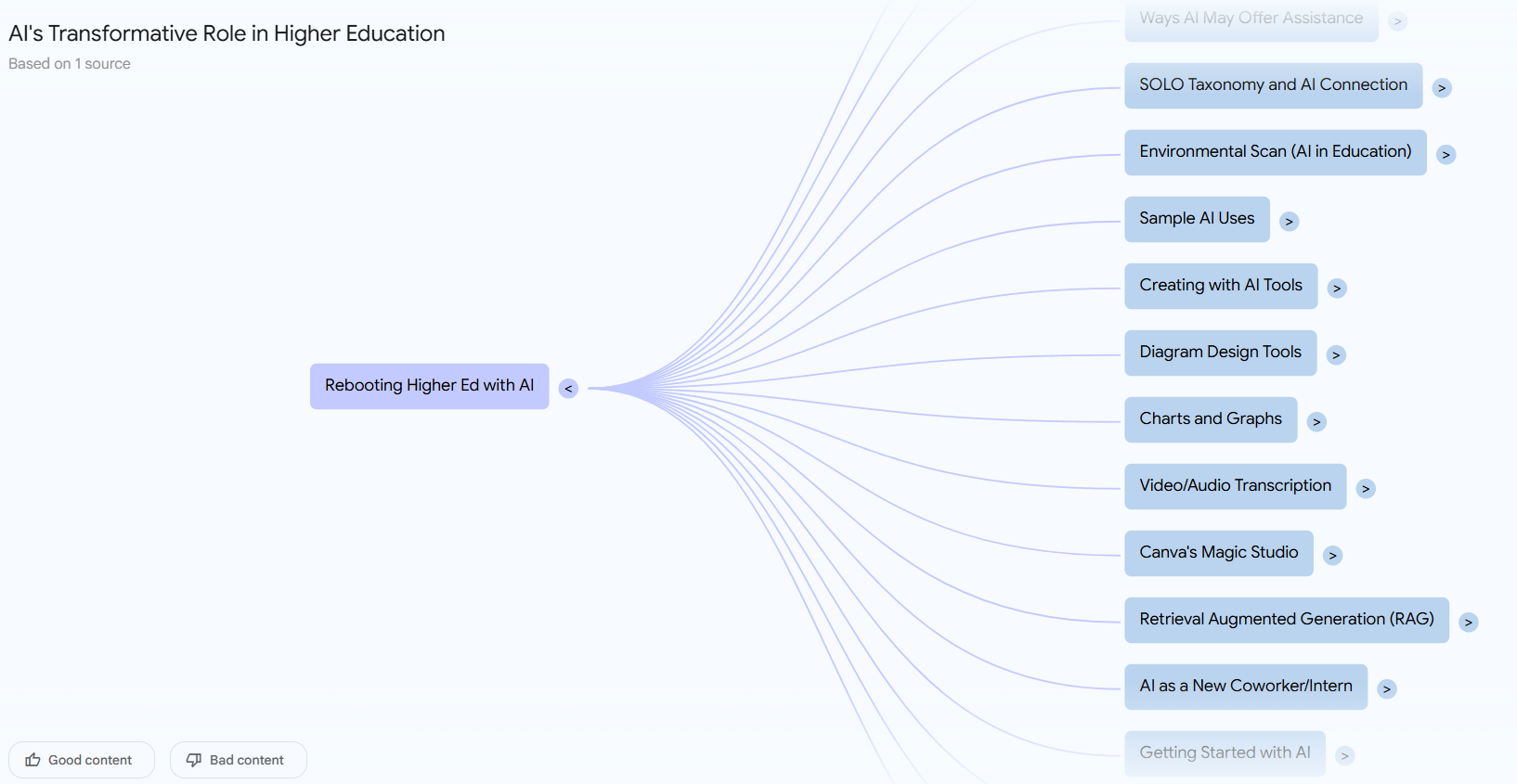
Click on a point, like “Creating with AI Tools,” and you get more details:

Listen to Audio Discussion About Preso
This is always a lot of fun to listen to. Listen to two AI hosts discuss the content of the presentation in podcast format.
Briefing Document: Rebooting Higher Ed with AI
Source: Excerpts from “Ctrl+Alt+Teach Rebooting Higher Ed with AI” by Miguel Guhlin
Author: Miguel Guhlin, Director, TCEA.org
Overview:
This briefing document summarizes the key themes and important ideas presented in Miguel Guhlin’s “Ctrl+Alt+Teach Rebooting Higher Ed with AI.” The document explores the transformative potential of Artificial Intelligence (AI) in higher education, offering practical guidance, highlighting emerging trends, and addressing crucial considerations for educators and institutions. The author (Guhlin) advocates for a proactive and thoughtful approach to AI adoption, emphasizing the need for AI literacy that empowers “dangerous thinkers, not docile users” (p. 26).
Main Themes and Important Ideas:
1. The Inevitable Integration of AI in Higher Education:
- Guhlin asserts that AI is not just a passing trend but a fundamental shift reshaping the landscape of higher education. He poses the critical question: “AI is reshaping higher ed. The question is: Will we lead, or be left behind?” (p. 9).
- The document highlights recent developments indicating rapid AI integration, such as free access to ChatGPT Plus and Perplexity Pro for college students (pp. 10-12), and the launch of Anthropic’s “Claude for Education” (p. 11).
- Statistics are presented showing significant student demand for 24/7 AI support (63%) and administrator welcome of AI agents (83%) (pp. 13, 15). Pilot programs, like the one at Georgia State University, demonstrate AI’s potential to reduce student wait times (by 21%) (p. 14).
2. A Phased Approach to AI Adoption:
- The “Five Phases of AI Adoption” provides a framework for institutions to strategically integrate AI. These phases range from “AI Secured” (prohibiting AI use) to “AI Unification” (centralized management) and ultimately “AI Everywhere” (seamless integration across all aspects of the institution) (p. 5). This suggests a gradual and considered implementation process is recommended.
3. Practical Applications of AI for Educators:
- The document offers numerous practical ways educators can leverage AI tools to enhance their teaching and streamline their work. These include:
- Content Creation: Generating lesson plans, syllabi, quizzes, and other materials (p. 27, 30, 33). Anna Mills suggests using AI for “Quiz questions,” “Discussion Questions,” and “Lesson Plan and lesson hook ideas” (p. 30).
- Assessment and Feedback: Automating feedback and creating rubrics (pp. 27, 30, 34-36).
- Personalized Learning: Tailoring learning paths for individual students (p. 27). Jason Gulya notes that “AI allows professors to: Personalize instructions, Design better lessons” (p. 31).
- Administrative Tasks: Automating tasks and streamlining operations (p. 11, 31).
- Creating Engaging Activities: Utilizing AI image generators (like Padlet’s) for icebreakers and visual aids (pp. 3, 43).
4. AI Tools and Resources:
- The document provides an extensive list of AI-powered tools categorized by their function, including:
- General Purpose: ChatGPT, Perplexity AI, Google Gemini, Khanmigo Tools, MagicSchool.ai, Padlet TA (pp. 63, 75-78).
- Presentation Creation: Gamma.app, Gemini AI + Gamma AI (pp. 40-41).
- Image Generation and Editing: Lummi.ai, Canva’s Magic Studio, Ideogram, Adobe Firefly, Freepik AI, Prodia, Craiyon, NightCafe Art, Bing Image Creator (pp. 42, 53, 86-94).
- Diagram and Infographic Creation: Napkin AI, Draw Charts (pp. 44-51).
- Video/Audio Transcription: Whisper Desktop (p. 52).
- Retrieval Augmented Generation (RAG): Perplexity.ai Spaces, Google Gemini Gems, ChatGPT Custom GPTs (pp. 54-56).
- Note-Taking and Meeting Assistance: Otter.ai, Fireflies.ai (pp. 79-80).
- Email Management: Tools for simplifying email writing and organization (pp. 81-82).
- Website Design: Framer AI (p. 83).
- Research Assistance: Consensus, Elicit (pp. 84, 97).
- Logo Creation: LogoFast (p. 98).
- Text-to-Video: Sora, Typpo (pp. 95, 106).
- PDF Interaction: Ask Your PDF (p. 96).
5. Key Considerations and Concerns:
- Academic Integrity: The document acknowledges that “Assessments no longer assure one of attained learning outcomes” in the age of AI (p. 22).
- Bias and Ethical Concerns: AI models are trained on biased data, raising concerns about the perpetuation of these biases (p. 22).
- Data Privacy and Security: Using free AI tools raises data privacy concerns (p. 22, 24). Guhlin recommends a three-step approach to safeguarding data privacy when using AI (p. 24) and emphasizes the importance of understanding an organization’s AI data policy (p. 25).
- Threats to Critical Thinking: Over-reliance on AI may lessen students’ willingness to engage in critical thinking (pp. 22-23). However, the document also highlights how AI, like Anthropic’s Claude, can take on critical thinking tasks and potentially support its development (p. 23).
- AI and the Job Market: The potential for AI job displacement is raised, along with the emergence of new AI-powered roles. The “JobGPT” tool is presented as a resource to analyze AI’s impact on specific jobs (pp. 19-21).
6. The Importance of AI Literacy and Responsible Use:
- Guhlin emphasizes the need to cultivate “AI literacy that makes students dangerous thinkers, not docile users” (p. 26), echoing James O’Hagan’s call to empower students to critique and design alternatives to AI platforms.
- The document stresses treating AI as a “new coworker or Intern” that requires clear communication and guidance (p. 58).
- Practical guidance on effective prompting techniques is provided, including using natural language, defining roles, specifying actions, and managing output formats (pp. 60-61). Ethan Mollick’s quote reinforces this: “Working with AI is a dialogue, not an order.” (p. 62).
- The SOLO Taxonomy is presented as a framework for understanding students’ learning phases in relation to AI integration (pp. 28-29).
7. Building Institutional Capacity for AI Integration:
- The TCEA’s five-phase adoption policy suggests a structured approach to district-wide AI integration (p. 5).
- The concept of creating “Digital Backpacks for Your AI Assistant” and “Knowledge Stacks” (including custom instructions, exemplars, and reference documents) is introduced as a way to enhance the effectiveness and consistency of AI outputs, particularly in tasks like syllabus generation (pp. 67-69).
Conclusion:
“Ctrl+Alt+Teach Rebooting Higher Ed with AI” serves as a comprehensive and practical guide for educators and institutions navigating the rapid advancements in artificial intelligence. Miguel Guhlin highlights both the immense opportunities AI presents for enhancing teaching, learning, and administrative efficiency, while also underscoring critical considerations related to ethics, equity, and the development of essential skills like critical thinking. The document encourages a proactive, informed, and responsible approach to AI adoption, emphasizing the need for ongoing learning and adaptation in this evolving technological landscape. The extensive list of AI tools and practical strategies makes this a valuable resource for anyone looking to effectively integrate AI into the higher education environment.
A Study Guide
In the study guide below, you’ll find a quiz, answer key, essay format questions, and glossary of key terms.
AI in Higher Education: A Study Guide
Quiz
- According to the TCEA’s AI Adoption framework, what are the five phases an educational institution might go through when integrating AI? Briefly describe two of these phases.
- The text mentions “dangerous thinkers.” Explain what James O’Hagan means by encouraging students to be “dangerous thinkers” in the context of AI literacy.
- Describe two potential benefits of using AI for assessment and feedback in higher education as outlined in the text.
- Explain the core idea behind the SOLO Taxonomy and how it can be used to understand students’ learning in relation to AI integration.
- The text highlights concerns about bias in AI. Explain why AI tools might exhibit bias and what the potential consequences of this bias could be in an educational setting.
- What is Retrieval-Augmented Generation (RAG) as it is presented in the context of AI tools like Perplexity.ai Spaces and Google Gemini Gems?
- According to Ethan Mollick, how should educators approach AI as a “new coworker or intern”? What are two key characteristics he uses to describe this relationship?
- The text outlines essential skills for effective prompting of AI tools. Describe two of these essential skills and why they are important.
- Name two AI tools mentioned in the text that are specifically designed to assist with creating visual content, such as presentations or infographics.
- Briefly describe how AI agents are being used in higher education settings, providing at least one specific example mentioned in the text.
Answer Key
- The five phases of TCEA’s AI Adoption are Secured, Exploration, Pilot Programs, AI Unification, and AI Everywhere. In the Exploration phase, teachers pilot AI tools in their classrooms, and basic guidance on evaluating and using AI responsibly is provided. In the AI Unification phase, AI tools are integrated into district policies and procedures, detailed guidance on using AI effectively in subjects and grade levels is provided, and managed accounts for all users are established.
- By “dangerous thinkers,” O’Hagan means educators should foster AI literacy that encourages students to critically examine AI tools, question their funding and limitations, and understand who benefits from them. He advocates for students to critique the AI platforms they use and even design alternatives rooted in their own experiences, moving beyond passive acceptance of externally dictated integration.
- Two potential benefits of using AI for assessment and feedback are automated feedback, which can expedite the process and maintain consistency across large cohorts, and the creation of tailored learning paths for individual students based on their needs identified through AI analysis of their work.
- The SOLO Taxonomy (Structure of Observed Learning Outcomes) is a framework that describes increasing levels of complexity in a student’s understanding, from pre-structural (no understanding) to extended abstract (can apply knowledge to new situations). It can be used to identify a student’s current phase of learning and to tailor instructional strategies and AI integration to support their progression.
- AI tools are trained on existing data, and if that data contains societal biases (e.g., in language, representation), the AI can learn and perpetuate these biases in its outputs. This can lead to unfair or discriminatory outcomes in education, such as biased grading rubrics, skewed recommendations, or content that lacks diverse perspectives.
- Retrieval-Augmented Generation (RAG) is a process where AI tools enhance their responses by retrieving information from external knowledge sources (like the web or specific documents) and then using that information to generate more accurate and contextually relevant answers. This helps overcome the limitations of the AI’s training data.
- Ethan Mollick suggests treating AI like an “infinitely patient new coworker or intern who forgets everything you tell them each new conversation,” one that comes highly recommended but whose actual abilities are not always clear. Key characteristics are infinite patience and a lack of retained memory between interactions, requiring clear and repeated instructions.
- Two essential skills for effective AI prompting are using natural language (clear, conversational language as if explaining to a coworker) and specifying the desired output format (e.g., lists, tables, markdown). Natural language helps the AI understand the user’s intent more easily, while specifying the format ensures the AI presents the information in a usable and organized way.
- Two AI tools mentioned for creating visual content are Napkin AI, which transforms text into infographics and diagrams, and Gamma.app, which helps create and format presentations easily.
- Higher education institutions are using AI agents, such as chatbots, to provide 24/7 student support, answer common questions about financial aid and registration, and automate administrative tasks. For example, Georgia State University’s AI chatbot pilot program decreased summer melt (students admitted but not enrolling) by 21% by streamlining financial aid and registration processes.
Essay Format Questions
- Discuss the potential ethical implications of widespread AI adoption in higher education, focusing on at least three distinct areas of concern raised in the text (e.g., bias, data privacy, critical thinking). How might institutions proactively address these challenges?
- Analyze the potential impact of AI on the roles of both educators and students in higher education. Consider how AI tools might augment their work, create new opportunities, and potentially pose challenges to traditional responsibilities and learning processes.
- Drawing upon the TCEA’s Five Phases of AI Adoption and the various AI tools discussed in the text, outline a strategic plan for a university to integrate AI effectively and responsibly across its academic and administrative functions. Consider key milestones, necessary resources, and potential challenges.
- Explore the concept of “AI literacy” for both educators and students in the context of higher education. What key knowledge, skills, and dispositions are essential for navigating an AI-integrated learning environment, and how can institutions foster the development of this literacy?
- Critically evaluate the argument that AI will primarily lead to job displacement versus job creation in the future, particularly within fields traditionally associated with higher education graduates. How can universities prepare students for the evolving job market in an age of increasing AI capabilities?
Glossary of Key Terms
- AI Agent: An autonomous program that can perceive its environment and take actions to achieve goals. In higher education, these can include chatbots providing student support.
- AI Literacy: The understanding of AI concepts, capabilities, limitations, and ethical implications, as well as the ability to effectively interact with and utilize AI tools.
- Bias (in AI): Systemic prejudice in AI outputs resulting from biased data used in training, leading to unfair or skewed results.
- Critical Thinking: The ability to analyze information objectively, evaluate arguments, identify biases, and form reasoned judgments. The text discusses potential threats of AI to this skill.
- Few-Shot Prompting: A technique in AI prompting where examples of the desired output are provided to guide the AI’s response.
- Generative AI: A type of artificial intelligence that can produce new content, such as text, images, or audio, based on the data it has been trained on.
- Hallucination (in AI): Instances where an AI generates false or nonsensical information that is not grounded in its training data or provided context.
- Khanmigo: An AI-powered tutor and assistant from Khan Academy integrated into their learning platform.
- Megaprompt: A comprehensive and detailed prompt provided to an AI, containing specific instructions, context, and desired outcomes to guide its generation.
- Natural Language Processing (NLP): A field of AI focused on enabling computers to understand, interpret, and generate human language.
- Padlet: A collaborative online bulletin board platform that offers AI-powered features like an image generator and teaching assistant.
- Prompt Engineering: The process of designing and refining prompts to elicit desired and high-quality responses from AI models.
- Retrieval-Augmented Generation (RAG): An AI technique that enhances the accuracy and relevance of generated text by retrieving information from external sources and incorporating it into the response.
- SOLO Taxonomy (Structure of Observed Learning Outcomes): A framework for classifying learning outcomes based on their complexity, ranging from simple recall to extended abstract thinking.
- TCEA (Texas Computer Education Association): An organization focused on advancing teaching and learning through technology. The text references their AI adoption policy framework.
- Token Limits: The maximum number of words or sub-word units that an AI model can process in a single input or generate in an output, which can affect the length and complexity of interactions.
Discover more from Another Think Coming
Subscribe to get the latest posts sent to your email.
 Another Think Coming