While attending a STEM-related workshop in Austin,Texas, I read a fascinating take on AI and writing. As you probably know, this is a hot topic. I have often asked myself how I might react if in the Writing Workshop class back in the day. After attending a workshop on computational thinking, decomposition (which I liken to summarizing, a way of discarding the non-essential), in the evenings, I retired to my hotel room villa (joke) to read. Taking notes, reflecting on the book featured in this blog entry took me back in time.
Writing Workshop in Cotulla, Texas
As writers in a writing workshop, my students and I worked out of manila folders, looseleaf sheets of paper, doing a sharing circle (a.k.a. Group Share) to read/reflect/offer feedback on writing done in class. I’d teach mini-lessons on various aspects of writing (e.g. grammar, passive vs active voice, writing leads, etc.). It was a lot of fun writing with my students. That was my first year of teaching, and I remember it fondly. I refined the work with sixth graders over time and in later years, but I long for those days of watching barely literate students make slow, painstaking, snail-like progress towards writing. I suspect the type-written anthology of their work is still somewhere in my garage, printed on goldenrod and bound. They all got copies. Today’s it’s child’s play to publish student writing online, but it still needs to be students’ writing.
Back to Today
Instead of perusing one of the dozen fiction books I had on my phone in those long evenings without my usual distractions, I decided to focus on Dennis Magliozzi‘s and Kristina Peterson‘s book, AI in the Writing Workshop: Finding the Write Balance. I don’t know about you, but focusing on one book is hard. Every device I have has a different type of media I can read/listen/interact with. It’s easy to flip between them.
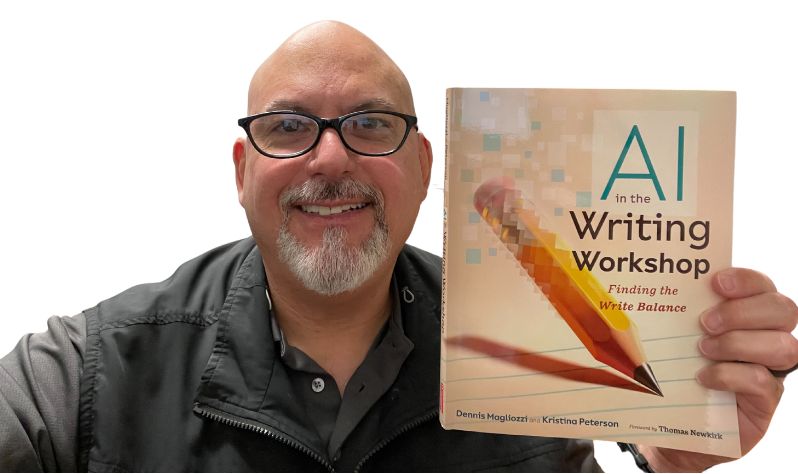
Thank you
Before I share my notes and a graphic summarizing my understanding, imperfect, of the book, I’d like to thank Kristina and Dennis for an awesome read. When my employer bought this book for me after an exchange I had on Bluesky (which I’ve dropped), a colleague also dropped a collection of 50+ books into my office. All were focused on writing and reading, mostly a la writing workshop approach.
As a teacher who relied on Nanci Atwell’s In the Middle and the writing workshop for working with third, fifth, and sixth grade students in K-12, this book (AI in the Writing Workshop) was terrific in making the connections. Having just read Peter Elbow’s Writing is Power book–a classic–for the first time, exploration of freewriting, I found the inclusion of quickwrites interesting.
So much so, I had to pause to see the differences, which an AI provided fairly quickly:
| Feature | Peter Elbow’s Freewriting | Quickwrites |
| Primary Aim | Idea generation, overcoming writer’s block, finding voice, fluency | Content engagement, reflection, assessment, discussion starter |
| Initiation | Often self-initiated or with a general goal | Usually prompt-driven by an instructor |
| Stopping | Strictly no stopping; continuous writing | Write quickly, but less rigid about non-stop |
| Editing | No editing during the process | No editing during the process |
| Privacy | Often emphasized as private, especially initially | May be private or shared for learning purposes |
| Duration | Typically 10-20 minutes | Typically 2-10 minutes |
| Context | Often a personal writing practice | Often an in-class instructional strategy |
| Variations | Focused freewriting, looping | Can be used as admit/exit slips, responses to readings, etc. |
Overall, I found the ideas shared in AI in the Writing Workshop to be in line with the spirit of writing workshop.
My Purpose
My purpose for reading the book? To see if the authors had found a response to the ethical dilemmas of using AI. Some argue that AI is unethical from the get-go, and that makes everything else done with it, unethical and unworthy of being relied upon in the classroom. Worse, we are starting to see some research points highlighting how AI undercuts productive struggle, critical thinking, and cognition. It’s not that AI does these things poorly (although some will argue “hallucinations” detract from any real benefit AI brings to the table), but that human beings lose out when using AI.
I applaud the authors of this book in their valiant attempt to deal with ethical AI issues. While they didn’t cover everything in their bullet list, organized as Fear and Mindset, they did well enough.
My Favorite Part
While it’s hard to pick out a favorite section, I love how the authors organized the book, addressing different topics through the process they put together. I’ve taken the liberty of making an infographic out of it (I hope they don’t get mad at me), trying to capture my understanding. It may be inaccurate, and you should read the book to get your own sense of it all:
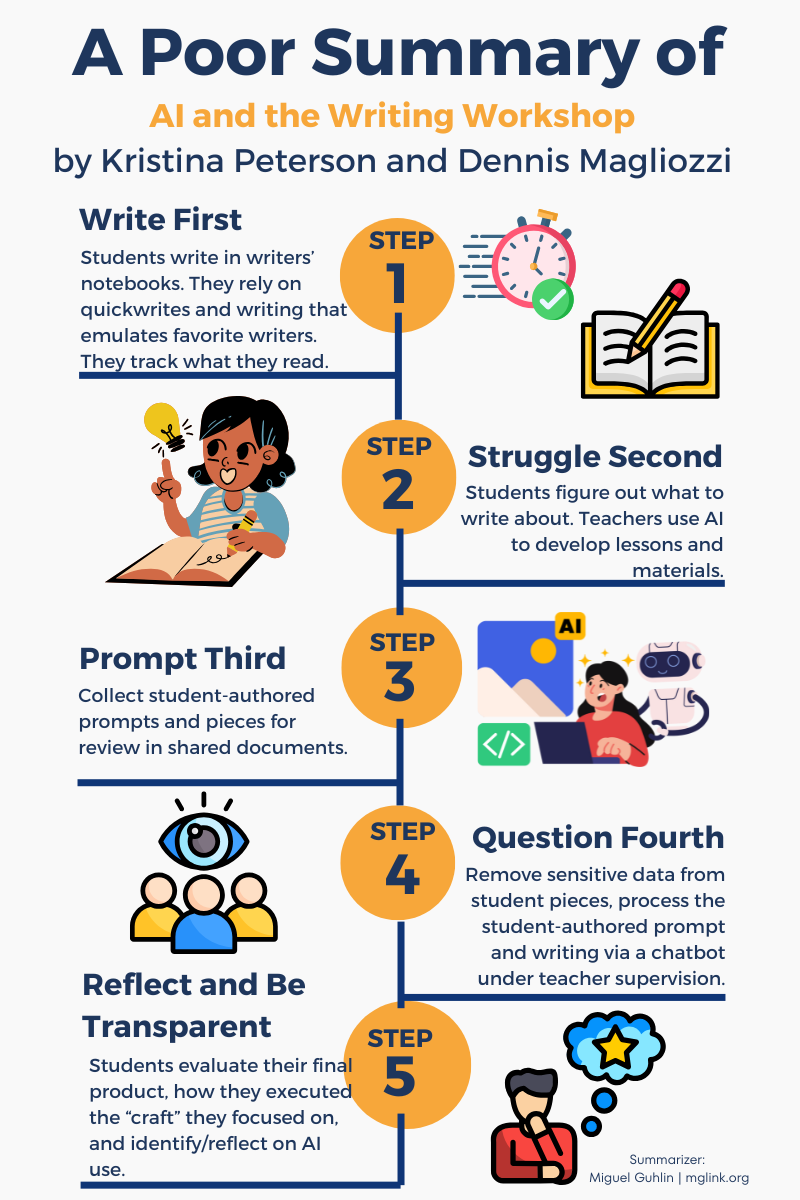
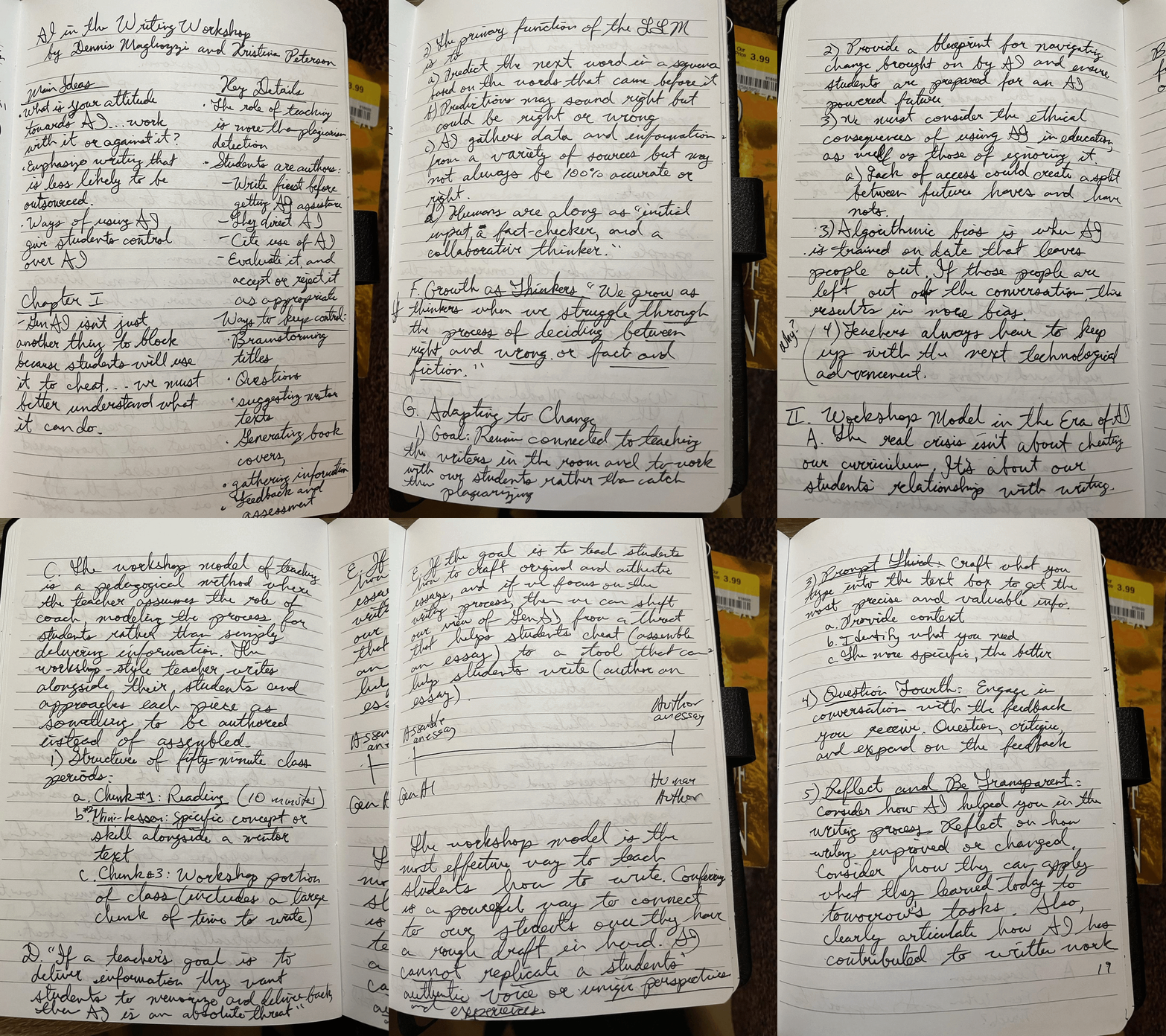
I love how they use this process to move through a variety of pertinent topics. Here are MyNotes, which I handwrote (see end of blog entry for an animated GIF), and I’m revisiting for the first time after finishing the book a few weeks ago.
MyNotes
These are my notes for Dennis Magliozzi’s and Kristina Peterson’s AI in the Writing Workshop. When I first started reading the book, I started organizing it into several quadrants, such as:
Main Ideas
What is your attitude towards AI…work with it or against it?
Emphasize writing that is less likely to be outsourced
Ways of using AI give students control over AI
Key Details
The role of teaching is more than plagiarism detection
Students are authors:
- Write first before getting AI assistance
- Students direct AI
- Cite use of AI
- Evaluate it, and accept or reject it as appropriate
Some ways to keep control:
- Brainstorming titles
- Questions
- Suggesting mentor texts
- Generating book covers
- Gathering information
- Feedback and assessment
As you can see, the authors get into their core ideas pretty quickly. The more I read, the harder it was to organize these ideas into quadrant notes (hey, I need a huge whiteboard or digital page, but I am committed to writing my notes by hand), so I dropped that approach and switch to simple outline form.
Chapter I
- Generative AI isn’t just another thing to block because students will use it to cheat…we must better understand what it can do.
I. Emergence and Role of the Gen AI in the English Classroom
- A. Avoid becoming a plagiarism detector
- B. It’s not enough to ignore it because it’s a part of our students’ lives already and they will grow up with it.
- C. Teaching students to leverage the power of AI has the potential to aid both students and teachers in the classroom.
- D. Multi-Literacies: As new literacies and media arrive, we have to learn their language and how to communicate with and through them.
- E. Compare AI to humans riding an electric bike. While the ebike gives humans an effective push, humans are still present and in control. Honest and transparent engagement is needed.
- 1) Avoid taking what the AI gives us as the final answer.
- 2) The primary function of the LLM is to:
- a) Predict the next word in a sequence based on the words that came before it
- b) Predictions may sound right but could be right or wrong
- c) AI gathers data and information from a variety of sources but may not always be 100% accurate or right
- d) Humans are along as “initial input, a fact-checker, and a collaborative thinker”
- F. Growth as Thinkers. “We grow as thinkers when we struggle through the process of deciding between right and wrong, or facts and fiction.”
- G. Adapting to Change.
- 1) Goal: Remain connected to teaching the writers in the room and to work with our students rather than catch them plagiarizing.
- 2) Provide a blueprint for navigating change brought on by AI and ensure students are prepared for an AI powered future.
- 3) We must consider the ethical consequences of using AI in education, as well as those of ignoring it.
- a) Lack of access could create a split between future haves and have nots
- 4) Algorithmic bias is when AI is trained on data that leaves people out. If those people are left out of the conversation, this results in more bias.
- 5) Teachers always have to keep up with the next technological advancement.
II. Workshop Model in the Era of AI
- A. The real crisis isn’t about cheating our curriculum. It’s about our students’ relationship with writing.
- B. Writing is often reduced to a formulaic exercise, one that can be outsourced and easily assembled by AI.
- 1) Many tasks in schools ask students to provide information or explain in a coherent way the answer to a prompt-based question. This is often the same question everyone else is responding to.
- 2) Re-evaluate our approach to teaching writing, and how that instruction enlivens that relationship or deadens it.
- 3) Classrooms need to be places where real writing happens.
- 4) Students need to engage with and explore a topic important to them.
- 5) Writing is about learning, how to think critically, creatively, and analytically. It is also about the nuances of language and developing a unique voice.
- C. The workshop model of teaching is a pedagogical method where the teacher assumes the role of coach. They model the process for students rather than delivering information. The workshop-style teacher writes alongside their students and approaches each piece as something to be authored instead of assembled.
- 1) Structure of a fifty-minute class period:
- a. Chunk #1: Reading (10 minutes)
- b. Chunk #2: Mini-Lesson: Specific concept or skill alongside a mentor text.
- c. Chunk #3: Workshop portion of class, and this includes a large chunk of time to write.
- 1) Structure of a fifty-minute class period:
- D. “If a teacher’s goal is to deliver information they want students to memorize and deliver back, then AI is an absolute threat.”
- E. If the goal is to teach students how to craft original and authentic essays, if we focus on the writing process, then we can shift our view of GenAI from a threat that helps students cheat (assemble an essay) to a tool that can help students write (author an essay).
- This can be represented as a continuum with “Assemble an essay” and “GenAI” as the agent on the left side, while “Author an essay” and “Human Author” as agent on the far right side. Presumably, with all sorts of gradations in between.
- The workshop model is the most effective way to teach students how to write. Conferring is a powerful way to connect to our students once they have a rough draft in hand. AI cannot replicate a students’ authentic voice or unique perspectives and experiences.
- F. GenAI as Writing Process
- 1) Use AI to complement the writing process
- 2) Teachers use chatbots with students as an ally for brainstorming and feedback
- 3) The key is to navigate it ourselves and teach students to use it ethically.
III. Central Rules for Writing with AI
- A. Core principles
- 1) Focus on writing process
- 2) Conference and collaborate with students
- 3) Engage in the writing process as an act of discovery
- 4) Set ground rules for AI engagement
- B. Five Rules
- 1) Write first
- 2) Struggle Second: Try to solve your own challenges and roadblocks before going directly to AI.
- 3) Prompt Third: Craft what you type into the text box to get the most precise and valuable info.
- a. Provide context
- b. Identify what you need
- c. The more specific, the better
- 4) Question Fourth: Engage in conversation with the feedback you receive. Question, critique, and expand on the feedback.
- 5) Reflect and Be Transparent: Consider how AI helped you in the writing process. Reflect on how writing improved or changed. Consider how they can apply what they learned today to tomorrow’s tasks. Also, clearly articulate how AI has contributed to written work.
Wow, that was only Chapter 1! It’s in Chapter 2 that the authors deal with Finding the Write Balance in the Ethics of AI. That makes it the most interesting chapter for me, but I found Chapter 1 enthralling as well. It lays out these five rules that really set the tone for the entire book. I highly recommend the book and a closer read. I’ll be sharing my notes for other chapters as time allows.
Discover more from Another Think Coming
Subscribe to get the latest posts sent to your email.
 Another Think Coming
[…] be denied AI access at the appropriate moments, and that access be tightly scaffolded (e.g. AI in the Writing Workshop is a book that describes the authors’ experiences in doing […]
[…] some ways, GUIDE reminds me of AI in the Writing Workshop process. What’s interesting is that in writing for publication, no author is going to be barred […]
[…] learn AI literacy without individual access. (Aside: In fact, this is quite similar to the approach AI in the Writing Workshop […]