It’s not every day you run into a number line inventor, but that was the case this morning at the Education Service Center, Region 9 Conference I attended. Slide-A-Round Math‘s Jim Franklin ( ) shared an amazing set of manipulatives for mathematics, one that you can even use with students who may be blind. You can watch this video before listening to the podcast and read some of his published articles below.
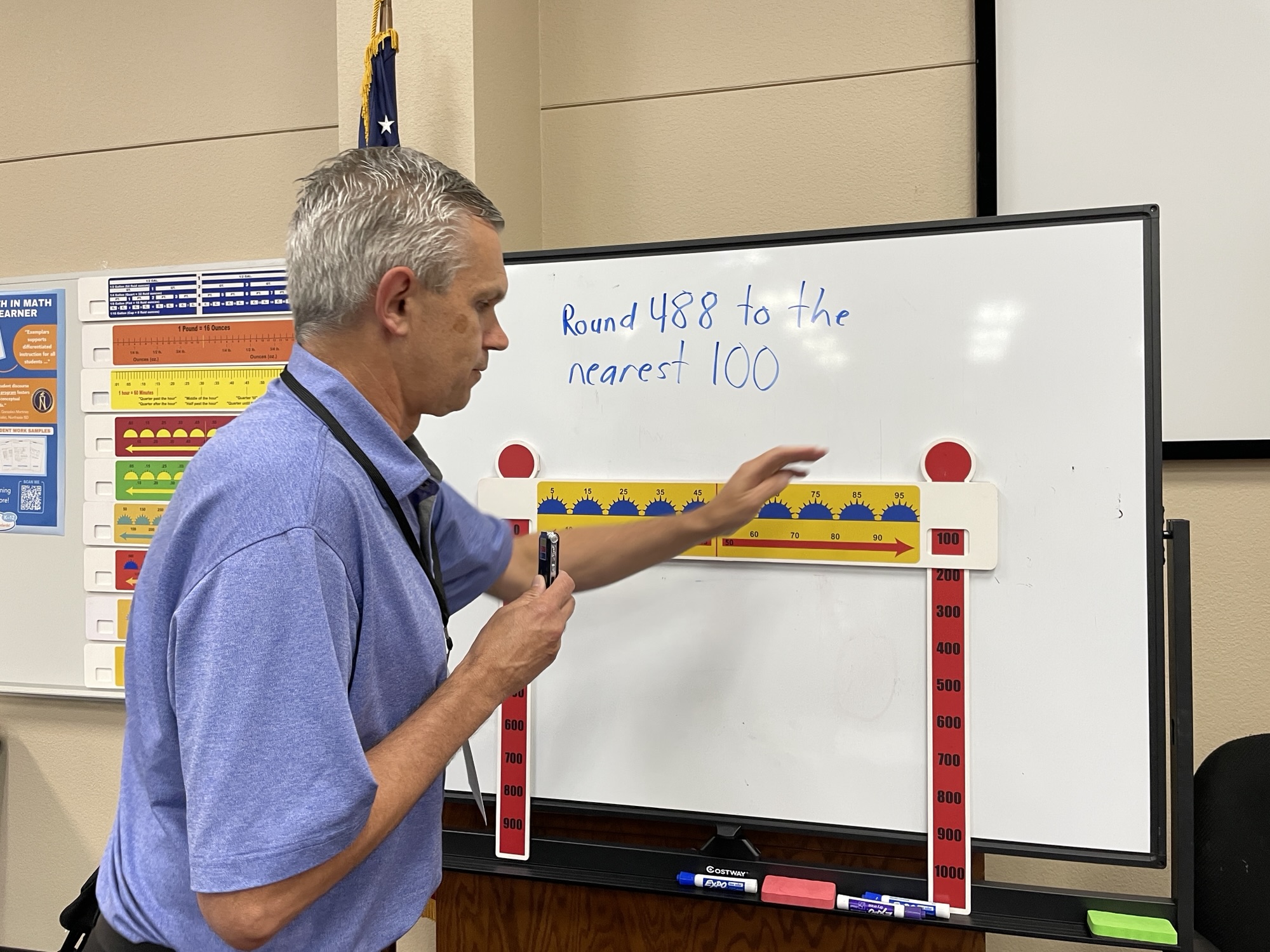
Slide-A-Round Math Manipulatives provide visual aids and a hands-on approach that increases students’ understanding and comprehension of place value, estimating and rounding of whole numbers and decimals, simplifying and comparing fractions, as well as addressing the standards of elapsed time, weight, and capacity.
Jim was kind enough to share the slide deck for his presentation:

Update 10/2025
Be sure to read these articles from Jim Franklin:
- Is it a STEM Project, Life Skills Unit, a Gift, or All of the Above?
- STEM & So Much More
- “Living Table” STEM Project
Listen to Jim Franklin on Slide-A-Round
Transcript
Note: The audio was transcribed using Whisper Desktop on Windows, with Google Gemini Pro 2.5 Pro processing it to organize it.
Miguel Guhlin: I’m here at the Education Service Center, Region 9, for the Collaboration for Growth Conference in June 2025. I’m in the exhibit hall and just happened to be walking by and saw what looked like thermometers, but now I realize they’re something else entirely. I’m chatting with Jim Franklin. Jim, why don’t you tell us a little bit about yourself, what you’ve been doing the last few years, and what you’ve got here.
Jim Franklin: Thank you for your time. My name is Jim Franklin. I’m a special ed teacher from Rome, Georgia.

The Slide-Around Math Manipulatives
Jim Franklin: I’ve invented a number line that goes to 10 million by incorporating the base 10 system into it. I’ve also created a way for students to add or subtract mixed numbers with different denominators and reduce them without paper and pencil. In addition to those, I have manipulatives for elapsed time, decimals, money, capacity, and weight.
They’re currently used in 43 different states, and teachers like that they’re used in all academic settings. They are used by students at deaf schools, blind schools, and the Helen Keller School in Alabama uses the Braille versions. I travel to conferences and school districts for in-person or virtual workshops. I’ve had really good feedback in Texas and will be going to Amarillo, Dallas, and Abilene this summer.

How the Manipulatives Work
Miguel Guhlin: That’s fantastic. Why don’t you tell us a little bit about how they work? Folks will be able to see a picture of it, but just walk us through the explanation.
Jim Franklin: The first one I want to talk about is my 100X. It’s set up to look like the letter H. The semi-circle on top goes from left to right with lines on it that are equal to one. Underneath the semi-circle, I have increments of 10 (10, 20, 30, etc.). The vertical slide on the left has 0, 100, 200, up to 900. The slide on the right has 100, 200, up to 1000. In the middle, there’s a line with a value of 50. An arrow indicates to go to the right for 50 or greater, and to the left for 49 or less.
For example, to round 488 to the nearest 100, you would put 400 in the window on the left slide and 500 in the window on the right. Then, you look at the “88” part. You move to the number 80 and count up 8 lines. When I ask students how they know the answer is 500, they say their finger is closer to 500, 88 is greater than 50, and it’s to the right of the middle line.
Eventually, I try to get them off the manipulative. I’ll take it away, draw two boxes and a line, give them a similar problem, and have them explain how they got the answer. The basic principle is that great teaching happens when students don’t know they’re being taught.
Adaptations for Visually Impaired Students
Miguel Guhlin: Jim, you mentioned your product is used in schools for the blind. Could you tell us how it has been adapted for those students?
Jim Franklin: That’s a great question. I’m not able to meet with the students individually, so I talk to their teachers. I ask them what we can do to adapt the manipulatives to meet their students’ needs. A TVI (Teacher of the Visually Impaired) who is a good friend of mine applies the Braille. I then relay her suggestions to other TVIs who might use them or tweak her ideas to better meet the needs of their specific students.
Finding Out More
Miguel Guhlin: Jim, thanks so much for sharing about your product. If folks wanted to find out more, where would they go?
Jim Franklin: They would go to www.slidearoundmath.com.
Miguel Guhlin: That’s fantastic. Thank you so much for sharing about your inventions.
Discover more from Another Think Coming
Subscribe to get the latest posts sent to your email.
 Another Think Coming
[…] Quickchat #2: Slide-A-Round Math […]