While much of my experiments on the desktop with GenAI have been disappointing (Gemma3:latest is one model that works well after a pause), I have found that models like tinyllama, phi3, gemma3n just don’t work well on my 1 GPU machine. In this blog entry, I test one model that does work well in two examples. The first focuses on analyzing claims and the second answering a tough question Texas school librarians face.
Ok, so what was one exception I stumbled upon in the Ollama Library of models?

OpenThinker:7b
A fully open-source family of reasoning models built using a dataset derived by distilling DeepSeek-R1.
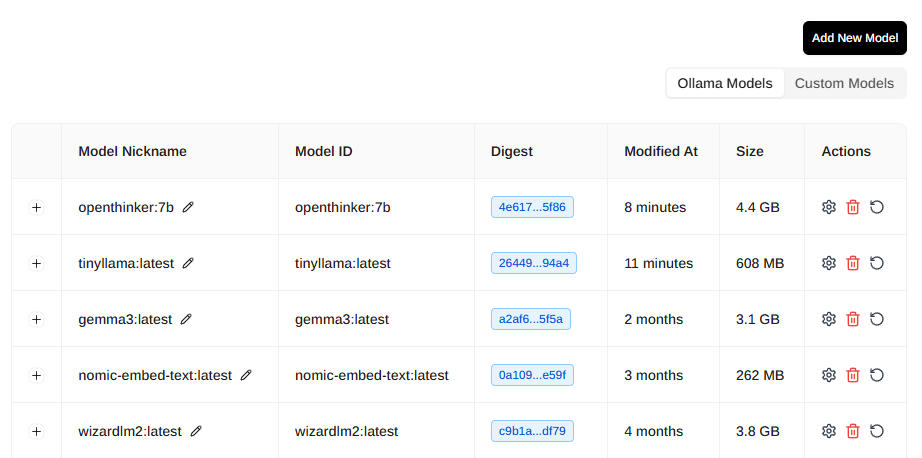
To get started, I downloaded it using PageAssist’s Add New Model button via my browser, which connects to Ollama. Models that are <=7b seem to work well as long as I don’t give them too much to do up front and provide custom instructions (or “system prompts”). A short time later, after waiting for download, openthinker was ready to go.
Getting Ready
I like to use critical thinking frameworks and have AI apply them. This allows me to test my custom instructions (a.k.a. system prompt in Page Assist). For example:
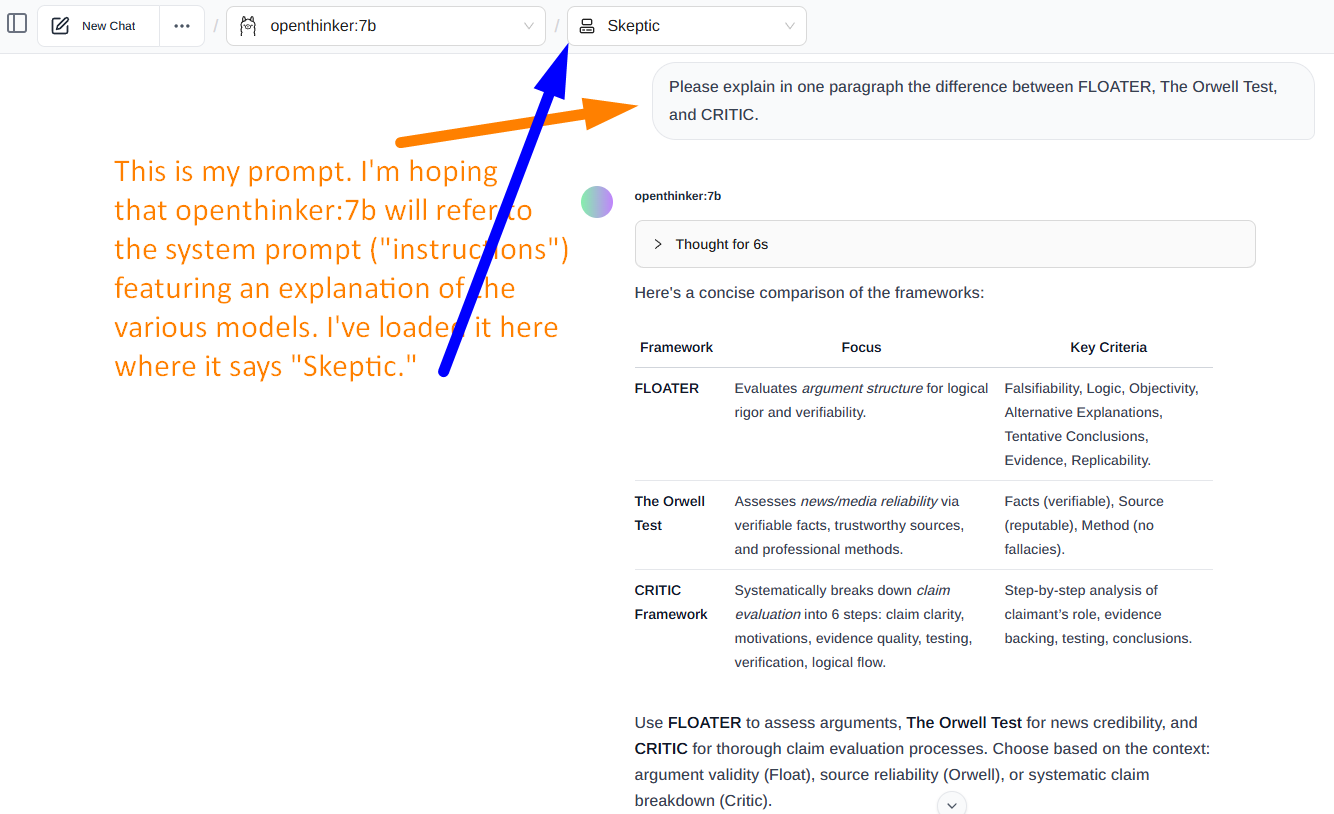
Since openthinker is a reasoning model, it actually thought about the answer for 6 seconds, which is amazing. It would take me a long time to come up with a table like this, much less prepare to apply it to a text.
Test #1: Identifying the Best Framework
The first test is to see how it decides which is the better framework of the three to use for a selection of text. In this case, it was the “An open letter from educators who refuse the call to adopt GenAI in education.” How would OpenThinker handle it?
Although OpenThinker did its best, it went off the rails:
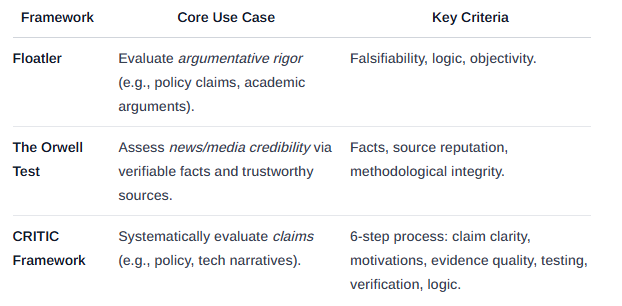
You can see that the FLOATER acronym got turned into “Floatler,” whatever that is.
Since FLOATER seems to be giving it a bit of trouble, I decided to have it assess the Open Letter using the CRITIC Framework.
Test #2: Analyzing Text
The results from the analysis:
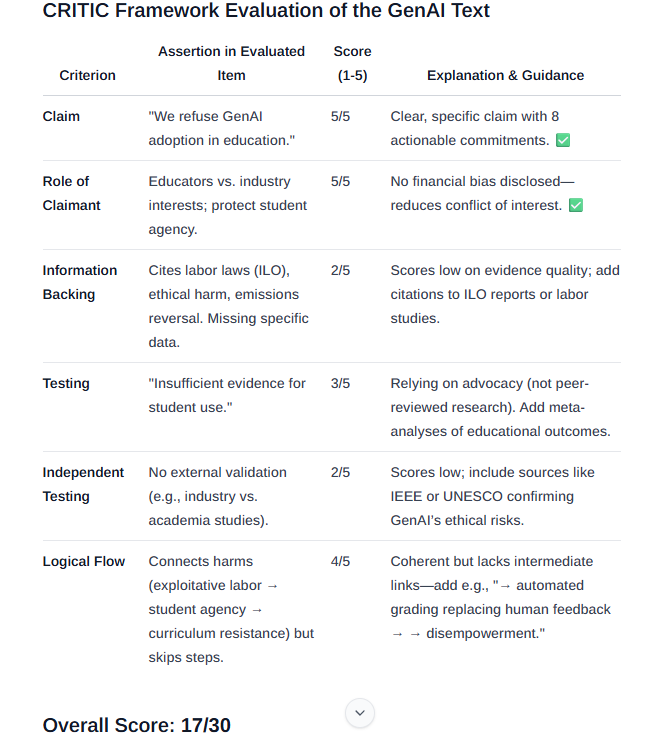
You know, what I thought was pretty interesting? The 14 second reasoning:
Thought for 14s
Okay, I need to apply the CRITIC Framework to evaluate the given text about rejecting GenAI in education. Let me start by recalling the six steps: claim clarity, role of the claimant, information backing, testing, independent verification, and logical flow.
First, identify the claim. The main claim here is that GenAI harms education and should not be adopted. The sub-claims include GenAI’s ethical issues like labor exploitation, environmental harm, etc. But I need to check if all claims are clearly stated. The text does present a unified front against GenAI adoption with specific non-negotiable policies (8 points). So the claim is clear.
Next, role of the claimant. The authors are education professionals, not corporate or GenAI stakeholders. They state their motivations: protecting student agency and academic freedom. This helps assess potential bias. Since they’re educators, their role is to guide learners, which aligns with opposing GenAI that might replace human roles. So no obvious conflict of interest here.
Information backing the claim. The text cites legal issues (piracy), ethical concerns (exploitative labor), environmental harm (reversal of emissions), and mental health crises. However, I should check if these are supported by specific examples or references. The text mentions “unethically-developed foundation models like ChatGPT” but doesn’t provide concrete data on labor exploitation rates or exact emissions figures. This might affect the score for evidence quality.
Testing: Have GenAI claims been tested and corroborated? The text argues there’s insufficient evidence for student use, relying on academic consensus (like IFLA reports). However, it’s a position paper rather than peer-reviewed research. Independent testing would require educational institutions conducting their own studies, which the current text doesn’t mention. So this criterion might score lower.
Independent verification: The CRITIC Framework requires checking if independent sources corroborate the claim. For example, looking for non-GenAI professionals or environmental groups confirming GenAI’s harm. The text mostly relies on education organizations’ stance without external validation beyond their own policies. This could affect replicability.
Logical flow: Does the argument logically connect points? From harmful practices (piracy, labor) to impacts on students and environment, then to pedagogical principles. It seems coherent, but some steps skip intermediate links. For instance, connecting “exploitative labor” directly to “genAI replacing educators” might need more bridging evidence.
Now, applying the CRITIC Framework step-by-step:
- Claim: Clearly stated as opposing GenAI adoption in education with 8 non-negotiable points. ✅
- Role of Claimant: Educators advocating for student agency and academic freedom. No conflicts. ✅
- Information Backing: Cites legal (ILO), ethical (creator rights), environmental (emissions reversal) harms, but lacks specific data or citations beyond general statements. Scores low on evidence quality.
- Testing: The claim asserts lack of evidence for student GenAI use, relying on academic integrity. No independent testing mentioned from outside education. Low score here.
- Independent Testing: No external validation provided (e.g., environmental impact studies by non-profit groups). Low score.
- Logical Flow: Coherent but skips some connections between harms and educational outcomes. Moderate score.
Overall Score: Sum the scores for each criterion. Since evidence quality, testing, independent verification are weak, while claim clarity and role are strong. Overall moderate score indicating partial validity with room for improvement in supporting evidence.
For now, I’ve turned off Web Search capability. This ensures the Open Letter isn’t used for training data or saved anywhere without permission. The model even suggests ways to improve the argument:
Guidance for Improvement:
- Enhance Evidence: Link GenAI’s ethical claims to specific legal/ethical frameworks (e.g., GDPR, Universal Ethical Charter).
- Independent Verification: Cite non-GenAI-led research on AI in education, e.g., studies from MIT or Stanford showing ethical AI tools.
- Strengthen Links: Explicitly connect GenAI harms (e.g., “→ replaces human creators → → → → reverses SDG 12 progress”).
Confirmation bias, appeal to fear, slippery slope may be biases/fallacies present in the Open Letter unsupported by evidence. That aside, what do you think of OpenThinker’s reasoning and results?
Test #3: Library Law
For fun, I took a knowledge bank and custom instructions for a Library Law Bot I put together. This allows me to compare responses to the same question using openthinker on local AI vs BoodleBox-based Bot I made earlier this month.
The question is:
“What steps do I need to take as a public school librarian in Texas before I buy a new book for my library collection?”
OpenThinker
Reasoning
Thought for 12s
Okay, so the user is asking about steps a public school librarian in Texas needs to take before buying a new book. Let me break this down.
First, they need to comply with HB 900 (READER Act) and SB 13. The key components here are mandatory collection standards, parental transparency, removal of certain materials, and alignment with TEA guidelines. So the steps should cover checking these laws.
They must evaluate each book against criteria like age-appropriateness, educational suitability, and community standards. Also, check for sexually explicit content which is prohibited. Parental rights mean they need to ensure parents can access the catalog and submit book challenges.
Inventory and cataloging are important. The librarian needs to maintain a detailed record of all books in the classroom library, using tools like Booksource or TeachingBooks.net. TEA guidelines mention collection analysis, so maybe referencing their model policies.
Parental access means the catalog should be public, possibly through an online system parents can view. They also need to handle parent requests to restrict specific materials for their kids.
For book evaluation, they need to check interest levels, professional reviews, and subject headings. Resources like Mackin.com or Publishers Weekly could help. Also, checking copyright years ensures compliance with usage rights.
Before purchasing, the librarian should remove any books that are sexually explicit, have indecent content, or are otherwise unsuitable. Following a district-approved policy is crucial here.
They might need to use TEA-provided forms for challenges and ensure removal during reviews. Teacher notifications are part of this process too.
I should structure the answer step by step, covering each legal requirement and practical step. Make sure to reference specific sections of HB 900 and SB 13 where applicable. Also, mention resources like TEA guidelines and challenge forms.
Wait, the user might not know about TEA’s model policies or the exact criteria for book challenges. Need to clarify those points. Emphasize the removal requirements for certain materials and parent transparency laws.
Also, ensure compliance with SB 13’s classroom library standards which mirror campus libraries. Parental rights include submitting lists of objectionable books, so the process should include handling those requests.
Finally, remind them to use challenge forms provided by TEA and notify teachers when removing books post-challenge. This ensures all parties are aware and compliant.
Results
Wow, this provided a response AND it linked to my Bot Feedback form. Cool.
Steps for Texas Public School Librarians Before Purchasing a New Book:
- Comply with Legal Requirements (HB 900/SB 13):
- Mandatory Standards: Ensure new books align with district-approved TEA guidelines for age-appropriateness, educational relevance, and community standards.
- Sexually Explicit Material Removal: Verify no books contain explicit content (Penal Code §43.24). Use tools like the Texas Collection Analysis Initiative to screen materials.
- Parental Transparency:
- Catalog Access: Make your library catalog (both campus and classroom) fully accessible online for parents.
- Challenge Process: Inform parents they can submit book restrictions via district forms (TEA-provided templates). Follow SB 13’s requirement to remove challenged books temporarily during review.
- Inventory & Cataloging:
- Use tools like Booksource Classroom Organizer or TeachingBooks.net to catalog every classroom library book, noting grade level and subject.
- Maintain a detailed list of removed books (e.g., for sexual explicitness) per TEA guidelines.
- Evaluate Book Suitability:
- Interest Level: Match the book’s content to Texas Essential Knowledge & Skills (TEKS) standards.
- Professional Reviews: Cross-reference resources like Publishers Weekly, School Library Journal, and ATSD for annotations on appropriateness.
- Challenge Criteria: Flag books with “pervasively vulgar” or indecent content (Penal Code §43.25).
- Remove Inappropriate Materials:
- Remove books meeting criteria like sexual explicitness immediately, per HB 900.
- Notify teachers in writing when classroom copies are removed post-challenge.
- District-Approved Protocols:
- Use TEA’s Challenge Form to document parent/guardian objections and district responses (SB 13).
- Follow board-approved policies for collection development, reviewed annually.
- Teacher Notification: Ensure affected teachers remove the book from classrooms per TEA guidelines.
Example Action Plan:
- Screen a new book by checking Penal Code §43.24 for explicit content.
- Add it to the catalog via Booksource Classroom Organizer, noting grade level and TEKS alignment.
- Share the catalog with parents through your district’s online portal (e.g., ClassroomDojo).
- If a parent challenges the book, use TEA’s challenge form to document their request. Temporarily remove the book from classroom shelves during review.
Next Steps for Guidance:
- Use TEA’s Collection Development Tool to draft your district’s policy.
- Train staff on handling parental challenges using SB 13’s protocols.
- Update catalog records quarterly with TEA-mandated assessments.
Note: Always consult district legal counsel for specific interpretations. [FeedbackFormFeedbackForm|https://docs.google.com/forms/d/e/1FAIpQLSe6td8EMbeAyOhLZJm4_wDUghDuKg6Vffxx-Vw6IXX6CB79yg/viewform?usp=header]
BoodleBox Library Law Bot
This Bot is based on the free version using ChatGPT 4o-mini, Library Law Bot. So there won’t be any reasoning.
Result
As a public school librarian in Texas, here are the steps you need to follow before purchasing a new book for your library collection, in compliance with HB 900 (READER Act) and SB 13:
Adhere to Board-Approved Collection Development Policies:
- Ensure that your district has adopted a board-approved collection development policy that aligns with the Texas Education Agency (TEA) model standards. This policy should outline the criteria for selecting library materials.
- Evaluate the Book:
- Use established evaluation criteria to assess the book. Consider factors such as interest levels, annotations, subject headings, professional reviews, and the book’s educational suitability. Resources like Mackin.com and Follett Titlewave can help consolidate this information.
- Check for Compliance with Content Standards:
- Confirm that the book does not contain sexually explicit material, is not pervasively vulgar, and meets the educational suitability standards as defined by Texas Penal Code 43.24.
Consult with a Library Advisory Council (if applicable):
- If your district has a library advisory council, seek their advice and recommendations regarding the book purchase. If your district does not have a council, follow the established local procedures for book acquisitions.
Public Posting (if required by local policy):
- While there is no statewide mandate for a 30-day public posting period for all book acquisitions, check your district’s local policy. If required, ensure that the proposed purchase is publicly posted for the necessary duration before final approval.
Document the Purchase:
- Maintain clear records of the book’s title, author, genre, and grade level appropriateness as part of your inventory and cataloging responsibilities.
Follow Local Procedures for Approval:
- If your district has implemented more stringent local approval processes, ensure that you comply with those requirements before finalizing the purchase.
By following these steps, you can ensure that your book purchases comply with Texas library legislation and meet the needs of your school community.
Assessing Responses
To assess the OpenThinker (local AI) response vs the BoodleBox AI, I turned to Gemini 2.5 Pro, a reasoning model with search capabilities. Let’s see what it says:
Response #1 provides a better, more thorough guide for a Texas school librarian, despite its one significant inaccuracy regarding the HB 900 vendor ratings. Its detailed, step-by-step approach, specific examples of tools, and comprehensive inclusion of new procedures from both HB 900 and SB 13 make it more practically useful.
Response #2’s primary strength is its superior accuracy on the most confusing part of HB 900. It correctly places the (currently halted) rating responsibility on vendors, which is a crucial distinction.
For a librarian seeking to understand the full scope of their new duties, Response #1 is the more valuable resource. However, it should be read with the critical caveat that the vendor-rating system it alludes to is not currently in effect, and librarians should focus on evaluation based on professional standards and their district’s board-approved policy, as Response #2 correctly emphasizes.
Gemini also offers this chart:
| Feature | Response #1 | Response #2 | Analysis |
|---|---|---|---|
| Accuracy on HB 900 | Partially Inaccurate. Implies librarians must actively screen books using a vendor-based system. This is misleading, as the vendor rating requirement of HB 900 is currently blocked by a court injunction. | More Accurate. Correctly clarifies that vendors, not librarians, are responsible for the ratings under the law. This reflects the current legal reality more precisely. | Winner: Response #2. Its description of the librarian’s role concerning content ratings is more precise and legally up-to-date. Response #1’s guidance could lead to a misunderstanding of a librarian’s obligations. |
| Completeness | More Complete. Provides a comprehensive workflow that includes legal compliance, parental transparency, cataloging, suitability evaluation, and specific procedures for handling challenges and removals as mandated by SB 13 (e.g., temporary removal of a challenged book). | Less Complete. Offers a good high-level summary of pre-purchase steps but omits key post-purchase details that librarians must be aware of, such as the process for temporarily removing a challenged book. | Winner: Response #1. It covers more ground and gives the librarian a fuller picture of the entire ecosystem of responsibilities connected to a new acquisition. |
| Actionability & Specificity | Highly Actionable. Gives specific examples of cataloging tools (Booksource Classroom Organizer), refers to TEA-provided forms, and presents a clear “Example Action Plan.” This makes the advice concrete and easier to implement. | Moderately Actionable. Suggests useful professional resources (Mackin.com, Follett Titlewave) but is otherwise a more generalized list of principles. It explains what to do but provides fewer specifics on how to do it. | Winner: Response #1. The inclusion of specific tools, forms, and a workflow example makes it a more practical guide for a librarian on the job. |
| Clarity & Organization | Very Clear. Uses strong headings, bullet points, and a concluding “Next Steps” section. The structure is logical and easy to follow. | Very Clear. The simple, numbered list format is straightforward and easy to digest. | Winner: Tie. Both responses are well-organized and clearly present their information. |
| Coverage of New Legislation (SB 13) | Good Coverage. Explicitly references SB 13 and accurately describes its key impacts, such as the parental challenge process and the requirement to remove books temporarily during a review. | Partial Coverage. Alludes to newer requirements like local Library Advisory Councils and public posting, which are components of SB 13, but does not connect them to the specific bill or detail the challenge process. | Winner: Response #1. It more directly and thoroughly integrates the new procedures from the most recent legislation, which significantly alters the day-to-day reality of school librarians. |
But Wait, There’s More!
I have a Library Law Pro version of the free one. It relies on Claude and it came up with:
Book Acquisition Process for Texas School Librarians
Based on current Texas legislation (HB 900 and SB 13), here are the steps you need to follow before purchasing new books for your school library:
1. Follow Your District’s Board-Approved Collection Development Policy
Your district must have a board-approved collection development policy that aligns with the standards adopted by the Texas State Library and Archives Commission (TSLAC). This policy should:
- Prohibit materials that are:
- Harmful as defined by Section 43.24 of the Texas Penal Code
- Sexually explicit
- Pervasively vulgar or educationally unsuitable
2. Evaluate the Book Using Approved Criteria
Evaluate potential acquisitions using professional criteria such as:
- Interest levels
- Professional review journals
- Subject headings
- Reading lists and awards
- Publisher reputation
- Copyright year
Consider using resources like Mackin.com or Follett Titlewave to help with evaluation.
3. Public Posting Requirement (SB 13)
According to SB 13, your district must:
- Make the list of proposed library materials accessible for public review for at least 30 days before final approval
- This applies to both purchased materials and donations
4. Obtain Proper Approval
SB 13 requires that the school board:
- Approve all library materials to be procured by a school library
- If your district has established a local school library advisory council, the board should consider their advice and recommendations
- The board must approve or reject the list of proposed materials in an open meeting
5. Document Compliance
Maintain documentation showing that:
- The material meets collection development standards
- You followed all required approval processes
- The material is appropriate for your school’s community standards
Important Notes:
- The specific approval workflow may vary by district, as some districts may have implemented more stringent local approval processes
- SB 13 implementation timeline: Districts must adopt acquisition policies before the 2025-2026 school year, and TSLAC must adopt new standards by April 1, 2026
- While HB 900 originally required vendors to rate books, this provision was struck down by the Fifth Circuit Court of Appeals, but the collection development standards remain in place
Would you like more specific information about any part of this process?
Gemini revised its assessment of all three responses to include the following:
Revised Conclusion
After assessing all three responses, Response #3 is the most accurate, up-to-date, and legally sound guide for a Texas school librarian. Its key strengths are:
- Legal Accuracy: It is the only response that correctly states the vendor-rating portion of HB 900 was struck down by the courts, providing essential legal context.
- Procedural Clarity: It provides the clearest, most detailed breakdown of the new acquisition process mandated by SB 13, including the 30-day public posting period and the requirement for final school board approval.
- Timeliness: Its inclusion of specific compliance deadlines for the 2025-2026 school year makes it the most actionable guide given the current date.
While Response #1 remains a valuable resource for its holistic view—particularly its useful description of how to handle parental challenges after a book is on the shelf—its inaccuracy regarding HB 900 makes it less reliable as a primary guide. Response #2 serves as a reasonable but overly general summary that is surpassed in detail and accuracy by the other two.
Therefore, Response #3 should be considered the best and most reliable set of instructions for the specific task of purchasing a new book. A librarian would be best served by using Response #3 as their primary guide for the acquisition process while using the information in Response #1 to supplement their understanding of how to manage their collection once the books have been acquired.
What I Think
Response #1, which was provided by OpenThinker, did a great job teasing out a sensitive topic and response. It was only beat by BoodleBox Bot running Claude 3.7 Sonnet. This suggests to me that it’s all about 1) The Model; 2) The Machine the Model is Running On. I can’t wait until BoodleBox upgrades it’s available Premium models to work for it’s Bots:
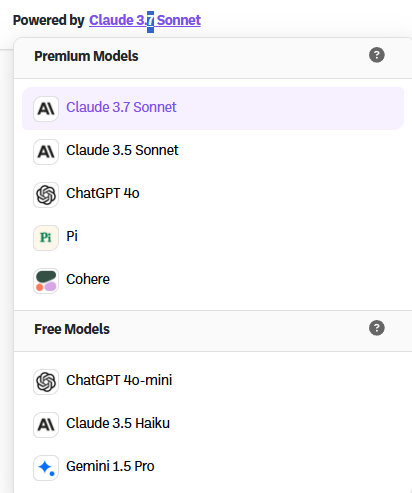
In the meantime, OpenThinker does a passable job.
Discover more from Another Think Coming
Subscribe to get the latest posts sent to your email.
 Another Think Coming