Note: This is a guest blog from my friend and colleague, Judy A., sharing about her experience with BoodleBox AI. Judy is a high school writing teacher at a local school. It has been slightly edited to remove identifying information. To facilitate readability, headings were added. No other edits or revisions were made. – Miguel
My Experience with BoodleBox
by Judy A.
I began investigating AI platforms a few weeks ago as a result of a visit with a friend. Initially, I listened to a presentation on basic usage of AI for classroom teachers. The presenter sent attendees to ChatGPT with an assignment. I was amazed at the results: organized content, thought-provoking input, and well-written. That began my interest in the feasibility of using AI as a teacher.
My friend suggested that I try a variety of AI platforms. Although limited in my experience with the various ones, I have found BoodleBox easy to use and its capabilities quite helpful for me as a teacher.
Retaining an In-Depth Critique
Beyond the concern about getting students to do their own thinking, one concern is retaining an in-depth critique of several components in my students’ papers. Most of the rubrics I have seen in platforms that allow online grading are too generic or holistic. In the past when I have tried to grade online with software, I could not apply my rubric and I was unable to adjust the software’s rubric, which was holistic. The newest AI platform available at school lacks the ability to assign any score even if the rubric has numerical values. I want my rubrics to be clear enough that I can defend points objectively.
Applicable and Thoughtful Feedback
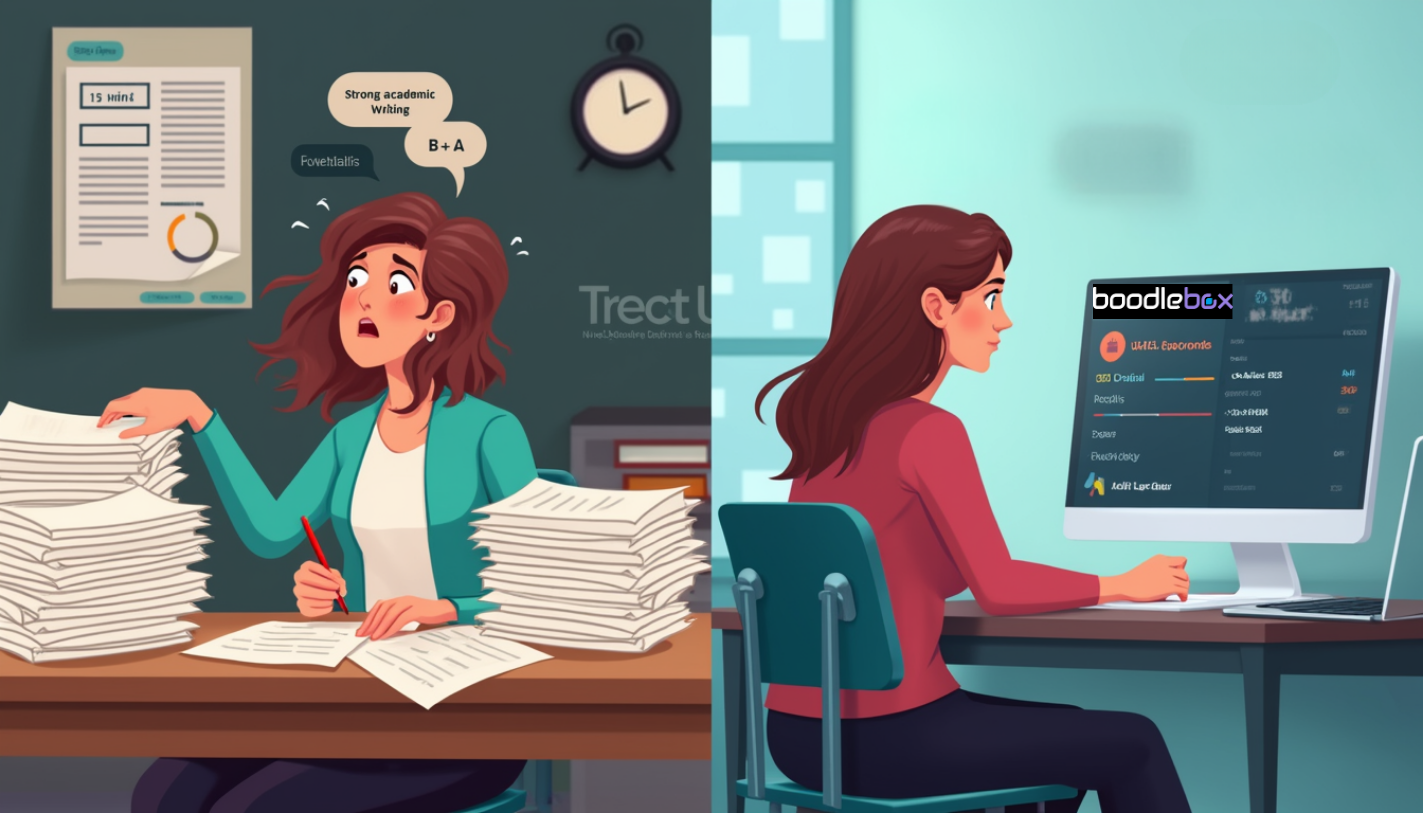
In my first created Bot, I provided a detailed rubric for a high school junior composition class and a sample research paper. My goal was to see how well the assistant could use the Bot to accurately score students’ research papers. My first direction for the AI assistant using my Bot reads as follows: Evaluate the attached research paper for its compliance with the components of the attached rubric, noting its strengths and weaknesses. Using my rubric, the AI’s evaluation appeared in about thirty seconds with applicable and thoughtful feedback. That research paper would have taken me fifteen minutes or more to evaluate.
Impressive Outcome
In regard to accuracy with my rubric, the assistant scored the paper a B+/A-. The grade was fair, but I was curious as to the distinction between the lower and the higher grade that it assigned; the assistant did not give a numerical score even though the rubric’s components each had a numerical value. As a teacher, I would not give a paper a score with a five point gap. I would need to commit and justify my rationale for the B+ or the A-. Since AI provides answers to questions, I figured mine was “fair game”.So, I asked the assistant for clarity: With no other major issues noted, explain whether this paper’s score is closer to an A- or B+ range. The AI response was quite distinct—and precise. It more accurately applied the terms that I had used in the rubric to differentiate between the number of points for each component based on a B or B+, an A- or A value. The outcome is impressive.
AI Assistant’s Clarity Shines
Using my rubric, the AI assistant addressed each component and sub-component and did so with verbiage that was encouraging in tone. Its response reads as follows: This paper demonstrates strong academic writing with proper formatting, credible sources, logical analysis, and effective organization. However, it falls short of the exceptional, standout quality required for an A+ according to the specific descriptors in the rubric. The difference between an A- and an A+ in this rubric appears to be the distinction between “very good” work and truly “exceptional” work. The AI assistant’s score matched mine within thirty seconds or so. This paper would have taken me fifteen minutes or more to read, score, and provide feedback. Additionally, the AI assistant’s justification was precise and clearly stated without being harsh. The assistant’s feedback outshone mine on this specific paper.
Benefits Go Beyond Time-Saving
The benefit I see in using an AI platform like BoodleBox is the saving of time, as well as recognizing ways to make my feedback clearer for students, especially the distinctions between points in the often gray areas, the difference between a B+ and A-, or an A- and A. As a teacher, I appreciate BoodleBox’s capacity to respond to input that helps me to be more efficient and more thorough for the benefit of both me and my students.
About the Author: Judy A.

Originally from Wisconsin, I’ve been teaching in Texas since 1983. I began at Del Rio High School where I taught English and coached debate and speech. An offer to coach debate and speech full time took me to San Antonio. Currently, I teach high school English to 10th, 11th, and 12th graders. Three years ago, I joined LeTourneau University’s adjunct staff to teach dual credit to the 11th and 12th graders. For refreshment I enjoy hiking, swimming, and reading biographies of European and American leaders.
Discover more from Another Think Coming
Subscribe to get the latest posts sent to your email.
 Another Think Coming