Over the last few weeks, I’ve heard numerous podcasts focused on ChatGPT’s “imminent arrival,” “the model router of [ChatGPT] AI models,” and how easy ChatGPT 5, the model that achieves elusive “Artificial General Intelligence.” As you might imagine, there is a lot of hype around frontier AI models. But what’s a poor educator to do?
Counting Up the Cost of Subscriptions
Like many folks out here in high-priced egg land, I’m counting my pennies and wondering, “What’s the benefit of Gen AI hype when it comes to putting groceries in the fridge and pantry?” You can’t eat all those subscriptions to various streaming media services. The same is true for Generative AI services. Here are a few I’ve subscribed to (and dropped) over time because I kept looking for a one stop-shopping solution.
- Perplexity: This was my first AI model, and I was blown away by what it could do. Not only did I not run into usage limits, I [subjectively] found that it was much better at avoiding hallucinations and providing fake web addresses for resources. I’d often start with Perplexity, then copy-n-paste that content into another Gen AI service. After awhile, working with different solutions, I realized that as much as I wanted Perplexity to succeed (early powerful experiences), it wasn’t worth the $20 subscription.
- ChatGPT: A powerful collection of models, it quickly became overwhelming to have to deal with multiple versions, like that fancy screwdriver or electric drill set with so many different bits, you long for the simplicity of that toolbox your Dad gave you when you were 8 years old (or sooner). This tool is still in my toolbox, and I measure it’s performance periodically to see, “Is this really able to be my one-stop, get ‘er done solution?” The answer is “almost.” The cost is $20 a month.
- Claude: I really enjoyed my Claude use, from getting quick answers to prompts to processing files, and building Projects and Artifacts. But Claude’s usage limits really grated on me. My work paid for an account, and I paid for a personal account. Between the two of them, I was still able to hit rate limits, told to wait for a few hours before everything reset. Worse, Claude would inexplicably come up with crazy answers. It’s like it would forget the context of our conversation, fail to read the materials I’d entrusted it with. Worse, I’d have to endlessly redirect it. If Gen AI is an intern, I was quite severe and direct with it. In the end, I decided the $20 wasn’t worth the return, even with Artifacts. I haven’t been back.
- Google Gemini: Up until version 2.5 Pro, I found Gemini to be a waste of time and effort. I’d kept up with it. Now, Gemini has taken its hits and grown. Although I canceled my subscription ($21.32 a month) yesterday, I am (like ChatGPT) able to use it through my work. I’ve built quite a few Gems and love Notebook LM and other features. It’s a great Gen AI, but there are a few caveats…all your data is used for training purposes, unless your license falls into Education or Business. Worse, they retain your data. So, Gemini keeps getting better with it’s inclusion of wonderful tools (e.g. Veo, Audio/Video Overview in Notebook LM, Flow).
You get the idea. When you factor in other subscriptions for popular Gen AI tools, you could end up making the hard decision, “Are all these subscriptions necessary?” The hype would have you believe they are. I suspect most of us can get by with one or two subscriptions to Gen AI tools.
But which ones? To make that decision, you have to know what you need to do, then bring them on as you need them, and cut them loose like you would a consultant. You don’t keep them on retainer forever.
Bot Stacking
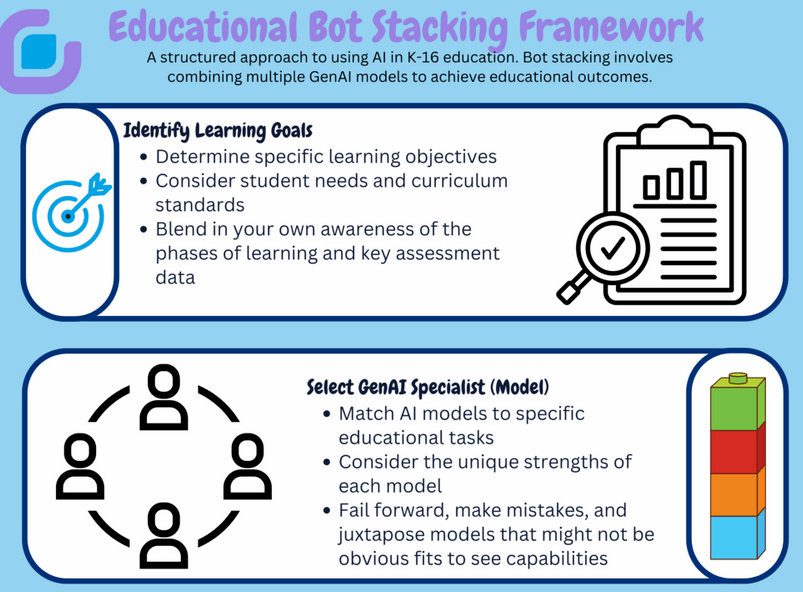
All this copying-and-pasting between models, though, did help me imagine the kind of workflow I wanted. I explore that in a TCEA TechNotes blog entry, Bot Stacking your way to a Gen AI Team. Here’s a little appetizer (and “Look, Ma! No hands!” where hands are “No paywall” haha):
Stop juggling AI models. Stack models to transform lesson planning, assessment creation, and curriculum development. It is tempting to adopt a one-AI-fits-all mentality. But the real transformation happens when you assemble an AI dream team tailored to your educational needs. This is the essence of bot stacking. It is a strategy for combining multiple AI models to enhance teaching, learning, and educational leadership.
Let’s take a look at how you can build an educational AI dream team and leverage it for maximum impact in K-16 settings.
Read the rest of the blog entry
Discover more from Another Think Coming
Subscribe to get the latest posts sent to your email.
 Another Think Coming