Over the weekend, David Cutler’s article, ChatGPT-5 Just Changed My Mind — AI Has No Place in My Classroom, was shared a few times (by Dr. Scott Mcleod, that trouble-maker extraordinaire). For a while, it was funny because no one could find the article. It sure seemed like Medium, who hosted the article, was closing down the link after so many hits. People who wanted to read it had to go hunting for the article via a search engine or wherever. No doubt, there was some other process at work but who has time to play the shell game of finding the working link?

Read the Original Article
Here is the article itself, but again, the link may go “bad.” Don’t be “daunted” by this, simply do a Google Search on the author and title.
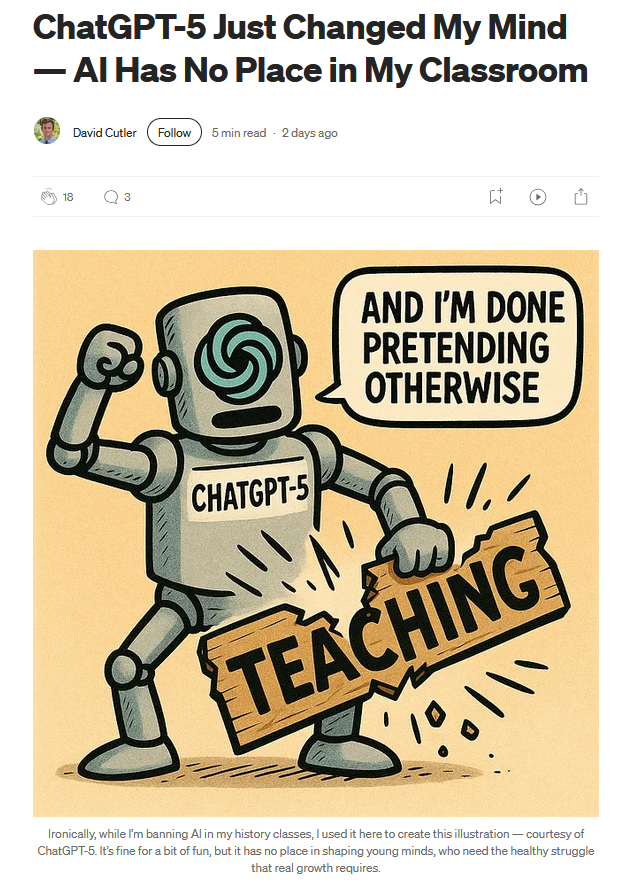
Outline of the Article
This outline was generated by my Boodle Box Bot, Outline Helper. You are welcome to give it a try. It is designed to transform text (like audio transcriptions) into traditional outline format. This is a big help when dealing with a lot of content from audio/video transcription for workshop sessions I present and record. It works fine with text articles, too. What’s more, Boodle Box doesn’t send the data and safeguards it against being used for training in any way. It’s as close to running local Gen AI model on your computer as you can get. So, no accusations that I’ve just violated copyright or something.
I. Introduction and Author’s Position
A. Author Background and Initial Stance
- David Cutler, a history teacher who previously wasn’t anti-technology
- Has written about beneficial AI uses in education when used carefully
- Experience with ChatGPT-5 changed his perspective dramatically
B. Core Argument
- ChatGPT-5 represents a fundamental threat to education
- Author is now “sounding the alarm” about AI in classrooms
- Declares AI has “no place in shaping young minds”
“This is different. This is dangerous. And I’m finally sounding the alarm.”
II. The ChatGPT-5 Threat Assessment
A. Previous Detection Methods
- Teacher developed system to recognize student writing styles
- Built familiarity with students’ voices through early assignments
- Could previously identify inconsistencies in writing patterns
B. New Capabilities That Nullify Detection
- ChatGPT-5 can precisely mimic a student’s writing style
- Can reproduce quirks, pacing, and diction after analyzing past essays
- Generates papers with accurate citations that appear time-consuming
- Can analyze even obscure or hard-to-find texts when uploaded
C. Impact on Learning Process
- AI erodes depth while offering efficiency
- Replaces the struggle that leads to intellectual growth
- Shortcuts the process of wrestling with ideas and language
- Undermines development of patience and writing skills
“When AI shortcuts that process, it doesn’t just ‘assist’ — it replaces the very struggle that leads to growth.”
III. The Calculator Comparison Fallacy
A. Historical Context of Calculator Concerns
- 1970s fears that calculators would destroy math education
- Concerns about basic numeracy collapsing
- Required adaptation of tests and teaching methods
B. Why AI Is Fundamentally Different
- Calculators automated only computation, one part of the process
- Students still needed to understand problems and apply formulas
- ChatGPT-5 takes over the entire process: brainstorming, outlining, writing, revising
- AI replaces thinking itself, not just tools
C. The Democratization of Cheating
- Companies like Phrasely.ai market directly to students
- Promise to help beat AI detectors and fool teachers
- AI companies frame this as “empowerment” and “working smarter”
- Makes cheating more accessible than traditional methods (buying papers)
IV. The Author’s Solution
A. Classroom-Based Writing Approach
- Elimination of take-home papers
- In-class writing using blue books or secure digital platforms
- Real-time monitoring of student work
- Breaking assignments into visible stages to track thinking development
B. Pedagogical Adjustments
- Expansion of weekly seminars and debates
- Emphasis on process over product
- Acceptance that less content may be covered
- Focus on proving engagement with texts through discussion
C. Philosophical Justification
- Goal is ensuring students can think independently
- Emphasis on explaining ideas in conversation
- Valuing ability to adapt and defend arguments when challenged
- Prioritizing intellectual independence over technological assistance
V. Broader Implications and Concerns
A. Educational Impact
- Loss of academic integrity
- Diminished intellectual independence
- Risk of students trusting algorithms over their own judgment
B. Societal Consequences
- Negative implications for future generations
- Concerns about critical thinking in society
- Potential broader impacts beyond education
“When students hand over the thinking to a machine, the loss isn’t just academic integrity — it’s intellectual independence. We risk raising a generation that trusts algorithms over their own judgment.”
VI. Next Steps and Action Items
A. For Teachers
- Implement more in-class writing assessments
- Develop secure, monitored writing environments
- Redesign assignments to emphasize visible thinking processes
- Prioritize real-time demonstration of knowledge
B. For Educational Institutions
- Reconsider policies around take-home assignments
- Invest in secure assessment platforms
- Balance content coverage with deeper learning processes
- Prepare for fundamental shifts in assessment methods
Clarification from David Cutler
David Cutler writes a clarification on, what Daniel Rezac says is a “click-baitey” title, and posts it to a Facebook group.
I. Author’s Clarification of Position on AI in Education
A. Actual AI Usage in Teaching
- Uses AI in specific, practical applications
a. Co-Grader to expedite feedback (wrote about this for Edutopia) b. Custom chatbot for course information and deadlines c. InQuizitive in AP Government and Politics d. Journalism tools for transcription and media editing - Advises one of the country’s most successful student news sites (bmgator.org)
- Self-identifies as pro-technology when it genuinely enhances learning
“I’m not anti-tech. I love technology when it actually fosters learning.”
B. Transparency with Students
- Openly discusses AI usage rationale with students
- Emphasizes Co-Grader’s purpose is improving feedback turnaround time
- Distinguishes between teacher efficiency and student skill development
- Acknowledges personal expertise in assessment after years of experience
II. Core Educational Philosophy
A. Writing as Cognitive Development
- “Writing is thinking” – views writing as fundamental to intellectual growth
- Concerned AI allows students to bypass critical developmental stages
- Identifies key developmental processes being shortcut:
a. Forming original claims b. Selecting appropriate evidence c. Revising logical structure
B. The “Muscle-Building” Metaphor
- Intellectual growth requires resistance and challenge
- Compares cognitive development to physical training
- “Nobody ever got stronger by watching someone else work out”
- Views AI as removing necessary resistance for growth
C. Antifragility in Education
- School should provide “safe stressors” for intellectual development
- Identifies key growth-producing challenges:
a. Drafting b. Experiencing failure c. Revising work d. Defending ideas - Believes AI intervention prevents development of resilient thinking
- Concerns about students’ limited life experience affecting judgment
III. Practical Concerns About AI Implementation
A. Realistic Assessment of Student Behavior
- Acknowledges AI will continue improving and becoming more accessible
- Skeptical about student self-regulation with powerful AI tools
- Views home usage of large language models as particularly problematic
- Characterizes expectations of responsible use as “wishful thinking”
B. Classroom Control and Boundaries
- Focuses on controlling what happens within classroom environment
- Implementing “guardrails” to prevent AI from replacing student thinking
- Concerned about AI doing the “hard work of thinking and growing”
- Emphasizes teacher’s role in establishing appropriate boundaries
IV. Developmental Approach to Technology
A. Age-Appropriate Technology Access
- Draws parallel to other age-restricted activities (driving, drinking)
- Argues for staged access to AI based on developmental readiness
- Acknowledges imperfect enforcement but values setting expectations
- Believes limits reduce potential harm to student development
B. Skill Development Before Tool Integration
- Advocates building fundamental skills before introducing AI tools
- “Build fundamentals first, then open the toolbox”
- Wants to limit content-generating AI access “for as long as possible”
- Emphasizes visible and stable thinking/writing skills as prerequisites
V. Nuanced Final Position
A. Balanced Approach to AI
- Accepts AI’s utility “on the margins” of education
- Draws firm line at content generation specifically
- Prioritizes learning to think and write independently first
- Views AI as “another helpful tool—but nothing more” after skills develop
B. Ongoing Adaptation
- Doesn’t claim to “have all the answers”
- Recognizes continuing evolution of AI capabilities
- Focuses on protecting core educational values amid technological change
- Maintains commitment to student growth as primary concern
VI. Next Steps and Action Items
A. For Educators
- Evaluate AI tools based on whether they foster or replace learning
- Consider implementing in-class writing assessments
- Be transparent with students about AI usage rationale
- Develop clear boundaries for appropriate AI use in assignments
B. For Educational Institutions
- Consider developmental frameworks for introducing AI tools
- Develop policies distinguishing between helpful and harmful AI applications
- Support teachers in establishing appropriate guardrails
- Balance technological integration with core educational values
Here’s how that might work out in an essay according to my WriteWell Pro bot:
The Gen AI Threat to Authentic Assessment
The college admission essay—350 to 650 words that can determine a student’s future—is now threatened by a keystroke. ChatGPT-5 doesn’t just help students cheat; it robs them of the very skills colleges seek to evaluate.
Bypassing Essential Development
Let’s be blunt: AI doesn’t just bypass the MLA formatting requirements and pre-writing revision process—it obliterates the entire developmental journey. When a student prompts AI instead of struggling through multiple drafts, they never learn to craft the rising action, build to a recognizable epiphany, or resolve their narrative with meaningful denouement. The machine does it all, perfectly mimicking their writing style while teachers stand powerless to detect the deception.
Literary Devices Without Learning
The damage goes deeper. Those three required imagery presentations that showcase a student’s observational skills? Generated in seconds. The two dialogue exchanges that reveal character depth? Artificial. The figurative language—similes and metaphors—that demonstrates creative thinking? Counterfeit. Even the first-person viewpoint, authentic voice, and varied sentence patterns that colleges use to evaluate a student’s potential? All fabricated by an algorithm that never experienced a moment of human growth.
Grammar Without Effort
This isn’t about technology resistance. It’s about preserving the fundamental purpose of writing education. When students outsource their college essays to AI, they never develop the grammar, punctuation, and mechanical skills the rubric demands—skills that transfer to every professional context.
The Path Forward
The solution isn’t complicated: supervised, in-class writing assessments where students demonstrate their abilities without digital intervention. Either we establish these boundaries now, or we accept that the next generation will graduate without ever having written a single authentic sentence of their own.
Discover more from Another Think Coming
Subscribe to get the latest posts sent to your email.
 Another Think Coming