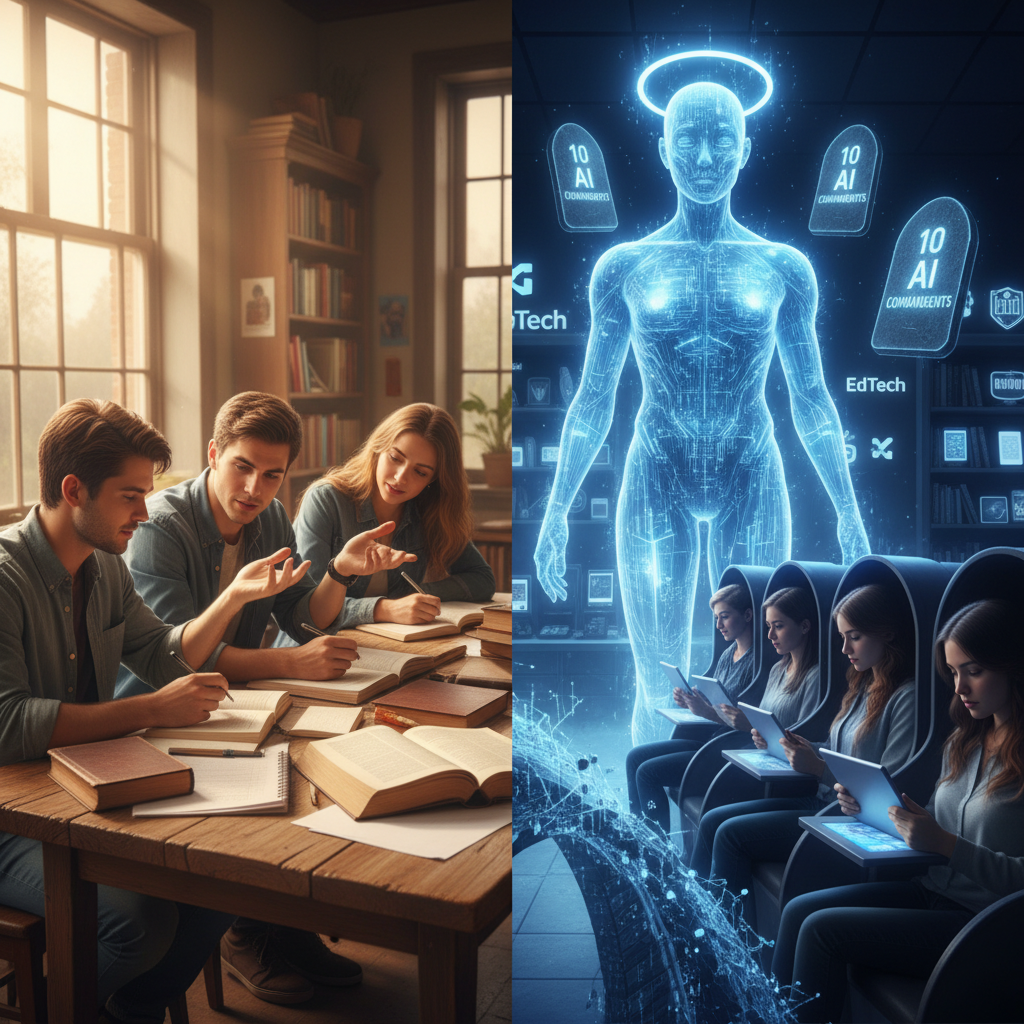
There’s word going around that Gen AI may soon become a religion, that AI gods are coming soon (don’t click this link…it leads down a rabbit hole). You know, that idea that people need something to worship, and it might as well be Gen AI because it fosters self-reflection and conversation that may or may not result in growth or mental illness. But the idea that “you shall not have false gods before me” comes to mind. Allow me to have a little fun exploring this. Audio at the end.
(Aside: That’s one of the big ten, isn’t it? Gee, the 10 Commandments were posted in my classroom for K-12 and I can’t remember off the top of my head…what does that say about long-term information retention efforts of indoctrinating Catholic, er now Public, schools? Or, maybe that’s just me…probably).
Given my Catholic upbringing, it’s clear that “God has a name; He is not an anonymous force.” Ok, definitely leaning a little too much into my religious background. Let me back up.
Computers Under Attack
In their quest to demonize learning and take America back into the dark ages, certain unknowns are blaming Gen AI and NOT fixing old broken systems, presumably, schools.

Over on LinkedIn, Holly Clark shares this:
Once again, computers in classrooms are under attack. But the term “screen time” has become a lazy metric. We are blaming the new shiny object to avoid fixing the old broken system.
Every time we reduce the conversation about educational technology to a clock ticking in the corner, we miss the point entirely.
Let’s be honest: Putting students on devices to practice isolated skills was never the goal. A digital worksheet is still just a worksheet. Digitizing compliance is not innovation; it is efficiency without depth. [Isn’t this a straw man argument? Is Gen AI being used in this way? This argument made sense with Integrated Learning Systems (ILSs) of yesteryear, but today, not so much. -Miguel]
The real opportunity isn’t about the screen. It is about the way teachers often think to use it.
I still spend a significant amount of time in classrooms because I simply cannot lead without it. I need to be next to students, unpacking the work in real time. So this isn’t a theory I’ve cooked up in an office; it is a reality I observe every single day
We need to stop asking “How much time?” and start asking “What is the task?”
Passive Consumption: Clicking through multiple-choice answers? No.
Active Creation: Using tools to visualize complex thinking? Yes.
When students use technology to revise, explain, and reflect on their ideas, the device shifts from a distractor to a thinking partner. It provides a window into student metacognition that paper simply cannot match.
The future our students are walking into will not reward them for knowing the answer. It will reward them for showing their reasoning and adapting their thinking alongside powerful tools.
This should not be a binary debate.
This is not a blame this – it is a yes…and
But let’s be honest about why we focus so heavily on the screen. We love a simple villain.
It is convenient to point the finger at the “classroom devil” of the moment.
While we obsess over screen time, we remain silent on the structural dinosaurs that actually kill engagement: The legacy of “No Child Left Behind” standardization, the outdated industrial teaching methods, and the fragmented bell schedules that make deep work nearly impossible.
The real barrier is a collective blind spot: We are still viewing student work as a static product to be collected, rather than a dynamic process to be curated
It is easy to ban a device. It is much harder to fix a broken system.
The people making these arguments in best-selling books, have not taught in a classroom and most likely have not seen a great teacher intentionally and meaningfully infusing technology – not ALL the time but when it makes sense for deeper learning. I would invite them to follow me around for a week, and let me show them how it looks when it is being used to make student thinking visible, to give students a voice and allowing them to metacognitively reflect on their learning. Not work on math problems in IXL. (Yup I went there.) Because the problem may be more about companies trying to capitalize on the moment and not thinking about what is best for kids.
You may like Holly’s passionate rejection of the idea that Gen AI, Ed Tech tools, should be in schools. But the research is in, isn’t it? Ed Tech, and Gen AI is getting there, maybe, should NOT be in K-8, possibly K-16 at all. Why? It short-circuits student thinking.
Don’t Make Me A Sinner to Prove Your Religion
One argument may very well be that schools need not be labeled as “broken,” and that such rhetoric is damaging to actually improving schools. Every day, new reforms and new efforts are trotted out (and Big Tech’s Gen AI push is no different, and neither are all the consultants and businesses that advocate for these) and school administrators are required to invest in them, paying exorbitant rates per student and staff member. Sure, you get it for free until 2027, but then what? Google Workspace’s pricing tiers for what was once a free service shows the way. Microsoft’s increasing costs show us the way.
Like that old dude who said, “Don’t make me a sinner to prove your religion is true,” don’t keep asserting schools are broken, or that they must be broken, simply so your miracle cure will be easier to sell.
My LinkedIn Comment
This IS complicated and convoluted. Life is.
Wait, is this about Ed Tech? or Gen AI? Either way, the research is in. There is an increasing amount of studies that show Ed Tech’s deleterious effects on learning, sweeping all our fun collaborative learning experiences that happen to involve tech aside, and long-term information retention. Gen AI goes even further in messing up long-term information retention.
So what if I’m engaged for a few hours but can’t remember what I was supposed to learn? The whole point IS long-term information retention so that it’s useful in solving real life problems. If you don’t have that info, then what have you got?
And, there is no separating out the profiteering of Big Tech companies, politicians, consultants, businesses that make money from pushing ed tech, Gen AI in schools. What do you want K-16 educators focused on, focusing on emphasizing core learning experiences for students or sifting through 50K+ AI solutions and ed tech stuff?
While Gen AI is a great time-saver for someone who knows what they are doing, makes vibe coding so easy a middle schooler can do it IF they know how to write in natural language what they want, it shouldn’t replace the fundamental learning that has to happen in K-12.
Discover more from Another Think Coming
Subscribe to get the latest posts sent to your email.
 Another Think Coming