This was certainly an interesting read, Why AI Boosts Creativity for Some Employees But Not Others. What caught my eye is that it highlights the conditions under which someone using Generative AI will be more creative, if not productive. I suspect that what intrigues me is how regular use of Generative AI is seen as “bad,” as a way to engage in cognitive offloading so that you never engage in critical thinking. And, research studies are showing that people who come to Gen AI for the answer suffer this consequence. That said, Gen AI’s response to a problem formulation isn’t the best or final version of the solution. That’s where the metacognition comes in.
Meta-cognition is thinking about thinking; includes methods used to help students understand the way they learn. Effect size is 0.58 (Source: Visible Learning MetaX Database).
How often do you, in every day tasks, engage in meta-cognition? Take a moment to ask yourself if you’re doing this:
Think through the steps to perform a task, keep track of how effective your approach is, and adjust when you notice a lack of progress.
This is definitely something that can be learned and taught. You might want to print and hang this checklist on your wall…I am.
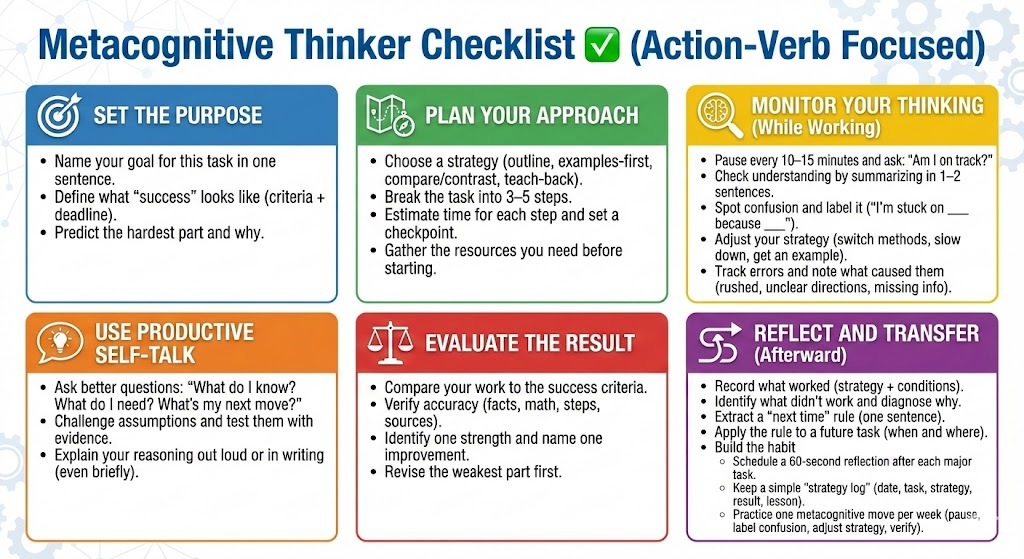
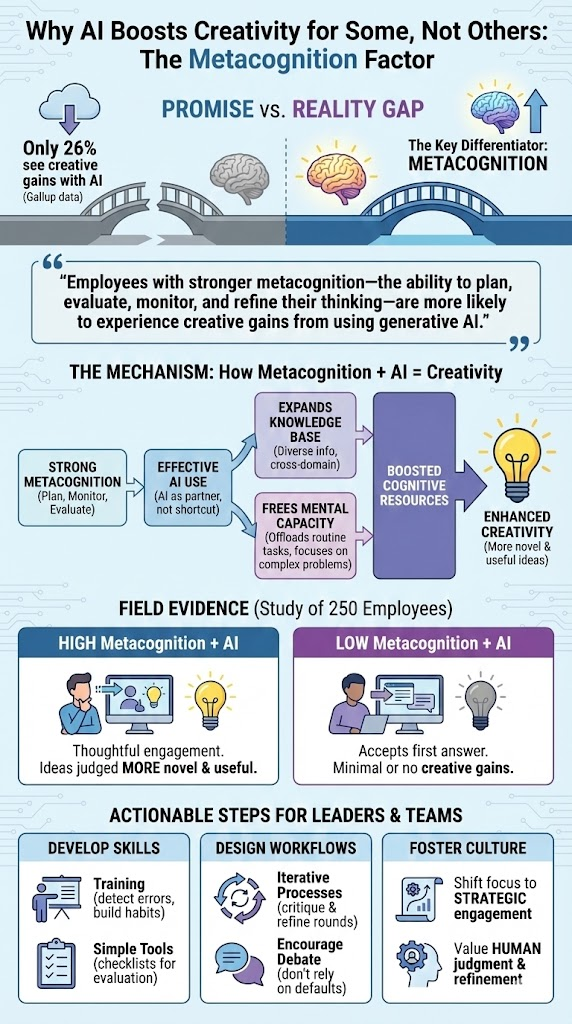
The outline below was generated by my BoodleBox Outline Helper. Working in education, it seems essential that we focus on encouraging meta-cognition in young learners as well as adult learners.
Why AI Boosts Creativity for Some Employees but Not Others – Article Outline
I. The Promise and Reality Gap of AI-Enhanced Creativity
“Only 26% of employees who use generative AI report improvements in their creativity.”
- Widespread adoption of AI tools (ChatGPT, etc.) for brainstorming, exploring alternatives, and accelerating projects
- Organizations hope for higher creativity levels and more impactful ideas
- Gallup survey reveals significant gap between adoption and creative gains
- Central question: Why do some employees benefit while others don’t?
II. Research Findings: Metacognition as the Key Differentiator
“Employees with stronger metacognition—the ability to plan, evaluate, monitor, and refine their thinking—are more likely to experience creative gains from using generative AI.”
- Study published in Journal of Applied Psychology
- Creative gains are not universal across all employees
- Metacognition enables effective use of AI to acquire cognitive job resources
- Organizations must go beyond tool deployment to develop employee capabilities
III. The Role of Cognitive Job Resources in Creativity
“Employees produce more creative ideas when they have sufficient cognitive job resources.”
A. Two Key Elements of Cognitive Resources
- Information and knowledge base
- Essential for recombining and synthesizing information
- Enables novel and useful combinations
- Opportunity to adjust work methods
- Switching between complex and simple tasks
- Taking mental breaks to restore capacity
- Breaking fixed mindsets
B. How AI Enhances Cognitive Resources
- Expanding knowledge
- Provides vast information quickly
- Enables cross-domain integration
- Freeing mental capacity
- Handles routine tasks (summarizing, drafting)
- Reduces cognitive overload
- Allows focus on complex problem-solving
IV. The Metacognition Advantage in AI Usage
“Employees with strong metacognition usually think through the steps to perform a task, keep track of how effective their approach is, and adjust when they notice a lack of progress.”
A. High Metacognition Employees
- Actively monitor their thinking during tasks
- Aware of knowledge gaps and mental states
- Better understand information needs
- Know when to shift gears or take breaks
- Treat AI suggestions as starting points
B. Low Metacognition Employees
- Accept AI’s first answer without questioning
- Rely on default outputs
- Fail to verify accuracy or relevance
- See minimal creative gains from AI
V. Field Experiment Evidence
“Employees with stronger metacognition became more creative when they used AI—they generated ideas that were judged as more novel and more useful.”
A. Study Design
- 250 employees at technology consulting firm in China
- Random assignment to AI (ChatGPT) or control condition
- One-week observation period
B. Creativity Assessment Methods
- Manager evaluations of creative performance
- External rater evaluations of novelty and usefulness
- Established metacognition scale measurement
C. Key Results
- Strong metacognition + AI = Enhanced creativity
- Weak metacognition + AI = Little difference
- Thoughtful engagement determines AI’s creative impact
VI. Practical Implications for Leaders
“The central question for leaders is not whether employees use AI, but whether they have the metacognitive skills to engage with it thoughtfully and strategically.”
A. Encourage Strategic AI Use
- Use AI to gather diverse information
- Explore multiple angles and perspectives
- Offload routine tasks to restore cognitive capacity
- Expand knowledge base and break fixed mindsets
B. Develop Metacognitive Capabilities
- Short training sessions
- Introduce metacognition concepts
- Practice detecting and correcting AI errors
- Longer programs
- Build deeper habits of planning and monitoring
- Develop evaluation skills
- Simple tools
- Checklists for problem clarification
- Frameworks for evaluating AI suggestions
C. Design Thoughtful Workflows
- Position AI as thinking partner, not shortcut
- Establish iterative processes
- Generate multiple perspectives
- Compare and critique outputs
- Refine ideas across rounds
- Prevent overreliance on defaults
- Encourage debate and synthesis
- Activate metacognitive thinking naturally
VII. Study Limitations and Future Considerations
A. Current Limitations
- Single organization in China
- Short-term effects (one week)
- Other traits may influence AI engagement
B. Future Considerations
- Cross-cultural and industry variations
- Long-term skill development impacts
- Regular assessment of AI influence on learning
VIII. Next Steps and Action Items
A. For Organizations
- Invest in metacognition training programs
- Design workflows that promote thoughtful AI engagement
- Regularly assess AI’s impact on creativity and skill development
- Consider metacognitive capabilities in hiring for AI-intensive roles
B. For Leaders
- Shift focus from AI adoption to strategic AI engagement
- Help employees understand AI as starting point, not final answer
- Create processes for iterative refinement of AI outputs
- Build team habits around questioning and improving AI suggestions
C. For Employees
- Develop self-awareness about thinking processes
- Practice questioning and refining AI outputs
- Use AI to expand knowledge rather than replace thinking
- Build habits of planning, monitoring, and evaluating work approaches
Discover more from Another Think Coming
Subscribe to get the latest posts sent to your email.
 Another Think Coming